
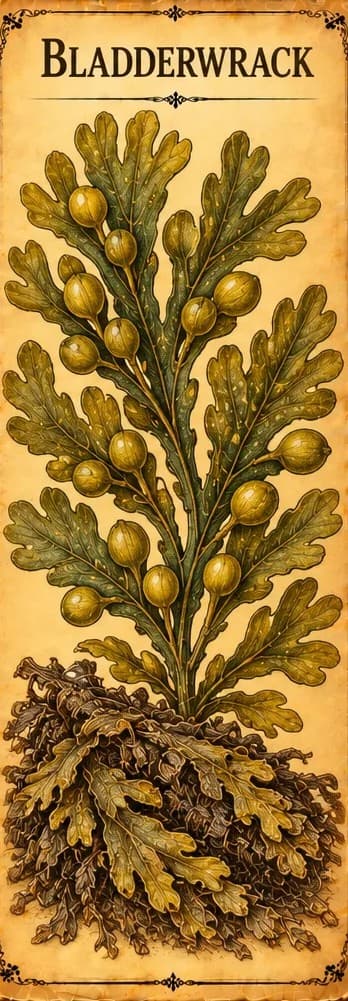
Bladderwrack
Fucus vesiculosus
A brown seaweed recognised in the EU as a traditional herbal medicine to help weight loss alongside a reduced-calorie diet. It can affect the thyroid.
Safety at a glance
- Pregnancy1 note →
- BreastfeedingNothing recorded
- Medicines1 note →
- Who should avoid it1 note →
- AllergiesNothing recorded
- ToxicityNothing recorded
Tap a box to read the safety notes below. “Nothing recorded” means our sources don't cover it, not that it's safe.
Bladderwrack may interact with some medicines. If you take any medicine, read Interactions with medicines below and talk to your doctor or pharmacist before using it.
What is Bladderwrack?
- Plant family
- Fucaceae, the rockweed family of brown seaweeds
- Parts used
- The whole dried seaweed (thallus), powdered
- Genus
- Fucus
- Species
- vesiculosus
Also called
Fucus, Bladder Wrack, Rockweed
Traditionally used for
- Weight loss with a reduced-calorie diet (traditional)
Traditionally described as
Traditions that use it
- European Folk Medicine
A traditional herbal medicine in the EU, used alongside a reduced-calorie diet to help weight loss.
How it's prepared
Common ways Bladderwrack is prepared or sold. This isn't advice on how to take it; see Safety below.
- Powder
The powdered dried seaweed is taken by mouth in tablets or capsules.[1]Health agency
Safety
Interactions with medicines
One person taking lithium for bipolar disorder developed an overactive thyroid while using bladderwrack.[1]Health agency
Who should avoid it
Not recommended for anyone under 18. Don't take it with other bladderwrack products, iodine supplements or thyroid medicines.[1]Health agency
Pregnancy
Its safety in pregnancy and breastfeeding hasn't been established, so it isn't recommended then.[1]Health agency
How much to use
Taking more than the recommended amount can change thyroid hormone levels. Too much may cause:
- Worse acne
- A pounding or fast heartbeat
- Trembling
- Changes in blood pressure
In three women, 700 or 1,400 mg a day for several weeks lengthened their menstrual cycles.[1]Health agency
What does the research say?
Traditional use
These are traditional uses, not proven treatments.
Bladderwrack is a brown seaweed. The European Medicines Agency recognises it as a traditional herbal medicine, based on long use rather than trials, to help overweight adults lose weight alongside a reduced-calorie diet, after a doctor has ruled out serious conditions.
- The usual dose is 130 mg of the powdered seaweed twice a day, 2 hours before meals
- If you haven't lost weight after 10 weeks, see a doctor or qualified practitioner
Research in people
In a small 2024 trial, 36 people with type 2 diabetes added 5 g of dried bladderwrack, another brown seaweed, or a control seaweed to their diet daily for 5 weeks. Bladderwrack didn't change average blood sugar, weight or blood fats compared with the control.[2]Study
In a 2019 trial with 18 healthy adults, a single dose of a polyphenol-rich bladderwrack extract taken before an evening meal didn't lower the rise in blood sugar overall, though peak blood sugar was lower in women.[3]Study
In a 12-week trial, 56 overweight people with prediabetes on a weight-loss diet took 500 mg a day of an extract combining bladderwrack with another brown seaweed (Ascophyllum nodosum), or a dummy pill. It didn't change blood sugar, but produced small drops in insulin output and heart rate and limited a rise in an inflammation marker.[4]Study
In short
Not for under-18s, in pregnancy or breastfeeding, or with iodine or thyroid medicines. Too much can affect the thyroid and heart rate.
Sources
- [1] Community herbal monograph on Fucus vesiculosus L., thallus (EMA/HMPC/313674/2012) — European Medicines Agency, Committee on Herbal Medicinal Products (HMPC)Government health agency
- [2] The Effect of Sargassum fusiforme and Fucus vesiculosus on Continuous Glucose Levels in Overweight Patients with Type 2 Diabetes Mellitus: A Feasibility Randomized, Double-Blind, Placebo-Controlled Trial · DOI: 10.3390/nu16121837Peer-reviewed study
- [3] A Single-Dose of a Polyphenol-Rich Fucus Vesiculosus Extract is Insufficient to Blunt the Elevated Postprandial Blood Glucose Responses Exhibited by Healthy Adults in the Evening: A Randomised Crossover Trial · DOI: 10.3390/antiox8020049Peer-reviewed study
- [4] Marginal Impact of Brown Seaweed Ascophyllum nodosum and Fucus vesiculosus Extract on Metabolic and Inflammatory Response in Overweight and Obese Prediabetic Subjects · DOI: 10.3390/md20030174Peer-reviewed study
This information is educational and traditional in nature, and is not a substitute for professional medical advice. Unfamiliar word? See what these words mean.