
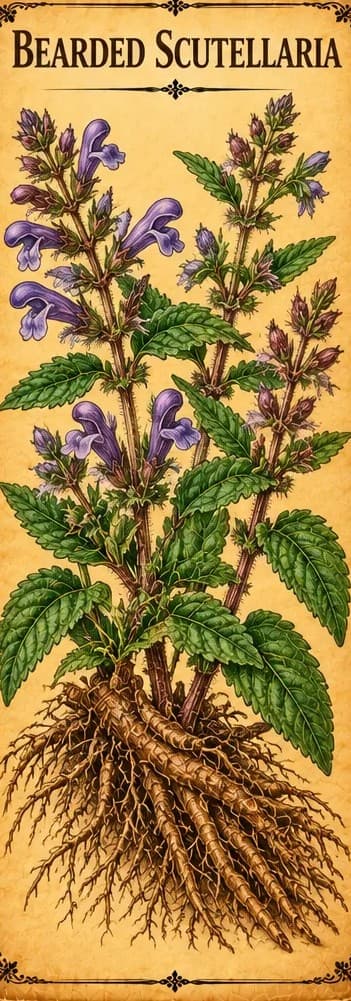
Bearded Scutellaria
Scutellaria barbata
Ban zhi lian, a Chinese herb first used for snake bites and now listed for sores, sore throat, swelling and jaundice. In China it's used alongside cancer treatment; most research is in the lab.
Safety at a glance
- PregnancyNothing recorded
- BreastfeedingNothing recorded
- MedicinesNothing recorded
- Who should avoid itNothing recorded
- AllergiesNothing recorded
- ToxicityNothing recorded
Tap a box to read the safety notes below. “Nothing recorded” means our sources don't cover it, not that it's safe.
What is Bearded Scutellaria?
- Plant family
- Lamiaceae, the mint family
- Parts used
- The dried herb
- Where it grows
- East Asia, including China, Japan and Korea
- Genus
- Scutellaria
- Species
- barbata
Also called
Scutellaria barbata
Traditional names
Ban Zhi Lian, Banzhilian
Traditionally used for
- Sores and abscesses (traditional)
- Sore throat (traditional)
- Snake bites (traditional)
- Alongside cancer treatment
Traditionally described as
- Killed cancer cells (in lab studies)
Health topics
Where Bearded Scutellaria appears in symptom search, and why. Being listed doesn't mean it's a proven treatment.
- Skin Irritation, Rashes and Itching
Traditionally used for sores and abscesses. Not tested in trials.
- Sore Throat
Listed in the Chinese Pharmacopoeia for sore throat. Not tested on its own in trials.
Traditions that use it
- Traditional Chinese Medicine
Called ban zhi lian; first recorded in the Ming Dynasty for snake bites, and used to "clear heat and remove toxins", reduce swelling and move blood.
How it's prepared
Common ways Bearded Scutellaria is prepared or sold. This isn't advice on how to take it; see Safety below.
What does the research say?
Traditional use
These are traditional uses, not proven treatments.
Ban zhi lian has been used for hundreds of years in China, Japan and Korea. It was first recorded by the Ming Dynasty physician Chen Shigong, who used it for snake bites. In Chinese medicine it's used to "clear heat and remove toxins", increase urination to reduce swelling, and get the blood moving. The Chinese Pharmacopoeia lists it for:
- Sores and abscesses
- Sore throat
- Injuries
- Swelling (oedema)
- Jaundice
- Snake bites
Laboratory & animal research
Lab and animal results show what might be worth studying in people. They don't show that the herb has these effects in humans.
In lab and animal studies, its extracts and compounds slowed or killed liver, breast, ovarian and prostate cancer cells and leukaemia cells, and reduced the spread of breast cancer to bone in animals. Most of this research is still at the lab stage.[1]Study
Research in people
In China it's used mainly alongside standard cancer treatment, often in herbal formulas, to ease the side effects of chemotherapy and radiotherapy and improve quality of life. There are relatively few clinical studies, and more research is needed to confirm that it's safe and works.[1]Study
In short
Not the same plant as the American skullcap on the Skullcap page.
Sources
- [1] Chemical Constituents, Anti-Tumor Mechanisms, and Clinical Application: A Comprehensive Review on Scutellaria barbata · DOI: 10.3390/molecules29174134Peer-reviewed study
This information is educational and traditional in nature, and is not a substitute for professional medical advice. Unfamiliar word? See what these words mean.