
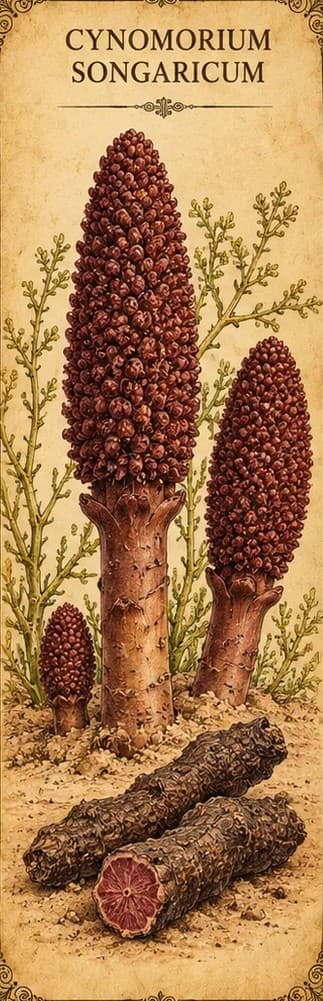
Cynomorium Songaricum
Cynomorium songaricum
Suo yang, a parasitic desert plant used in Chinese medicine to "tonify kidney yang" and enrich the blood. Lab and animal studies suggest effects on metabolism.
Safety at a glance
- PregnancyNothing recorded
- BreastfeedingNothing recorded
- MedicinesNothing recorded
- Who should avoid itNothing recorded
- AllergiesNothing recorded
- ToxicityNothing recorded
Tap a box to read the safety notes below. “Nothing recorded” means our sources don't cover it, not that it's safe.
What is Cynomorium Songaricum?
- Plant family
- Cynomoriaceae, the cynomorium family of parasitic plants
- Parts used
- The fleshy stem of a parasitic plant
- Where it grows
- Arid regions of Central Asia
- Genus
- Cynomorium
- Species
- songaricum
Also called
Cynomorii Herba, Cynomorium
Traditional names
Suo Yang, Suoyang
Traditionally used for
- Kidney yang tonic (traditional)
- Blood tonic (traditional)
Traditionally described as
- Improved insulin sensitivity (in animal studies)
Traditions that use it
- Traditional Chinese Medicine
Called suo yang; used for centuries to "tonify kidney yang" and enrich the blood.
How it's prepared
Common ways Cynomorium Songaricum is prepared or sold. This isn't advice on how to take it; see Safety below.
- Culinary Preparation
It's eaten as a food as well as used as a traditional Chinese medicine.[1]Study
What does the research say?
Traditional use
These are traditional uses, not proven treatments.
Suo yang is a perennial parasitic plant from the dry regions of Central Asia. In Chinese medicine it has been used for centuries to "tonify kidney yang" and enrich "blood essence".[2]Study
Laboratory & animal research
Lab and animal results show what might be worth studying in people. They don't show that the herb has these effects in humans.
A 2025 review of 92 studies found that its compounds may help metabolic syndrome in lab and animal research: proanthocyanidins reduced sugar absorption and acted as antioxidants, polysaccharides improved insulin sensitivity and gut bacteria, and triterpenoids reduced obesity. These haven't been confirmed in people.[3]Review or trial
In a 2026 lab and animal study, suo yang affected immune cells around breast tumours and slowed tumour growth.[2]Study
Sources
- [1] Cynomorium songaricum prevents bone resorption in ovariectomized rats through RANKL/RANK/TRAF6 mediated suppression of PI3K/AKT and NF-κB pathways · DOI: 10.1016/j.lfs.2018.08.008Peer-reviewed study
- [2] Systematic Investigation of Tumor Immune Microenvironment Modulation by Cynomorium songaricum Against Breast Cancer · DOI: 10.3390/ph19020314Peer-reviewed study
- [3] A decade review on phytochemistry and pharmacological activities of Cynomorium songaricum Rupr.: Insights into metabolic syndrome · DOI: 10.1016/j.phymed.2025.156602Review or clinical trial
This information is educational and traditional in nature, and is not a substitute for professional medical advice. Unfamiliar word? See what these words mean.