
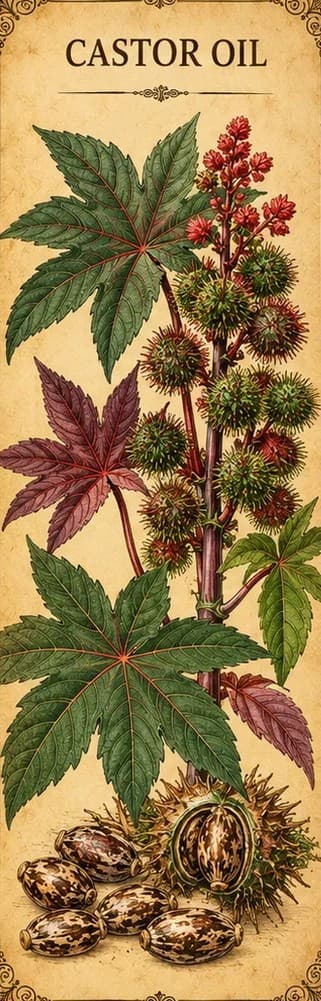
Castor Oil
Ricinus communis
Oil pressed from castor seeds, a strong traditional laxative also used to bring on labour. The seeds themselves contain ricin, one of the most toxic plant substances.
Safety at a glance
- Pregnancy1 note →
- BreastfeedingNothing recorded
- MedicinesNothing recorded
- Who should avoid itNothing recorded
- AllergiesNothing recorded
- Toxicity2 notes →
Tap a box to read the safety notes below. “Nothing recorded” means our sources don't cover it, not that it's safe.
What is Castor Oil?
- Plant family
- Euphorbiaceae, the spurge family
- Parts used
- The oil pressed from the seeds; the seeds themselves are poisonous
- Where it grows
- Grown throughout tropical and subtropical regions
- Genus
- Ricinus
- Species
- communis
Also called
Castor, Castor Bean, Castor Oil Plant, Ricinus
Traditionally used for
- Constipation (traditional)
- Bringing on labour (studied)
- Skin and cosmetics
Traditionally described as
- Strong laxative
Health topics
Where Castor Oil appears in symptom search, and why. Being listed doesn't mean it's a proven treatment.
- Constipation
Castor oil is a strong traditional laxative. The seeds are poisonous.
- Hair Loss
Traditionally used to thicken and condition hair. A compound in it may block a hair-loss signal in lab research, but it hasn't been tested for hair loss in people.
- Poisonous Plants
Raw castor seeds contain ricin and are the main danger; processed oil is generally regarded as safe.
- Pregnancy and Childbirth
Can bring on labour; a review of studies in women at full term found it made labour more likely to start. Nausea is common.
How it's prepared
Common ways Castor Oil is prepared or sold. This isn't advice on how to take it; see Safety below.
Safety
Side effects
Very rarely, castor oil on the hair has caused hair felting, where the hair suddenly mats into a tangle that can't be combed out and has to be cut off. It can also occasionally cause an allergic skin rash.[2]Study
Pregnancy
Castor oil can bring on labour. The studies only included women at full term (37 to 42 weeks), and nausea was common.[3]Review or trial
Toxicity testing
Castor seeds contain ricin, one of the most toxic plant substances known. Properly processed castor oil is generally regarded as safe because ricin stays in the seed pulp, not the oil. Raw seeds are the main danger.[1]Study
Children can be poisoned by eating castor seeds. In a 2025 case from Nepal, a 6-year-old boy who ate castor seeds became ill with stomach and gut symptoms and needed hospital care.[4]Study
What does the research say?
Traditional use
These are traditional uses, not proven treatments.
The castor plant's leaves, roots, seeds and oil have long been used in traditional medicine for pain, inflammation, infections, wounds, gut problems and skin diseases. Castor oil is used as a strong laxative for constipation, and traditional records describe its use to bring on labour, help expel the placenta, and as a purgative for children and older people. It's also widely used in cosmetics and industry.[1]Study
Castor oil is a staple of hair and scalp care in African, Caribbean and Indigenous American traditions, especially for textured hair, where it's used to add shine and make hair easier to manage.[2]Study
The ancient Egyptians put castor oil on the hair and scalp and thought it essential for thickening hair.[5]Review or trial
Laboratory & animal research
Lab and animal results show what might be worth studying in people. They don't show that the herb has these effects in humans.
A substance called prostaglandin D2 slows hair growth and is higher in the scalps of people with male- or female-pattern hair loss. Lab research suggests ricinoleic acid, the main compound in castor oil, may block the enzyme that makes it. It hasn't been tested as a hair-loss treatment in people.[2]Study
Research in people
A 2022 review of 12 studies with 1,653 women at full term (37 to 42 weeks) found that castor oil made it about 3 times more likely that labour would start, and more women gave birth vaginally (81% vs 69%). None of the studies reported serious harm, but nausea was common: in one trial, about half the women who took castor oil felt sick.[3]Review or trial
Technical detail: labour induction RR 3.27 (95% CI 1.96–5.46).
In short
Castor seeds contain ricin, a deadly toxin; the danger is in the seeds, not properly processed oil. Castor oil can bring on labour.
Sources
- [1] Phytochemistry, Pharmacological Potential and Industrial Applications of Ricinus communis L.: A Review · DOI: 10.3390/ph19081258Peer-reviewed study
- [2] Use of Castor Oil in Dermatology: A Narrative Review · DOI: 10.7759/cureus.103289Peer-reviewed study
- [3] Effect and Safety of Castor Oil on Labor Induction and Prevalence of Vaginal Delivery: A Systematic Review and Meta-Analysis · DOI: 10.4103/ijnmr.ijnmr_7_21Review or clinical trial
- [4] Pediatric ricin toxicity from castor seed ingestion: a case report from Nepal · DOI: 10.1097/MS9.0000000000003907Peer-reviewed study
- [5] Pathophysiology, conventional treatments, and evidence-based herbal remedies of hair loss with a systematic review of controlled clinical trials · DOI: 10.1007/s00210-025-04286-6Review or clinical trial
This information is educational and traditional in nature, and is not a substitute for professional medical advice. Unfamiliar word? See what these words mean.