
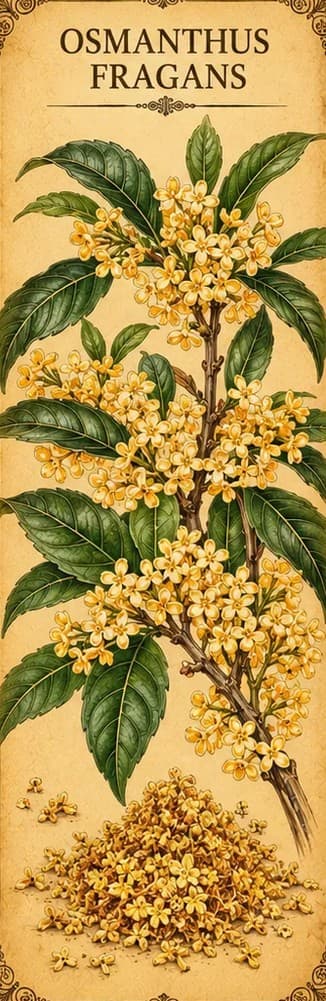
Osmanthus Fragrans
Osmanthus fragrans
Sweet osmanthus, a plant from southwestern China, Japan and Korea traditionally used for cough and asthma, bad breath, toothache, stomach ache, diarrhoea and rheumatism.
Safety at a glance
- PregnancyNothing recorded
- BreastfeedingNothing recorded
- MedicinesNothing recorded
- Who should avoid itNothing recorded
- AllergiesNothing recorded
- ToxicityNothing recorded
Tap a box to read the safety notes below. “Nothing recorded” means our sources don't cover it, not that it's safe.
What is Osmanthus Fragrans?
- Plant family
- Oleaceae, the olive family
- Parts used
- The small fragrant flowers; also other parts of the plant
- Where it grows
- Southwestern China, Japan and Korea
- Genus
- Osmanthus
- Species
- fragrans
Also called
Sweet Osmanthus, Osmanthus, Osmanthus Fragans
Traditional names
Gui Hua
Traditionally used for
- Cough and asthma (traditional)
- Bad breath (traditional)
- Stomach ache and diarrhoea (traditional)
Traditionally described as
- Antioxidant (in lab studies)
Health topics
Where Osmanthus Fragrans appears in symptom search, and why. Being listed doesn't mean it's a proven treatment.
How it's prepared
Common ways Osmanthus Fragrans is prepared or sold. This isn't advice on how to take it; see Safety below.
- Culinary Preparation
The flowers are used to give a strong, lasting fragrance to desserts, pastries, tea and wine.[1]Study
What does the research say?
Traditional use
These are traditional uses, not proven treatments.
Osmanthus is a medicinal plant found in southwestern China, Japan and Korea. It has traditionally been used for:
- Weak eyesight
- Bad breath
- Shortness of breath, asthma and cough
- Toothache and stomach ache
- Diarrhoea
- Rheumatism and body pain
- Hepatitis
Laboratory & animal research
Lab and animal results show what might be worth studying in people. They don't show that the herb has these effects in humans.
In lab and animal studies, osmanthus and its compounds (ionones, flavonoids, polyphenols and iridoids) acted as antioxidants, slowed tumours, may help reduce inflammation, lowered blood sugar, reduced blood clotting, lightened skin pigment and protected nerves. These haven't been confirmed in people.[2]Study
Research in people
In a Japanese trial of 361 people having a colonoscopy, breathing in osmanthus oil vapour during the procedure reduced anxiety, and eased stomach discomfort in people who were very anxious, compared with no aroma or plain vapour.[3]Study
Sources
- [1] Secondary Metabolites of Osmanthus fragrans: Metabolism and Medicinal Value · DOI: 10.3389/fphar.2022.922204Peer-reviewed study
- [2] Traditional uses, phytochemical constituents and pharmacological properties of Osmanthus fragrans: A review · DOI: 10.1016/j.jep.2022.115273Peer-reviewed study
- [3] Aromatherapies using Osmanthus fragrans oil and grapefruit oil are effective complementary treatments for anxious patients undergoing colonoscopy: A randomized controlled study · DOI: 10.1016/j.ctim.2017.08.012Peer-reviewed study
This information is educational and traditional in nature, and is not a substitute for professional medical advice. Unfamiliar word? See what these words mean.