
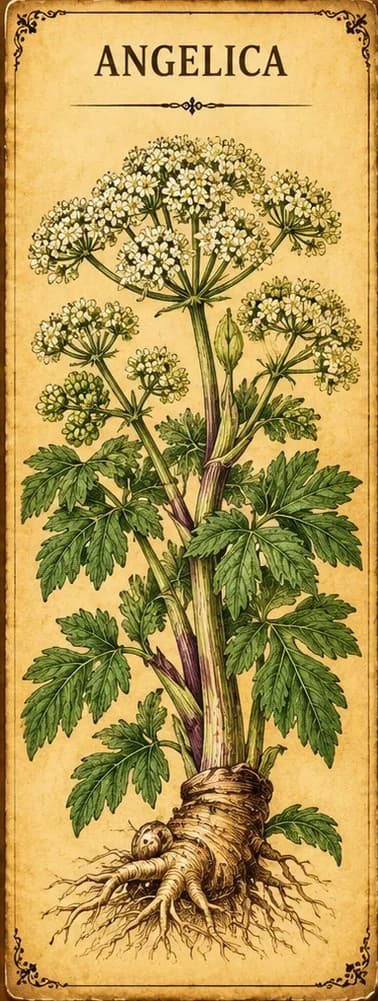
Angelica
Angelica archangelica
Garden angelica, an aromatic plant used to flavour food and known in folk medicine as the "angel plant". Research is in the lab and in animals.
Safety at a glance
- PregnancyNothing recorded
- BreastfeedingNothing recorded
- MedicinesNothing recorded
- Who should avoid itNothing recorded
- AllergiesNothing recorded
- Toxicity1 note →
Tap a box to read the safety notes below. “Nothing recorded” means our sources don't cover it, not that it's safe.
What is Angelica?
- Plant family
- Apiaceae, the carrot and parsley family
- Parts used
- The root, seeds and stems, used for flavouring and in traditional medicine
- Genus
- Angelica
- Species
- archangelica
Also called
Garden Angelica, Angelica archangelica
Traditionally used for
- Flavouring
- Traditional remedy
Traditionally described as
How it's prepared
Common ways Angelica is prepared or sold. This isn't advice on how to take it; see Safety below.
- Capsule
In one trial, angelica leaf extract was taken as capsules.[1]Study
- Decoction
Herbalists simmer 1 to 2 teaspoons of the dried root in a cup of water for 2 minutes, then steep it covered for 15 minutes.[2]General reference
- Poultice
A compress made with the leaves is applied to the chest.[2]General reference
- Tincture
Herbalists use it as a tincture.[2]General reference
Safety
Toxicity testing
Angelica root contains furocoumarins, natural compounds that can make skin react to sunlight. Europe's medicines agency says many of them can damage DNA and cause cancer when combined with UV light, and that their risk in herbal products is uncertain because data are lacking. Some furocoumarins are also eaten in everyday foods.[3]Health agency
Technical detail: photogenotoxic and photocarcinogenic; risk assessed against 8-methoxypsoralen (8-MOP) as a worst case.
What does the research say?
Traditional use
These are traditional uses, not proven treatments.
Garden angelica is an aromatic plant used to flavour food. In traditional medicine it's called the "angel plant" because of the healing powers once credited to it.[4]Study
Laboratory & animal research
Lab and animal results show what might be worth studying in people. They don't show that the herb has these effects in humans.
In lab and animal studies, angelica extracts and their compounds (mainly coumarins and essential oils) have shown calming and anti-seizure effects, effects on memory, antiviral and stomach-protecting activity, and reduced inflammation. These haven't been confirmed in people.[4]Study
Research in people
In a 2025 Spanish pilot trial, 143 adults with an overactive bladder took angelica leaf extract or a dummy pill for 6 weeks. The angelica group went to the toilet less often during the day and reported better quality of life and fewer bladder storage symptoms; night-time urination improved slightly but not clearly.[1]Study
In short
Contains furocoumarins, which can make skin react to sunlight.
Sources
- [1] Effects of Angelica archangelica Extract on Overactive Bladder: A Pilot Randomized Controlled Trial · DOI: 10.1002/fsn3.71258Peer-reviewed study
- [2] Angelica — Herban Herbalist materia medica — Herban Herbalist (herb shop)General reference
- [3] Reflection paper on the risks associated with furocoumarins contained in preparations of Angelica archangelica L. (EMEA/HMPC/317913/2006) — European Medicines Agency, Committee on Herbal Medicinal Products (HMPC)Government health agency
- [4] Understanding the phytochemistry and molecular insights to the pharmacology of Angelica archangelica L. (garden angelica) and its bioactive components · DOI: 10.1002/ptr.7206Peer-reviewed study
This information is educational and traditional in nature, and is not a substitute for professional medical advice. Unfamiliar word? See what these words mean.