
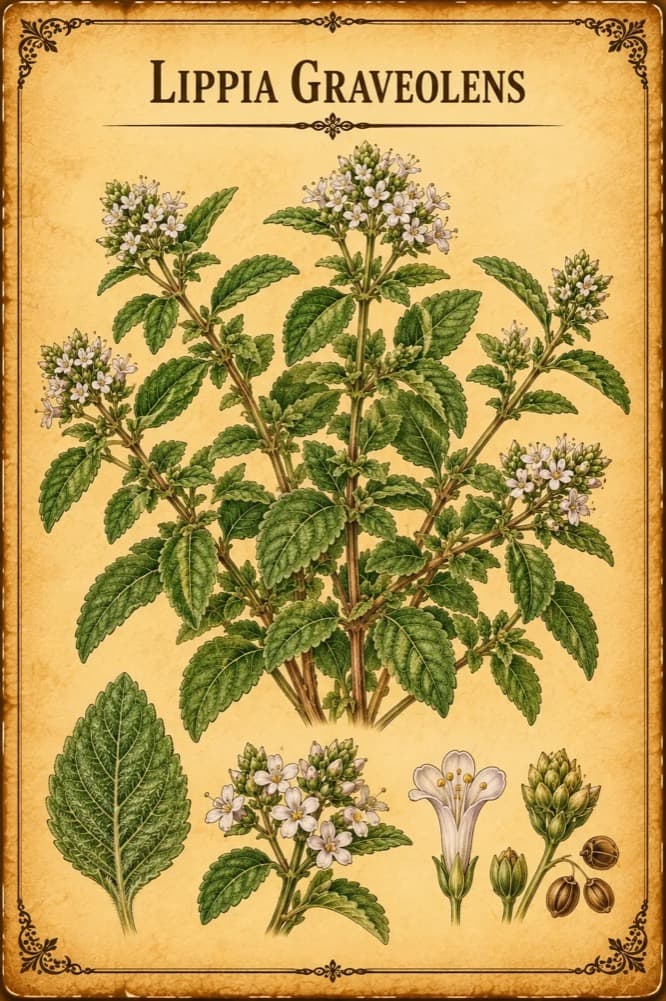
Lippia Graveolens
Lippia graveolens
A plant from northern Mexico also sold as Mexican oregano. It's in the verbena family, not the mint family, but its oil contains carvacrol and thymol like common oregano. Its oil has only been studied in the lab, not in animals or people.
Safety at a glance
- PregnancyNothing recorded
- BreastfeedingNothing recorded
- MedicinesNothing recorded
- Who should avoid itNothing recorded
- AllergiesNothing recorded
- ToxicityNothing recorded
Tap a box to read the safety notes below. “Nothing recorded” means our sources don't cover it, not that it's safe.
What is Lippia Graveolens?
- Plant family
- Verbenaceae, the verbena family
- Parts used
- The essential oil, studied in the lab
- Where it grows
- Grows wild in dry areas of northern Mexico, where it's also farmed
- Genus
- Lippia
- Species
- graveolens
Also called
Mexican Oregano
Traditionally used for
- Flavoring
Traditionally described as
- Antioxidant (in lab studies)
- Kills some bacteria (in lab studies)
Natural compounds
How it's prepared
Common ways Lippia Graveolens is prepared or sold. This isn't advice on how to take it; see Safety below.
- Culinary Preparation
Mexican oregano is sold as a culinary herb.[1]Study
- Essential Oil
The plant is grown mainly for its essential oil, which gives its strong aroma and flavor.[1]Study
What does the research say?
Laboratory & animal research
Lab and animal results show what might be worth studying in people. They don't show that the herb has these effects in humans.
In lab tests, essential oil from Lippia graveolens plants grown wild, in fields and in greenhouses in northern Mexico was a strong antioxidant. At higher strengths it stopped the growth of four kinds of bacteria: Salmonella, E. coli, Listeria and Staphylococcus. Oil from wild plants worked best overall. This was lab work only: it hasn't been tested in animals or people.[2]Study
Technical detail: hydrodistillation; main compounds carvacrol (mean 18.03%), o-cymene (12.77%), thymol (7.90%); ABTS antioxidant activity about 90–94% (mean 92.58%); inhibition zones over 8 mm from 5 µL/mL, up to about 32 mm against S. aureus and 36.7 mm against S. typhi; agar microwell diffusion.
In short
Not tested in animals or people.
Sources
- [1] Mexican Oregano (Lippia graveolens Kunth) as Source of Bioactive Compounds: A Review · DOI: 10.3390/molecules26175156Peer-reviewed study
- [2] Antioxidant and Antibacterial Activity of Mexican Oregano Essential Oil, Extracted from Plants Occurring Naturally in Semiarid Areas and Cultivated in the Field and Greenhouse in Northern Mexico — Molecules · DOI: 10.3390/molecules28186547Peer-reviewed study
This information is educational and traditional in nature, and is not a substitute for professional medical advice. Unfamiliar word? See what these words mean.