
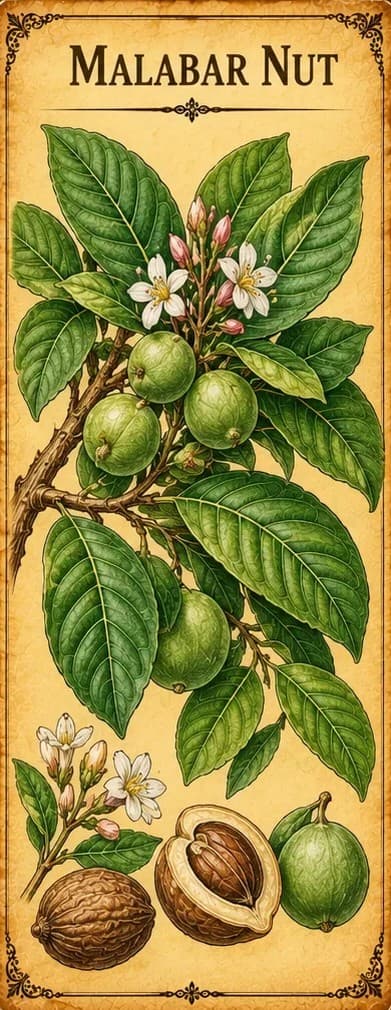
Malabar Nut
Justicia adhatoda
Vasaka, an Ayurvedic shrub used for coughs and asthma. Its compound vasicine led to the cough medicines bromhexine and ambroxol.
Safety at a glance
- Pregnancy1 note →
- BreastfeedingNothing recorded
- MedicinesNothing recorded
- Who should avoid itNothing recorded
- AllergiesNothing recorded
- ToxicityNothing recorded
Tap a box to read the safety notes below. “Nothing recorded” means our sources don't cover it, not that it's safe.
What is Malabar Nut?
- Plant family
- Acanthaceae, the acanthus family
- Parts used
- The leaves
- Genus
- Justicia
- Species
- adhatoda
Also called
Vasaka, Vasa
Older scientific names
Adhatoda vasica
Traditionally used for
- Cough (traditional)
- Asthma (traditional)
- Colds (combination product trial)
Traditionally described as
- Eases coughing (in animals)
- Loosens mucus (compound-derived medicines)
Health topics
Where Malabar Nut appears in symptom search, and why. Being listed doesn't mean it's a proven treatment.
- Asthma and Wheezing
Ayurvedic preparations of vasa are used for asthma.
- Cough
A traditional Ayurvedic cough remedy. A combination product with Malabar nut eased cough in one trial; it reduced coughing in animals.
Traditions that use it
- Ayurveda
A well-known Ayurvedic and Unani remedy, mainly for breathing problems.
How it's prepared
Common ways Malabar Nut is prepared or sold. This isn't advice on how to take it; see Safety below.
Safety
Side effects
In the COVID-19 trial, no side effects were reported with 500 mg of extract a day for 14 days.[2]Study
Pregnancy
Several scientific reports have described how vasicine, the plant's main active compound, can bring on contractions of the womb and miscarriage. This has raised questions about the safety of Malabar nut, especially during pregnancy.[3]Study
What does the research say?
Traditional use
These are traditional uses, not proven treatments.
Malabar nut (vasaka) is a well-known remedy in Ayurvedic and Unani medicine, used for many conditions but especially for coughs and other breathing problems.[3]Study
Ayurvedic texts describe many preparations of vasa for asthma, including decoctions, a leaf jam (avaleha), a medicated ghee (ghrita) and fermented tonics. A review of studies on these found the best results for the concentrated extract, the ghee and the jam.[1]Study
Two widely used modern cough medicines that loosen mucus, bromhexine and ambroxol, were made by chemically modifying vasicine, a compound from this plant.[4]Study
Laboratory & animal research
Lab and animal results show what might be worth studying in people. They don't show that the herb has these effects in humans.
In guinea pigs and rabbits, a Malabar nut extract reduced coughing. Taken by mouth it worked about as well as codeine against coughing from irritating mists, though injected it was much weaker than codeine.[5]Study
In a lab study, vasaka tea protected human airway cells from damage by wood smoke particles and reduced their production of a thick mucus protein. Several compounds in the tea, including vasicine and apigenin, contributed.[6]Study
Research in people
In a trial of 177 adults with a common cold, a liquid combining Malabar nut, echinacea and eleuthero (sold in Scandinavia as Kan Jang) relieved coughing better than a dummy liquid, and slightly faster than the cough medicine bromhexine. Because it's a mix, the effect of Malabar nut alone isn't known.[7]Study
Technical detail: 30 ml/day for 5 days; 762 mg extracts standardized to 0.2 mg/ml vasicine.
In an open-label trial in India of 150 people with mild COVID-19, 500 mg of Malabar nut extract a day for 14 days was compared with giloy (Tinospora) and with a mix of both. Everyone recovered and no side effects were reported. There was no placebo group, so it can't show whether the herbs helped.[2]Study
Technical detail: mean viral clearance 13.9 days (Malabar nut), 13.4 days (giloy), 11.9 days (combination).
In short
Its main compound has been linked to womb contractions and miscarriage; safety in pregnancy is in question.
Sources
- [1] A clinical review of different formulations of Vasa (Adhatoda vasica) on Tamaka Shwasa (asthma) · DOI: 10.4103/0974-8520.82032Peer-reviewed study
- [2] Adhatoda vasica and Tinospora cordifolia extracts ameliorate clinical and molecular markers in mild COVID-19 patients: a randomized open-label three-armed study · DOI: 10.1186/s40001-023-01507-7Peer-reviewed study
- [3] Adhatoda vasica: a critical review of ethnopharmacological and toxicological data · DOI: 10.1016/s0378-8741(00)00225-7Peer-reviewed study
- [4] Activity of bromhexine and ambroxol, semi-synthetic derivatives of vasicine from the Indian shrub Adhatoda vasica, against Mycobacterium tuberculosis in vitro · DOI: 10.1016/0378-8741(95)01331-8Peer-reviewed study
- [5] Antitussive effect of Adhatoda vasica extract on mechanical or chemical stimulation-induced coughing in animals · DOI: 10.1016/s0378-8741(99)00074-4Peer-reviewed study
- [6] Inhibition of TRPA1, Endoplasmic Reticulum Stress, Human Airway Epithelial Cell Damage, and Ectopic MUC5AC Expression by Vasaka (Adhatoda vasica; Malabar Nut) Tea · DOI: 10.3390/ph16060890Peer-reviewed study
- [7] Antitussive effect of a fixed combination of Justicia adhatoda, Echinacea purpurea and Eleutherococcus senticosus extracts in patients with acute upper respiratory tract infection · DOI: 10.1016/j.phymed.2015.10.001Peer-reviewed study
This information is educational and traditional in nature, and is not a substitute for professional medical advice. Unfamiliar word? See what these words mean.