
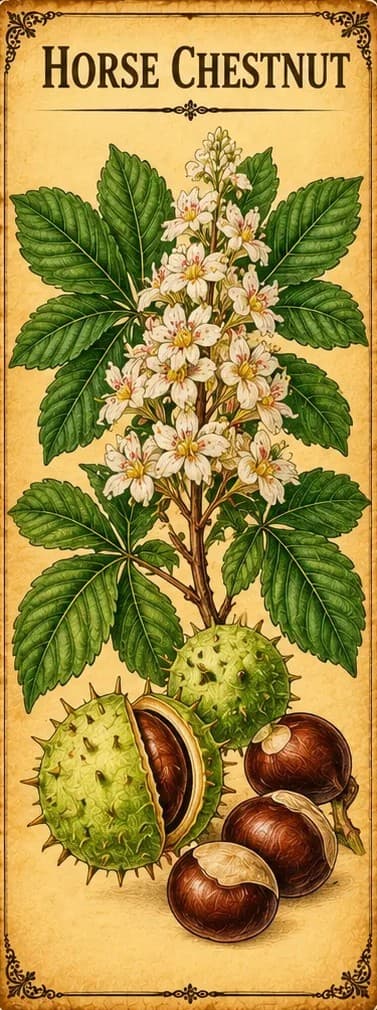
Horse Chestnut
Aesculus hippocastanum
A European tree whose standardized seed extract is used for chronic venous insufficiency (poor blood flow in the leg veins). The raw plant is toxic.
Safety at a glance
- Pregnancy1 note →
- BreastfeedingNothing recorded
- Medicines1 note →
- Who should avoid it1 note →
- AllergiesNothing recorded
- Toxicity1 note →
Tap a box to read the safety notes below. “Nothing recorded” means our sources don't cover it, not that it's safe.
What is Horse Chestnut?
- Plant family
- Sapindaceae, the soapberry family
- Parts used
- The seeds (as standardized extracts)
- Where it grows
- Parts of southeastern Europe
- Genus
- Aesculus
- Species
- hippocastanum
Traditionally used for
- Chronic venous insufficiency
- Heavy
- tired legs (traditional)
- Bruises (traditional)
Traditionally described as
- Standardized for triterpene glycosides (aescin)
Health topics
Where Horse Chestnut appears in symptom search, and why. Being listed doesn't mean it's a proven treatment.
- Poor Circulation
Recognized in Europe for chronic venous insufficiency, and a Cochrane review found the seed extract eased leg pain and swelling.
- Sprains and Bruises
Recognized in Europe as a traditional remedy, by mouth or on the skin, for bruises.
How it's prepared
Common ways Horse Chestnut is prepared or sold. This isn't advice on how to take it; see Safety below.
- Extract
Standardized seed extracts are taken by mouth in tablets, capsules or liquids, some designed to release slowly.[1]Health agency
- Salve
Creams and gels made with seed extracts are applied to the skin.[2]Health agency
Safety
Interactions with medicines
No interactions with medicines have been reported.[1]Health agency
Who should avoid it
See a doctor first if you have skin inflammation, a vein clot or inflammation (thrombophlebitis), hard swollen skin, severe pain, ulcers, sudden swelling of one or both legs, or heart or kidney failure. Don't put horse chestnut creams on broken skin, around the eyes or on mucous membranes. Not recommended for anyone under 18 for vein problems.[1]Health agency
Side effects
Stomach and gut upset, headache, dizziness, itching and allergic reactions have been reported. Creams can cause itching and redness of the skin.[1]Health agency
Pregnancy
Its safety during pregnancy and breastfeeding hasn't been established, so the European Medicines Agency doesn't recommend it at these times.[1]Health agency
Toxicity testing
The raw seeds, bark, flowers and leaves are unsafe to take by mouth, because they contain a toxic compound. Standardized seed extracts, which have this compound removed, are likely safe for short-term use and have been used safely in studies for up to 12 weeks.[3]Health agency
What does the research say?
Traditional use
These are traditional uses, not proven treatments.
Horse chestnut seed extract was traditionally used for arthritis, pain and swelling, menstrual cramps and hemorrhoids. Today it's mainly promoted for chronic venous insufficiency (poor blood flow in the leg veins, which can cause leg pain, swelling and itching).[3]Health agency
Based on long-standing use, the European Medicines Agency recognizes horse chestnut seed preparations, taken by mouth or put on the skin, to ease heavy, uncomfortable legs from minor vein circulation problems and to relieve bruises.[2]Health agency
Research in people
Based on scientific evidence, the European Medicines Agency recognizes standardized horse chestnut seed extract taken by mouth for chronic venous insufficiency, with symptoms such as swollen legs, varicose veins, heavy or tired legs, pain, itching and calf cramps. It may take at least 4 weeks to help.[1]Health agency
A 2012 Cochrane review of trials found that horse chestnut seed extract eased the symptoms of chronic venous insufficiency more than a placebo, including leg pain and swelling. One trial suggested it may work as well as compression stockings. Side effects were usually mild and uncommon. The reviewers said larger, better trials are still needed.[4]Review or trial
Technical detail: leg pain WMD 42.4 mm on a 100 mm visual analogue scale (one trial); leg volume WMD 32.1 ml (95% CI 13.49 to 50.72) in six trials, n = 502.
In short
Raw seeds, bark, flowers and leaves are toxic by mouth. Use only standardized extracts.
Sources
- [1] European Union herbal monograph on Aesculus hippocastanum L., semen, Revision 1 — European Medicines Agency, Committee on Herbal Medicinal Products (HMPC)Government health agency
- [2] Horse-chestnut seed: summary for the public (EMA/60766/2020) — European Medicines Agency, Committee on Herbal Medicinal Products (HMPC)Government health agency
- [3] Horse Chestnut: Usefulness and Safety — National Center for Complementary and Integrative Health (NIH)Government health agency
- [4] Horse chestnut seed extract for chronic venous insufficiency · DOI: 10.1002/14651858.CD003230.pub4Review or clinical trial
This information is educational and traditional in nature, and is not a substitute for professional medical advice. Unfamiliar word? See what these words mean.