
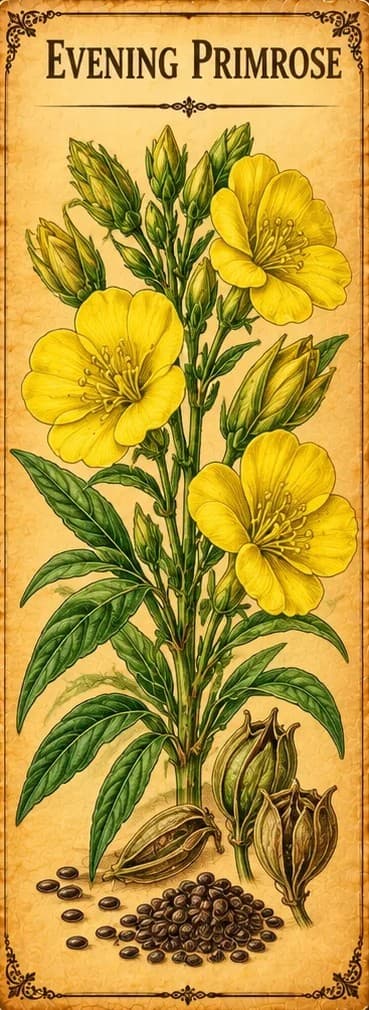
Evening Primrose
Oenothera biennis
A plant whose seed oil, rich in the fatty acid GLA, is promoted for eczema, PMS and breast pain. A Cochrane review found it doesn't help eczema.
Safety at a glance
- Pregnancy1 note →
- Breastfeeding1 note →
- Medicines1 note →
- Who should avoid itNothing recorded
- AllergiesNothing recorded
- ToxicityNothing recorded
Tap a box to read the safety notes below. “Nothing recorded” means our sources don't cover it, not that it's safe.
Evening Primrose may interact with some medicines. If you take any medicine, read Interactions with medicines below and talk to your doctor or pharmacist before using it.
What is Evening Primrose?
- Plant family
- Onagraceae, the evening primrose family
- Parts used
- The oil from the seeds
- Where it grows
- Native to North and South America; also grows throughout Europe and parts of Asia
- Genus
- Oenothera
- Species
- biennis
Also called
Evening Primrose Oil
Traditionally used for
- Eczema (shown not to help)
- Breast pain (no better than placebo)
- Skin inflammation and bruises (traditional)
Traditionally described as
- Seed oil rich in gamma-linolenic acid (GLA)
Health topics
Where Evening Primrose appears in symptom search, and why. Being listed doesn't mean it's a proven treatment.
- Eczema
A 2013 Cochrane review found evening primrose oil taken by mouth didn't improve eczema more than a placebo.
How it's prepared
Common ways Evening Primrose is prepared or sold. This isn't advice on how to take it; see Safety below.
- Oil
The oil from the seeds, rich in the omega-6 fatty acid GLA, is sold as a dietary supplement and added to products for the skin.[1]Health agency
Safety
Interactions with medicines
If you take any medicine, talk with your health care provider first. Some herbs and medicines interact in harmful ways.[1]Health agency
Side effects
Evening primrose oil taken by mouth is probably safe for most adults and is generally well tolerated. The most common side effects are stomach pain, nausea and diarrhea. Less is known about its safety in children.[1]Health agency
Pregnancy
It may be safe during pregnancy, but the evidence isn't conclusive. Side effects when used to try to start labor have mostly been mild, but the long-term safety of this use isn't known.[1]Health agency
Breastfeeding
Taking it while breastfeeding raises the amount of GLA (a fatty acid) in breast milk, but this hasn't been linked to harm in babies.[1]Health agency
What does the research say?
Traditional use
These are traditional uses, not proven treatments.
Native Americans put juice from the stem and leaves on the skin for inflammation, bruises and minor wounds, and took the leaves by mouth for stomach and gut problems and sore throats. The yellow flowers open at sunset and close during the day.[1]Health agency
Research in people
There isn't enough evidence to support evening primrose oil for any health condition:
- Eczema (atopic dermatitis): taken by mouth, it hasn't been shown to help
- Breast pain: it probably works no better than a placebo
- Starting labor: studies, taking it by mouth or vaginally, have had mixed results
- Rheumatoid arthritis, PMS and menopause symptoms: too little evidence to say
A 2013 Cochrane review of 19 trials of evening primrose oil for eczema found it didn't improve eczema symptoms more than a placebo, as judged by either patients or doctors. Most of the studies had a low risk of bias.[2]Review or trial
Technical detail: participant-rated global symptoms MD −2.22 (95% CI −10.48 to 6.04), 7 trials; doctor-rated MD −3.26 (95% CI −6.96 to 0.45), 8 trials. The review also covered 8 trials of borage oil.
In short
Usually well tolerated; can cause stomach upset. Evidence for use in pregnancy isn't conclusive.
Sources
- [1] Evening Primrose Oil: Usefulness and Safety — National Center for Complementary and Integrative Health (NIH)Government health agency
- [2] Oral evening primrose oil and borage oil for eczema · DOI: 10.1002/14651858.CD004416.pub2Review or clinical trial
This information is educational and traditional in nature, and is not a substitute for professional medical advice. Unfamiliar word? See what these words mean.