
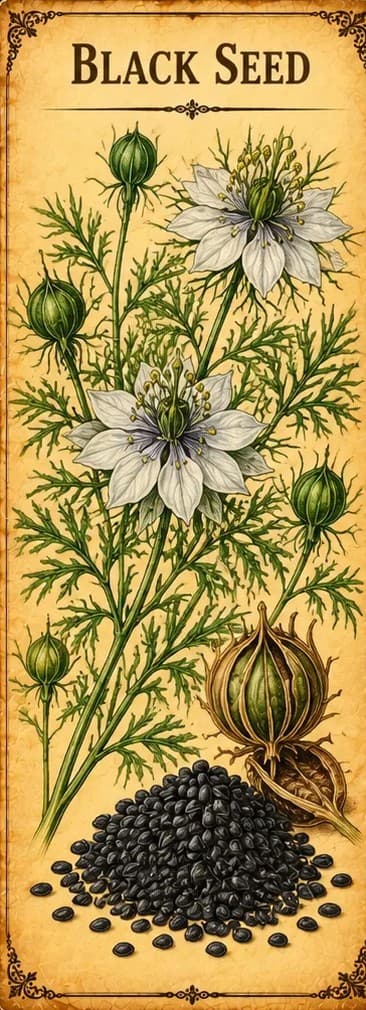
Black Seed
Nigella sativa
Black cumin seed, a spice and traditional remedy in India, Arabia and Europe. Reviews of small trials suggest it lowers blood pressure, cholesterol and blood sugar slightly.
Safety at a glance
- PregnancyNothing recorded
- BreastfeedingNothing recorded
- Medicines1 note →
- Who should avoid itNothing recorded
- Allergies1 note →
- Toxicity1 note →
Tap a box to read the safety notes below. “Nothing recorded” means our sources don't cover it, not that it's safe.
Black Seed may interact with some medicines. If you take any medicine, read Interactions with medicines below and talk to your doctor or pharmacist before using it.
What is Black Seed?
- Plant family
- Ranunculaceae, the buttercup family
- Parts used
- The seeds and seed oil
- Where it grows
- Found throughout India, Arabia and Europe
- Genus
- Nigella
- Species
- sativa
Also called
Black Cumin, Black Caraway, Nigella
Regional names
Kalonji
Traditionally used for
- Blood pressure (small effect)
- Cholesterol
- Blood sugar in type 2 diabetes
- Cooking spice
Traditionally described as
- Contains thymoquinone
Health topics
Where Black Seed appears in symptom search, and why. Being listed doesn't mean it's a proven treatment.
- High Blood Pressure
A 2016 review of 11 trials found it lowered blood pressure by about 3 points.
- High Blood Sugar
A 2017 review of 7 trials in type 2 diabetes found it improved fasting blood sugar.
- High Cholesterol
A 2016 review of 17 trials found it lowered total and LDL cholesterol and triglycerides.
Natural compounds
How it's prepared
Common ways Black Seed is prepared or sold. This isn't advice on how to take it; see Safety below.
- Culinary Preparation
The seeds are used as a spice in cooking.[1]General reference
- Oil
Black seed oil is taken by mouth or put on the skin, for example as a gel.[1]General reference
- Powder
In trials, black seed was taken as seed powder or seed oil.[2]Review or trial
Safety
Interactions with medicines
Black seed may raise the risk of side effects from medicines broken down by the liver's CYP450 enzymes. How much this matters in practice isn't known.[1]General reference
Allergies
Pure black seed oil put on the skin has caused allergic reactions.[1]General reference
Toxicity testing
High doses caused liver and kidney damage in rats. There's no information on this in people.[1]General reference
What does the research say?
Traditional use
These are traditional uses, not proven treatments.
The seeds are used in cooking and in traditional medicine in India, Arabia and Europe, to reduce inflammation and for infections and cancer. Black seed hasn't been shown to treat cancer in people.[1]General reference
Laboratory & animal research
Lab and animal results show what might be worth studying in people. They don't show that the herb has these effects in humans.
In lab and animal studies, compounds from the seeds, including thymoquinone, acted as antioxidants, calmed the immune system, protected the liver and slowed tumor growth. These effects haven't been shown in people.[1]General reference
Research in people
A 2016 review of 11 trials with 860 people found that taking black seed for about 8 weeks lowered blood pressure slightly more than a placebo or standard treatment, about 3 points for both numbers. Black seed powder seemed to work better than the oil.[2]Review or trial
Technical detail: SBP −3.26 mmHg (95% CI −5.10 to −1.42); DBP −2.80 mmHg (95% CI −4.28 to −1.32).
A 2016 review of 17 trials found black seed lowered total cholesterol, LDL ("bad") cholesterol and triglycerides compared with a placebo. The oil had a bigger effect on cholesterol than the powder, and only the powder raised HDL ("good") cholesterol.[3]Review or trial
Technical detail: total cholesterol −15.65 mg/dL; LDL −14.10 mg/dL; triglycerides −20.64 mg/dL.
A 2017 review of 7 trials in people with type 2 diabetes found black seed improved fasting blood sugar and blood fats. The authors noted there were only a few studies and more research is needed.[4]Review or trial
Technical detail: fasting blood sugar −17.84 mg/dL (95% CI −21.19 to −14.49).
Small trials suggest black seed may help asthma, rheumatoid arthritis, indigestion and fatty liver, and a gel put on the skin made radiation skin damage less severe in women with breast cancer. Larger studies are needed. Results for blood pressure have been conflicting.[1]General reference
In short
The pure oil can cause skin allergies. May affect medicines broken down by the liver.
Sources
- [1] Nigella sativa — About Herbs, Botanicals & Other Products — Memorial Sloan Kettering Cancer CenterGeneral reference
- [2] A systematic review and meta-analysis of randomized controlled trials investigating the effects of supplementation with Nigella sativa (black seed) on blood pressure · DOI: 10.1097/HJH.0000000000001049Review or clinical trial
- [3] Nigella sativa (black seed) effects on plasma lipid concentrations in humans: A systematic review and meta-analysis of randomized placebo-controlled trials · DOI: 10.1016/j.phrs.2016.02.008Review or clinical trial
- [4] Nigella sativa improves glucose homeostasis and serum lipids in type 2 diabetes: A systematic review and meta-analysis · DOI: 10.1016/j.ctim.2017.08.016Review or clinical trial
This information is educational and traditional in nature, and is not a substitute for professional medical advice. Unfamiliar word? See what these words mean.