
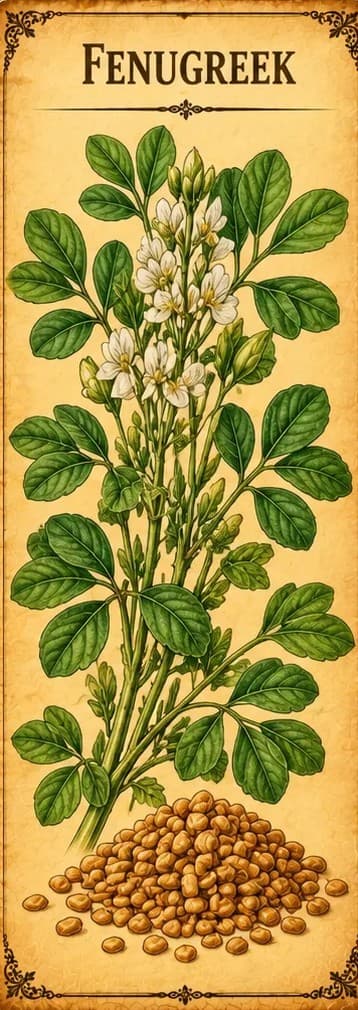
Fenugreek
Trigonella foenum-graecum
A maple-scented seed used as a spice and traditional medicine for about 6,000 years. It may lower blood sugar in type 2 diabetes, but it isn't safe in pregnancy beyond food amounts.
Safety at a glance
- Pregnancy2 notes →
- BreastfeedingNothing recorded
- Medicines2 notes →
- Who should avoid it1 note →
- Allergies1 note →
- ToxicityNothing recorded
Tap a box to read the safety notes below. “Nothing recorded” means our sources don't cover it, not that it's safe.
Fenugreek may interact with some medicines. If you take any medicine, read Interactions with medicines below and talk to your doctor or pharmacist before using it.
What is Fenugreek?
- Plant family
- Fabaceae, the pea and bean family
- Parts used
- The seeds
- Where it grows
- The Mediterranean region, southern Europe and western Asia
- Genus
- Trigonella
- Species
- foenum-graecum
Also called
Greek Hayseed, Bird's Foot
Regional names
Methi
Traditional names
Hu Lu Ba
Traditionally used for
- Loss of appetite (traditional)
- Minor skin inflammation (traditional)
- Blood sugar (some evidence)
- Breast milk supply (mixed results)
Traditionally described as
- Acts like estrogen in the lab
Health topics
Where Fenugreek appears in symptom search, and why. Being listed doesn't mean it's a proven treatment.
- Breast Milk Supply
Traditionally used to increase breast milk; studies have had mixed results.
- High Blood Sugar
May help lower blood sugar in type 2 diabetes, but many studies weren't high quality.
- Loss of Appetite
Recognized in Europe as a traditional remedy for temporary loss of appetite.
- Skin Irritation, Rashes and Itching
Recognized in Europe as a traditional remedy, put on the skin, for minor skin inflammation.
Traditions that use it
- Ayurveda
Used in Ayurveda for inflammation, diabetes and digestive problems, and to increase breast milk.
How it's prepared
Common ways Fenugreek is prepared or sold. This isn't advice on how to take it; see Safety below.
- Culinary Preparation
The seeds are used as a spice and as a maple-like flavoring in foods and drinks.[1]Health agency
- Extract
Dry and soft extracts of the seeds are taken in solid forms such as tablets.[2]Health agency
- Powder
The powdered seeds are taken by mouth, or steeped in hot water to apply to the skin.[2]Health agency
- Tea / Infusion
The whole or crushed seeds are made into an herbal tea.[2]Health agency
Safety
Interactions with medicines
Don't take fenugreek with warfarin (case reports suggest it may raise bleeding risk) or SSRI antidepressants (one case of serotonin syndrome).[3]General reference
Because fenugreek may lower blood sugar, people being treated for diabetes should have their blood sugar monitored closely.[2]Health agency
Who should avoid it
People with hormone-sensitive cancers should check with their doctor before taking more than is found in food, because fenugreek acts like estrogen in the lab.[3]General reference
Allergies
Don't use fenugreek if you're allergic to it, to peanuts or soy, or to other plants in the pea and bean family. Allergic reactions, some serious, have included facial swelling, wheezing, asthma and hay fever symptoms.[2]Health agency
Side effects
Fenugreek can cause diarrhea, nausea, gas and dizziness. Large doses may cause a harmful drop in blood sugar.[1]Health agency
Pregnancy
Don't take fenugreek during pregnancy in amounts larger than in food: it has been linked to a higher risk of birth defects in animals and people.[1]Health agency
Animal studies showed harm to reproduction, including fertility. The European Medicines Agency doesn't recommend fenugreek medicines during pregnancy or breastfeeding, or for women who could become pregnant and aren't using contraception.[2]Health agency
What does the research say?
Traditional use
These are traditional uses, not proven treatments.
Fenugreek has been used as a medicinal plant for about 6,000 years. Its seeds smell and taste like maple syrup and are used as a spice and flavoring. Traditionally it was used as a tonic or laxative, for menstrual cramps, menopause symptoms and kidney stones, and to increase breast milk.[1]Health agency
Based on long-standing use, the European Medicines Agency recognizes fenugreek seed as a traditional herbal medicine for adults, taken by mouth for temporary loss of appetite, or put on the skin for minor skin inflammation.[2]Health agency
Research in people
Research suggests fenugreek may help lower blood sugar in people with type 2 diabetes, but many studies weren't high quality. The evidence on menstrual cramps is of low quality, and studies on increasing breast milk have had mixed results.[1]Health agency
Small studies in people suggest fenugreek may lower blood fats and sugar or ease menopause symptoms, but larger, well-designed studies are needed. In the lab, it acted like estrogen and made breast cancer cells grow.[3]General reference
In short
Avoid in pregnancy beyond food amounts: linked to birth defects. Avoid with peanut or soy allergy, warfarin or SSRIs.
Sources
- [1] Fenugreek: Usefulness and Safety — National Center for Complementary and Integrative Health (NIH)Government health agency
- [2] European Union herbal monograph on Trigonella foenum-graecum L., semen, Revision 1 — European Medicines Agency, Committee on Herbal Medicinal Products (HMPC)Government health agency
- [3] Fenugreek — About Herbs, Botanicals & Other Products — Memorial Sloan Kettering Cancer CenterGeneral reference
This information is educational and traditional in nature, and is not a substitute for professional medical advice. Unfamiliar word? See what these words mean.