
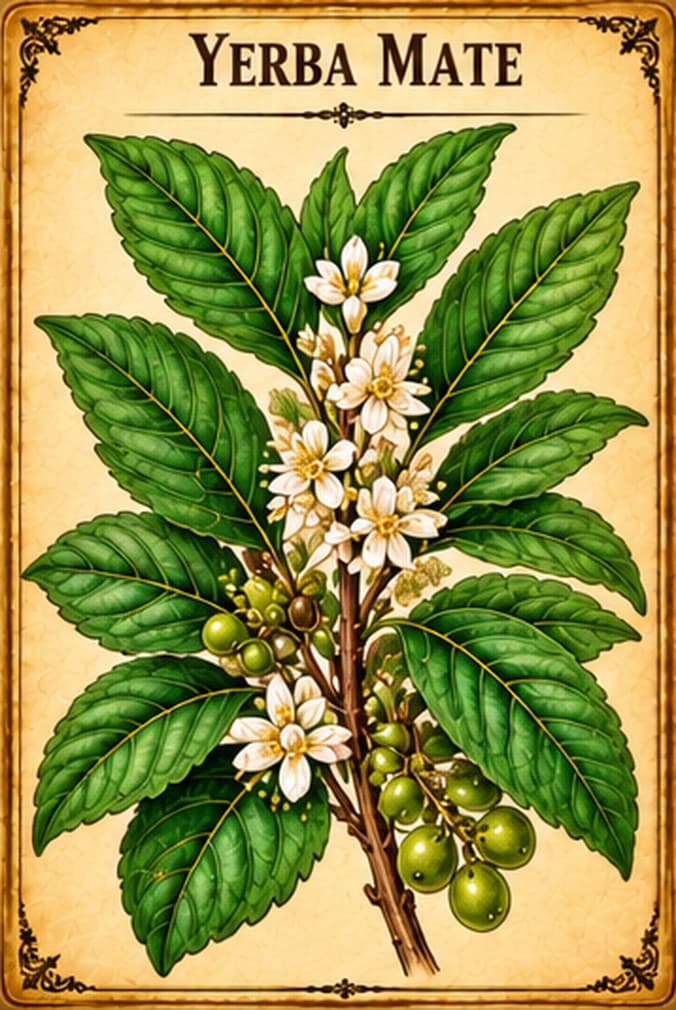
Yerba Mate
Ilex paraguariensis
A South American drink made from the dried leaves of a holly tree. Trials hint it may help blood sugar control, but found no effect on cholesterol.
Safety at a glance
- PregnancyNothing recorded
- BreastfeedingNothing recorded
- MedicinesNothing recorded
- Who should avoid itNothing recorded
- AllergiesNothing recorded
- Toxicity1 note →
Tap a box to read the safety notes below. “Nothing recorded” means our sources don't cover it, not that it's safe.
What is Yerba Mate?
- Plant family
- Aquifoliaceae, the holly family
- Parts used
- The dried leaves, made into a drink
- Genus
- Ilex
- Species
- paraguariensis
Also called
Maté
Traditionally used for
- Drink
- Blood sugar
Traditionally described as
- Leaves steeped as a drink
Health topics
Where Yerba Mate appears in symptom search, and why. Being listed doesn't mean it's a proven treatment.
- High Blood Sugar
May help blood sugar control in prediabetes, based on only 2 small trials.
How it's prepared
Common ways Yerba Mate is prepared or sold. This isn't advice on how to take it; see Safety below.
- Tea / Infusion
The dried leaves are steeped in water. It's traditionally drunk very hot, but can be drunk warm or cold; letting it cool lowers the cancer risk linked to very hot drinks.[1]Health agency
Safety
Side effects
Side effects reported in trials included mouth or throat irritation, trouble sleeping, a fast heartbeat, chest pain (angina), headache and stomach discomfort.[2]Review or trial
Toxicity testing
The World Health Organization's cancer agency classifies drinking very hot drinks (above 65 °C), including mate drunk very hot, as probably causing cancer of the esophagus (food pipe). It's the temperature, not the drink itself, that seems to be responsible. Mate drunk warm or cold couldn't be classified, because there wasn't enough evidence. Let mate cool before drinking.[1]Health agency
What does the research say?
Traditional use
These are traditional uses, not proven treatments.
Mate is a drink made by steeping the dried leaves of Ilex paraguariensis. It's drunk mainly in South America, and less often in the Middle East, Europe and North America. It's traditionally drunk very hot (about 70 °C), but may also be drunk warm or cold.[1]Health agency
Research in people
A 2025 review of 13 trials found yerba mate may help blood sugar control: in people with prediabetes, it lowered blood sugar after meals and HbA1c (a measure of average blood sugar), but these results came from only 2 studies. It had no clear effect on cholesterol, fasting blood sugar, waist size or body weight.[2]Review or trial
Technical detail: postprandial glucose MD −12.76 (95% CI −16.78 to −8.74); HbA1c MD −0.37 (95% CI −0.56 to −0.18); HOMA MD −0.24; N = 2 trials each.
A 2022 review of 7 studies with 378 people found drinking yerba mate didn't significantly change cholesterol or triglyceride levels. The studies were small, so more research is needed.[3]Review or trial
In short
Drinking it very hot (above 65 °C) probably raises the risk of esophageal cancer. Can cause trouble sleeping and a fast heartbeat.
Sources
- [1] IARC Monographs evaluate drinking coffee, maté, and very hot beverages (Press release No. 244) — International Agency for Research on Cancer (World Health Organization)Government health agency
- [2] Yerba Maté and its impact on glycemic control and metabolic health: a systematic review and meta-analysis · DOI: 10.3389/fendo.2025.1641592Review or clinical trial
- [3] Effect of Yerba Mate (Ilex paraguariensis) on Lipid Levels: A Systematic Review and Meta-Analysis · DOI: 10.1007/s11130-022-00991-2Review or clinical trial
This information is educational and traditional in nature, and is not a substitute for professional medical advice. Unfamiliar word? See what these words mean.