
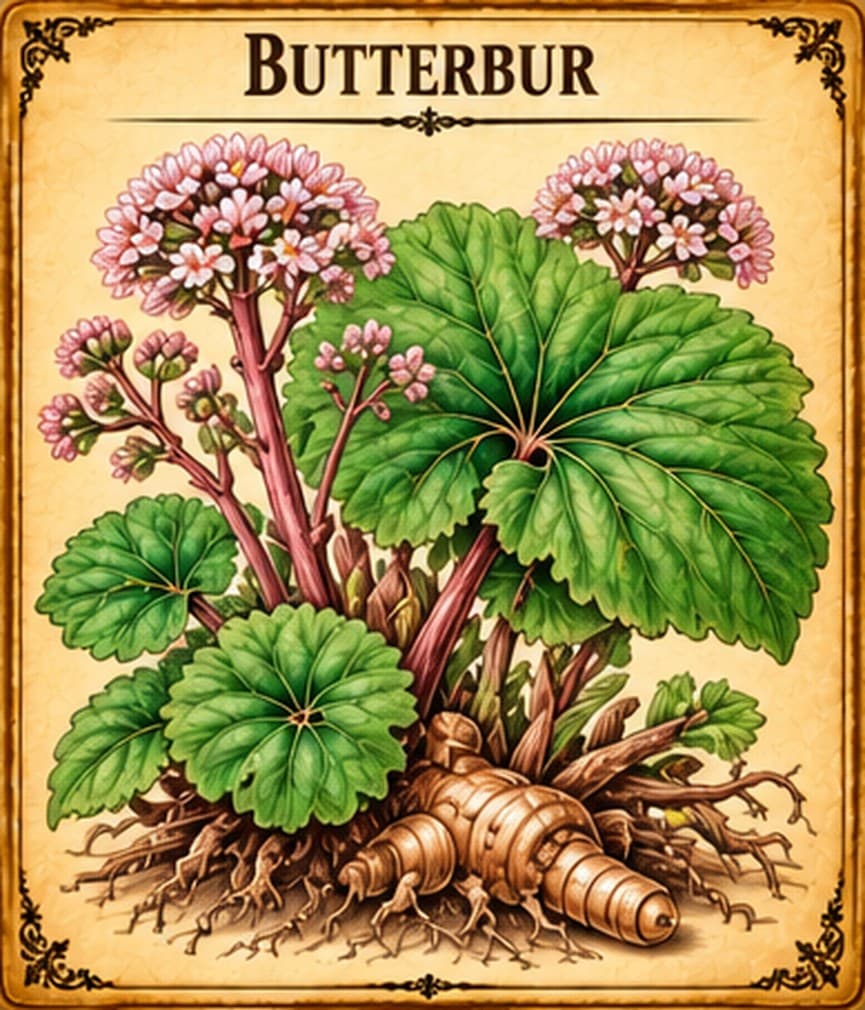
Butterbur
Petasites hybridus
A plant with huge leaves whose extracts are promoted for migraine and hay fever. Some studies suggest benefit, but there are safety concerns.
Safety at a glance
- Pregnancy1 note →
- Breastfeeding1 note →
- MedicinesNothing recorded
- Who should avoid itNothing recorded
- Allergies1 note →
- Toxicity1 note →
Tap a box to read the safety notes below. “Nothing recorded” means our sources don't cover it, not that it's safe.
What is Butterbur?
- Plant family
- Asteraceae, the daisy family
- Parts used
- The root and leaves, as extracts
- Where it grows
- Europe and parts of Asia and North America
- Genus
- Petasites
- Species
- hybridus
Traditionally used for
- Migraine
- Hay fever
Traditionally described as
- Root and leaf extracts
Health topics
Where Butterbur appears in symptom search, and why. Being listed doesn't mean it's a proven treatment.
How it's prepared
Common ways Butterbur is prepared or sold. This isn't advice on how to take it; see Safety below.
- Extract
Studies used a root extract for migraine and a leaf extract for hay fever, taken by mouth. Use only PA-free products.[1]Health agency
Safety
Allergies
Butterbur may cause an allergic reaction in people allergic to related plants, such as ragweed, chrysanthemums, marigolds and daisies.[1]Health agency
Side effects
PA-free products seemed safe taken by mouth for up to 16 weeks in studies, including some in children and teens, but there have been rare cases of liver injury with products said to be PA-free. Other side effects include belching, diarrhea, drowsiness, rash and upset stomach.[1]Health agency
Pregnancy
Don't use products that contain PAs during pregnancy: they can cause birth defects and liver damage. Little is known about whether PA-free products are safe in pregnancy.[1]Health agency
Breastfeeding
Don't use products that contain PAs while breastfeeding. Little is known about whether PA-free products are safe while breastfeeding.[1]Health agency
Toxicity testing
The butterbur plant contains pyrrolizidine alkaloids (PAs), which can damage the liver and lungs and may cause cancer. Only use products processed to remove PAs and labeled or certified "PA-free." Products containing PAs may not be safe on the skin either, since PAs could be absorbed through cuts or scrapes.[1]Health agency
What does the research say?
Traditional use
These are traditional uses, not proven treatments.
Butterbur is a shrub that grows in Europe and parts of Asia and North America. Its name comes from wrapping butter in its large leaves. In the Middle Ages, smoke from burning the roots was thought to fight plague. Today it's promoted for migraine, hay fever and other conditions.[1]Health agency
Research in people
A butterbur root extract may reduce how often migraines happen in adults and children. The American Academy of Neurology recommended it in 2012 but stopped in 2015 because of serious safety concerns.[1]Health agency
Studies of a butterbur leaf extract suggest it may help hay fever (allergic rhinitis) symptoms. Too little research has been done to say whether it helps anything else.[1]Health agency
In short
The plant contains pyrrolizidine alkaloids that can damage the liver: use only PA-free products. Rare liver injury has occurred even with products said to be PA-free.
Sources
- [1] Butterbur: Usefulness and Safety — National Center for Complementary and Integrative Health (NIH)Government health agency
This information is educational and traditional in nature, and is not a substitute for professional medical advice. Unfamiliar word? See what these words mean.