
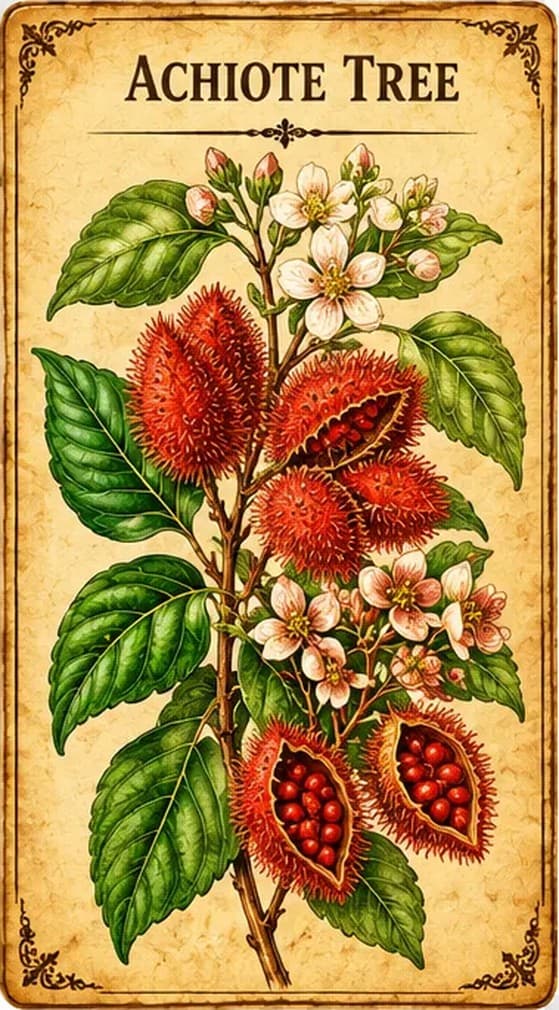
Achiote Tree
Bixa orellana
A tropical American shrub whose seeds give annatto, a red-orange food coloring. A small trial found its ointment improved the look of surgical scars.
Safety at a glance
- PregnancyNothing recorded
- BreastfeedingNothing recorded
- MedicinesNothing recorded
- Who should avoid itNothing recorded
- Allergies1 note →
- ToxicityNothing recorded
Tap a box to read the safety notes below. “Nothing recorded” means our sources don't cover it, not that it's safe.
What is Achiote Tree?
- Plant family
- Bixaceae, the annatto family
- Parts used
- The seeds, whose red coating gives annatto coloring
- Genus
- Bixa
- Species
- orellana
Also called
Annatto
Regional names
Urucu
Traditionally used for
- Food coloring
- Skin
Traditionally described as
- Seeds
- ointment
Health topics
Where Achiote Tree appears in symptom search, and why. Being listed doesn't mean it's a proven treatment.
- Cuts, Wounds, Burns and Skin Ulcers
A small trial found an achiote ointment improved the look of surgical scars.
Natural compounds
How it's prepared
Common ways Achiote Tree is prepared or sold. This isn't advice on how to take it; see Safety below.
- Culinary Preparation
The seeds give annatto, a red-orange food coloring.[1]Study
- Salve
An achiote (urucu) ointment was applied to healing surgical scars in a trial.[2]Study
Safety
Allergies
Allergic reactions to annatto coloring are rare, but two cases have been reported in young children, including recurring hives after eating food containing annatto.[3]Study
Side effects
In the scar trial, 2 people had a skin reaction or itching from the ointment, which went away when they stopped using it.[2]Study
What does the research say?
Traditional use
These are traditional uses, not proven treatments.
Achiote is native to the tropical Americas. Its seeds give annatto, a red-orange coloring used widely in foods (food additive E160b). In folk medicine it has been used for skin infections, burns, stomach ulcers, diabetes and high blood pressure.[1]Study
Laboratory & animal research
Lab and animal results show what might be worth studying in people. They don't show that the herb has these effects in humans.
Bixin, the main coloring compound in the seeds, acts as an antioxidant in the lab. In animal studies, the seeds lowered blood fats.[1]Study
Research in people
In a small 2025 trial in adults after foot and ankle surgery, an achiote (urucu) ointment applied for 4 weeks made scars look closer to normal skin than a standard ointment, especially in color and softness. The authors say the results should be read with caution because the trial was small and short.[2]Study
Technical detail: overall observer POSAS 2.56 vs 3.33 for control.
In short
Allergic reactions to annatto are rare but have been reported in young children.
Sources
- [1] Bixin Beyond Colour: Expanding Therapeutic Horizons Through the Integration of Pharmacological Potential with Modern Drug Design and Delivery Strategies · DOI: 10.2147/dddt.s556587Peer-reviewed study
- [2] Topical Bixa orellana for Postoperative Wound Healing: A Prospective Randomized Controlled Trial · DOI: 10.1177/24730114251345821Peer-reviewed study
- [3] Hidden and Rare Food Allergens in Pediatric Age · DOI: 10.3390/nu15061386Peer-reviewed study
This information is educational and traditional in nature, and is not a substitute for professional medical advice. Unfamiliar word? See what these words mean.