
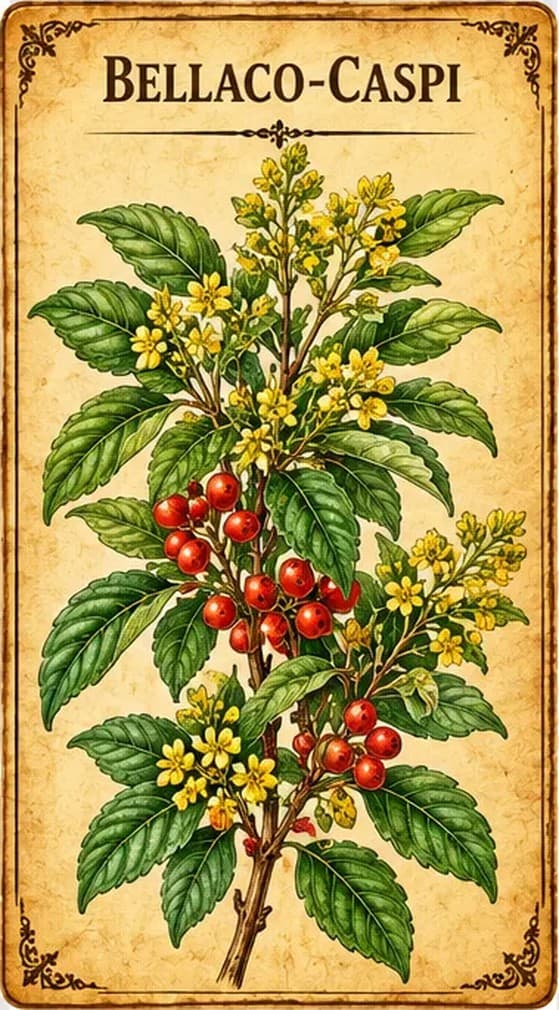
Bellaco-Caspi
Himatanthus sucuuba
An Amazonian shrub whose milky latex is used in Peru for wounds, ulcers and inflammation. It has only been studied in the lab and in animals.
Safety at a glance
- Pregnancy1 note →
- Breastfeeding1 note →
- Medicines1 note →
- Who should avoid itNothing recorded
- AllergiesNothing recorded
- Toxicity1 note →
Tap a box to read the safety notes below. “Nothing recorded” means our sources don't cover it, not that it's safe.
Bellaco-Caspi may interact with some medicines. If you take any medicine, read Interactions with medicines below and talk to your doctor or pharmacist before using it.
What is Bellaco-Caspi?
- Plant family
- Apocynaceae, the dogbane and milkweed family
- Parts used
- The latex (milky sap), and also the bark and leaves
- Where it grows
- The Amazon regions of Brazil, Peru and Colombia
- Genus
- Himatanthus
- Species
- sucuuba
Regional names
Janaguba, Sucuuba, Sucuba
Traditionally used for
- Wounds
- Ulcers
- Inflammation
Traditionally described as
- Latex (milky sap)
Natural compounds
How it's prepared
Common ways Bellaco-Caspi is prepared or sold. This isn't advice on how to take it; see Safety below.
- Decoction
The bark or leaves are simmered into a decoction or tea.[1]General reference
- Poultice
The fresh latex is applied directly to skin sores. Warm poultices of the bark or leaves are put on swellings.[1]General reference
Safety
Interactions with medicines
Interactions with painkillers such as ibuprofen (NSAIDs) and with blood thinners haven't been properly studied.[1]General reference
Side effects
The latex can irritate. Keep it away from the eyes and mouth, and it's generally not put on large open wounds. Larger amounts taken by mouth may upset the stomach.[1]General reference
Pregnancy
In pregnant rats, a bellaco-caspi extract given by mouth caused pregnancy loss, slowed the babies' growth and, at the higher dose, increased skeletal defects.[2]Study
Breastfeeding
Traditionally, it isn't taken by mouth while breastfeeding, or by children, without expert supervision.[1]General reference
Toxicity testing
A safe dose hasn't been established; the authors say its toxic dose still needs to be worked out.[3]Study
What does the research say?
Traditional use
These are traditional uses, not proven treatments.
Across the Amazon, Indigenous and riverside communities also use the bark and leaves for coughs, tuberculosis, anemia, arthritis, muscle and joint pain, and swellings.[1]General reference
Bellaco-caspi is a shrub of the Amazon. In Peruvian traditional medicine its latex is used for wounds, skin and stomach ulcers, inflammation, fever, low back pain, gastritis, hernias, herpes, inflammation of the uterus, malaria, rheumatism, tuberculosis and tumors. It's also used to expel worms.[3]Study
Laboratory & animal research
Lab and animal results show what might be worth studying in people. They don't show that the herb has these effects in humans.
The latex, bark and leaves contain plumericin, lupeol and other compounds. In mice, latex put on cuts helped the wounds heal. In the lab, the latex didn't kill colon cancer cells.[4]Study
In short
In pregnant rats, an extract caused pregnancy loss and skeletal defects. A safe dose hasn't been established.
Sources
- [1] Himatanthus sucuuba (Bellaco Caspi) — Yaogará Ark — Yaogará Research Initiative (Fundación Camino al Sol)General reference
- [2] Effect of Himatanthus sucuuba in Maternal Reproductive Outcome and Fetal Anomaly Frequency in Rats · DOI: 10.1002/bdrb.21152Peer-reviewed study
- [3] Histopathological evaluation of latex of Bellaco-Caspi, Himatanthus sucuuba (Spruce) Woodson on wound healing effect in BALB/C mice · DOI: 10.14202/vetworld.2020.1045-1049Peer-reviewed study
- [4] Phytochemical Screening of Himatanthus sucuuba (Spruce) Woodson (Apocynaceae) Latex, In Vitro Cytotoxicity and Incision Wound Repair in Mice · DOI: 10.3390/plants10102197Peer-reviewed study
This information is educational and traditional in nature, and is not a substitute for professional medical advice. Unfamiliar word? See what these words mean.