
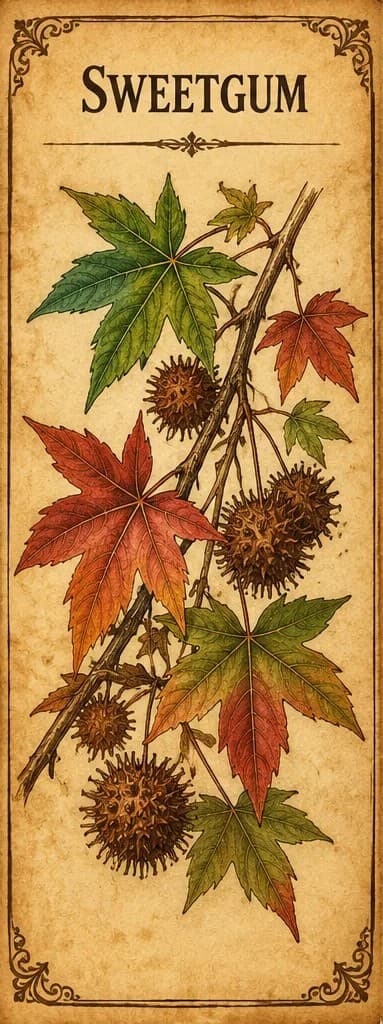
Sweetgum
Liquidambar styraciflua
A North American tree whose fragrant resin, storax, has long been used for coughs, skin problems and ulcers. Its seeds are a source of shikimic acid, used to make the flu medicine Tamiflu. It hasn't been studied in people.
Safety at a glance
- PregnancyNothing recorded
- BreastfeedingNothing recorded
- MedicinesNothing recorded
- Who should avoid itNothing recorded
- AllergiesNothing recorded
- ToxicityNothing recorded
Tap a box to read the safety notes below. “Nothing recorded” means our sources don't cover it, not that it's safe.
What is Sweetgum?
- Plant family
- Altingiaceae, the sweetgum family
- Parts used
- The resin (storax) from damaged bark, and the leaves, bark and seeds
- Where it grows
- The southeastern United States, Mexico and Central America
- Genus
- Liquidambar
- Species
- styraciflua
Also called
American Sweetgum, American Storax, Alligator Tree
Traditionally used for
- Coughs
- Skin problems
- Ulcers
- Dysentery
- Stomach problems
- Wounds
Traditionally described as
- Resin (storax)
- Source of shikimic acid
- Antioxidant (in lab studies)
Traditions that use it
- Native American Ethnobotany
Native Americans used storax, the tree's resin, to control coughs and dysentery.
Natural compounds
What does the research say?
Traditional use
These are traditional uses, not proven treatments.
Laboratory & animal research
Lab and animal results show what might be worth studying in people. They don't show that the herb has these effects in humans.
The leaves, bark and young seeds contain shikimic acid, the starting material for the flu medicine Tamiflu (oseltamivir). Infertile seeds hold the most.[1]Study
Technical detail: average seed yield 3.23% w/w; infertile seeds 6.5% w/w, fertile seeds 0.14% w/w.
In mice, a compound from the resin (benzyl benzoate) reduced the rise in blood pressure caused by a blood-pressure-raising hormone. In mice, compounds from the seed pods delayed skin tumors. In lab tests, the leaf and stem oils showed mild antioxidant activity and may help reduce inflammation.[1]Study
Technical detail: angiotensin II-induced rise of 20–40 mmHg with pretreatment vs 100 mmHg without; 5-LOX IC50 about 24 µg/mL.
In lab tests, the leaves and stems were rich in flavonoids and tannins, and stem extracts may help reduce inflammation. Some extracts made the antibiotic tetracycline work better against Enterococcus faecalis and Staphylococcus aureus bacteria.[2]Study
Technical detail: hyaluronidase inhibition assay; checkerboard synergy assay.
In short
No studies in people, so its safety as a remedy is unknown.
Sources
- [1] Sweetgum: An ancient source of beneficial compounds with modern benefits · DOI: 10.4103/0973-7847.156307Peer-reviewed study
- [2] Liquidambar styraciflua L.: A new potential source for therapeutic uses · DOI: 10.1016/j.jpba.2019.06.003Peer-reviewed study
This information is educational and traditional in nature, and is not a substitute for professional medical advice. Unfamiliar word? See what these words mean.