
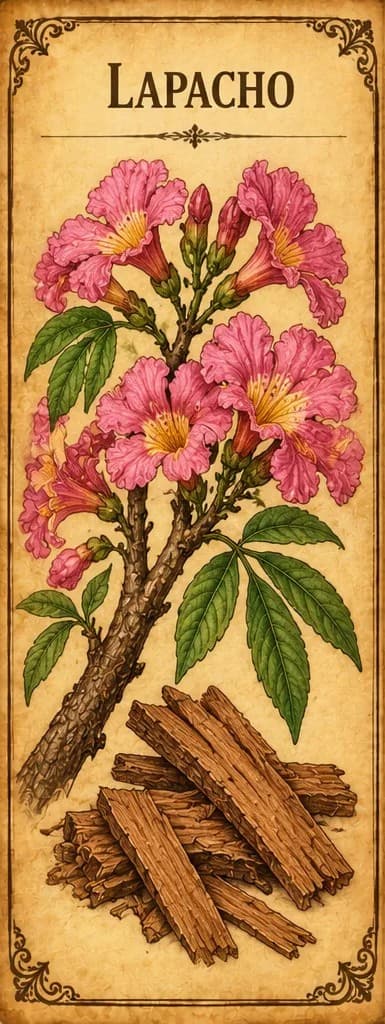
Lapacho
Handroanthus impetiginosus
Also called pau d'arco, a South American tree whose inner bark is made into a tea and sold as a supplement for infections and cancer. Its benefits haven't been shown in people.
Safety at a glance
- Pregnancy1 note →
- BreastfeedingNothing recorded
- Medicines1 note →
- Who should avoid itNothing recorded
- AllergiesNothing recorded
- ToxicityNothing recorded
Tap a box to read the safety notes below. “Nothing recorded” means our sources don't cover it, not that it's safe.
Lapacho may interact with some medicines. If you take any medicine, read Interactions with medicines below and talk to your doctor or pharmacist before using it.
What is Lapacho?
- Plant family
- Bignoniaceae, the trumpet-creeper family
- Parts used
- The inner bark, usually made into a tea
- Where it grows
- South America
- Genus
- Handroanthus
- Species
- impetiginosus
Also called
Pau d'Arco, Taheebo, Trumpet Bush
Regional names
Ipê-Roxo
Older scientific names
Tabebuia impetiginosa, Tabebuia avellanedae
Traditionally used for
- Infections
- Cancer (as a supplement)
Traditionally described as
- Antibacterial (in lab studies)
- Antifungal (in lab studies)
Natural compounds
How it's prepared
Common ways Lapacho is prepared or sold. This isn't advice on how to take it; see Safety below.
- Tea / Infusion
The inner bark is made into a tea.[1]General reference
Safety
Interactions with medicines
Don't take it with blood thinners such as warfarin, or antiplatelet medicines such as aspirin or clopidogrel. Its compound lapachol works in a similar way to warfarin and may raise the risk of bleeding.[1]General reference
Side effects
In a clinical study, people had nausea, vomiting and discolored urine.[1]General reference
Pregnancy
In animal studies, lapachol harmed unborn young and caused anemia and chromosome damage.[1]General reference
What does the research say?
Traditional use
These are traditional uses, not proven treatments.
Tea made from the inner bark of South American lapacho trees is used in traditional medicine. Supplements are sold for infections and cancer.[1]General reference
Laboratory & animal research
Lab and animal results show what might be worth studying in people. They don't show that the herb has these effects in humans.
In lab studies, pau d'arco killed some bacteria, fungi and cancer cells, and may help reduce inflammation. These effects haven't been shown in people. Its compounds lapachol and beta-lapachone are thought to be responsible.[1]General reference
Research in people
Research in people is limited:
- Small studies of a lapacho-based preparation suggested it may help prevent painful mouth sores in people having radiotherapy for head and neck cancer. The findings are preliminary.
- A 1974 study found lapachol didn't help people with chronic myelocytic leukemia.
- A small 2022 open-label study of adults with painful periods suggested it may reduce pain, but it had no comparison group.
In short
May raise the risk of bleeding, especially with blood thinners such as warfarin.
Sources
- [1] Pau D'arco — Memorial Sloan Kettering Cancer CenterGeneral reference
This information is educational and traditional in nature, and is not a substitute for professional medical advice. Unfamiliar word? See what these words mean.