
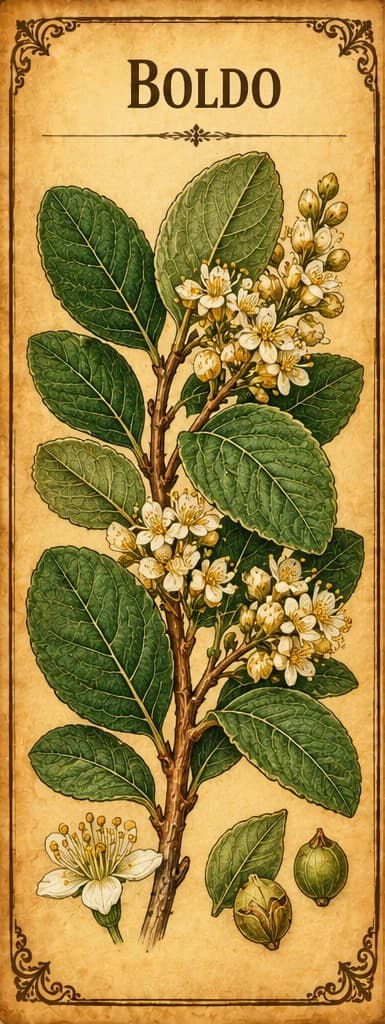
Boldo
Peumus boldus
A Chilean shrub whose leaf tea is a recognized traditional European remedy for indigestion and mild gut cramps.
Safety at a glance
- PregnancyNothing recorded
- BreastfeedingNothing recorded
- MedicinesNothing recorded
- Who should avoid it1 note →
- Allergies1 note →
- ToxicityNothing recorded
Tap a box to read the safety notes below. “Nothing recorded” means our sources don't cover it, not that it's safe.
What is Boldo?
- Plant family
- Monimiaceae, the boldo family
- Parts used
- The leaves
- Where it grows
- Central Chile
- Genus
- Peumus
- Species
- boldus
Traditionally used for
- Indigestion
- Gut cramps
Traditionally described as
- Digestive
Natural compounds
How it's prepared
Common ways Boldo is prepared or sold. This isn't advice on how to take it; see Safety below.
- Tea / Infusion
Usually taken as an herbal tea.[1]Health agency
Safety
Who should avoid it
Don't use boldo if you have a blocked bile duct, inflamed bile ducts (cholangitis), liver disease, gallstones or any other bile duct problem.[1]Health agency
Allergies
Allergic reactions have been reported.[1]Health agency
How much to use
Only for adults. See a doctor if your symptoms last longer than 2 weeks or get worse.[1]Health agency
What does the research say?
Traditional use
These are traditional uses, not proven treatments.
In Europe, boldo leaf is a traditional herbal medicine for indigestion and mild gut cramps, usually as a tea. This is based on long-standing use (at least 30 years), not on clinical trials.[1]Health agency
Laboratory & animal research
Lab and animal results show what might be worth studying in people. They don't show that the herb has these effects in humans.
In lab tests, a boldo extract reduced fat build-up in fat cells.[2]Study
Technical detail: 3T3-L1 adipocytes.
In short
Don't use it with liver disease, gallstones or bile duct problems.
Sources
- [1] Boldo leaf (Peumus boldus Molina, folium): summary for the public (EMA/810459/2016) — European Medicines Agency, Committee on Herbal Medicinal Products (HMPC)Government health agency
- [2] Peumus boldus Extract Inhibits Lipid Accumulation in 3T3-L1 Adipocytes · DOI: 10.3390/ijms26094326Peer-reviewed study
This information is educational and traditional in nature, and is not a substitute for professional medical advice. Unfamiliar word? See what these words mean.