
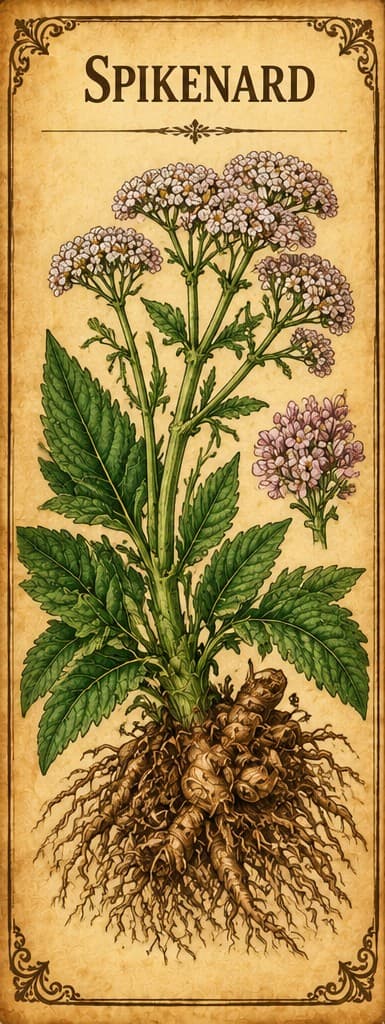
Spikenard
Nardostachys jatamansi
A fragrant, endangered Himalayan plant whose root is used in traditional Chinese medicine for pain and digestion. It has only been studied in the lab.
Safety at a glance
- PregnancyNothing recorded
- BreastfeedingNothing recorded
- MedicinesNothing recorded
- Who should avoid itNothing recorded
- AllergiesNothing recorded
- ToxicityNothing recorded
Tap a box to read the safety notes below. “Nothing recorded” means our sources don't cover it, not that it's safe.
What is Spikenard?
- Plant family
- Caprifoliaceae, the honeysuckle family
- Parts used
- The fragrant root and rhizome (underground stem)
- Where it grows
- The Himalayas
- Genus
- Nardostachys
- Species
- jatamansi
Also called
Nard
Regional names
Jatamansi
Traditionally used for
- Pain
- Digestion
Traditionally described as
- Fragrant
- Antioxidant (in lab studies)
- Antibacterial (in lab studies)
Traditions that use it
- Traditional Chinese Medicine
Used to regulate qi flow, relieve pain and improve digestion.
Safety
Contamination
Spikenard is an endangered plant, so wild-harvested root may come from threatened populations.[1]Study
What does the research say?
Traditional use
These are traditional uses, not proven treatments.
In traditional Chinese medicine, spikenard is a valued herb used to "regulate qi", relieve pain and help digestion.[2]Study
Laboratory & animal research
Lab and animal results show what might be worth studying in people. They don't show that the herb has these effects in humans.
In lab tests, the root oil showed strong antioxidant activity and killed Staphylococcus aureus and E. coli bacteria.[2]Study
Technical detail: 30 compounds identified by GC-MS; terpenes 68.8%; superoxide scavenging stronger than vitamin C.
In lab tests, a root extract blocked two enzymes that break down starch into sugar, more strongly than the diabetes drug acarbose.[3]Study
Technical detail: α-glucosidase IC50 61.7 µg/mL and α-amylase IC50 81.3 µg/mL vs acarbose 132.6 and 112.1 µg/mL.
In short
It's an endangered plant, and no safety studies were found.
Sources
- [1] Comprehensive Liquid Chromatography-Mass Spectrometry-based Metabolite Annotation Elucidates the Chemical Diversity of an Endangered Plant Nardostachys jatamansi · DOI: 10.1002/jssc.70494Peer-reviewed study
- [2] Chemical analysis, antioxidant and antimicrobial activities of Nardostachys jatamansi essential oil, and computational evaluation of mechanisms · DOI: 10.3389/fnut.2026.1764021Peer-reviewed study
- [3] Computational-experimental integration identifies potent carbohydrate-hydrolyzing enzyme inhibitors from Nardostachys jatamansi: molecular docking, dynamics and pharmacokinetic predictions · DOI: 10.3389/fphar.2025.1713452Peer-reviewed study
This information is educational and traditional in nature, and is not a substitute for professional medical advice. Unfamiliar word? See what these words mean.