
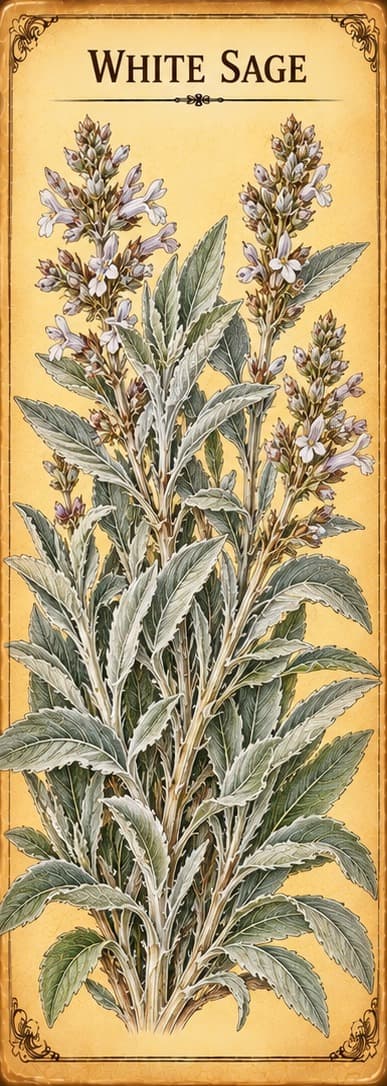
White Sage
Salvia apiana
A silvery Californian sage burned in Native American cleansing rituals and now widely sold in smudge sticks. Its oil has only been studied in the lab.
Safety at a glance
- PregnancyNothing recorded
- BreastfeedingNothing recorded
- MedicinesNothing recorded
- Who should avoid itNothing recorded
- AllergiesNothing recorded
- ToxicityNothing recorded
Tap a box to read the safety notes below. “Nothing recorded” means our sources don't cover it, not that it's safe.
What is White Sage?
- Plant family
- Lamiaceae, the mint family
- Parts used
- The leaves
- Where it grows
- Southern California and northern Baja California
- Genus
- Salvia
- Species
- apiana
Also called
Sacred Sage
Traditionally used for
- Smudging
- Cleansing rituals
Traditionally described as
- Aromatic
Traditions that use it
- Native American Ethnobotany
Bundled with other plants and burned for smudging, a cleansing ritual.
Natural compounds
Safety
Contamination
White sage is thought to be harvested unsustainably to meet growing demand for smudge sticks.[1]Study
What does the research say?
Traditional use
These are traditional uses, not proven treatments.
Native Americans burn white sage in bundles (smudge sticks) for cleansing rituals. It's now sold widely in Europe and elsewhere for personal "cleansing" and protection, which has raised concerns about cultural appropriation.[1]Study
Laboratory & animal research
Lab and animal results show what might be worth studying in people. They don't show that the herb has these effects in humans.
White sage oil contains no thujone, unlike common sage oil; its main compound is 1,8-cineole. In lab tests, the oil and 1,8-cineole slowed the growth of human immune T cells and made them self-destruct, more so at higher doses.[2]Study
Lab-grown white sage roots produced large amounts of rosmarinic acid, an antioxidant compound.[3]Study
In short
It's thought to be overharvested to meet demand for smudge sticks.
Sources
- [1] Commercialized "Smudge Sticks" Used as Incense in the Netherlands: An Inventory of Plants and Trends Behind a New Age Fashion · DOI: 10.3390/plants13213003Peer-reviewed study
- [2] Elicited Production of Essential Oil with Immunomodulatory Activity in Salvia apiana Microshoot Culture · DOI: 10.3390/molecules30040815Peer-reviewed study
- [3] Adventitious and Hairy Root Cultures of Salvia apiana as a Source of Rosmarinic Acid · DOI: 10.3390/ijms26073138Peer-reviewed study
This information is educational and traditional in nature, and is not a substitute for professional medical advice. Unfamiliar word? See what these words mean.