
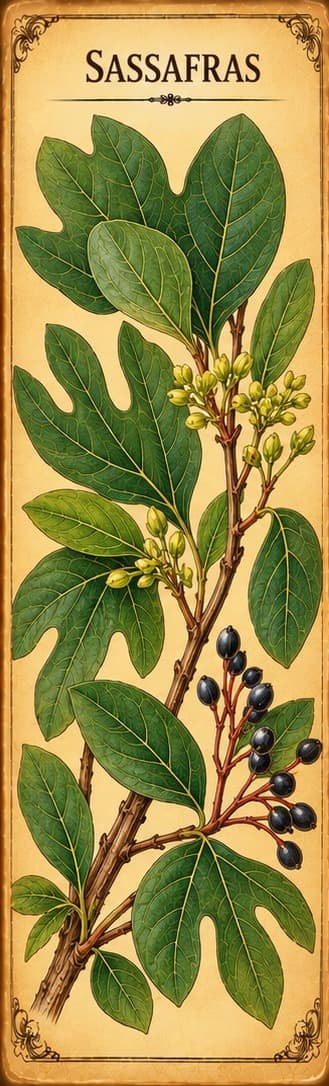
Sassafras
Sassafras albidum
An eastern North American tree whose fragrant root was made into tea and used for bronchitis and as a tonic. Its oil, safrole, causes cancer, and sassafras tea is banned as a food in the US.
Safety at a glance
- PregnancyNothing recorded
- BreastfeedingNothing recorded
- MedicinesNothing recorded
- Who should avoid it1 note →
- AllergiesNothing recorded
- Toxicity1 note →
Tap a box to read the safety notes below. “Nothing recorded” means our sources don't cover it, not that it's safe.
What is Sassafras?
- Plant family
- Lauraceae, the laurel family
- Parts used
- The root and root bark
- Where it grows
- Eastern North America
- Genus
- Sassafras
- Species
- albidum
Traditionally used for
- Bronchitis
- Tonic
- Nerve pain
- Toothache
Traditionally described as
- Aromatic
- Numbing
Traditions that use it
- Native American Ethnobotany
Root tea used as a tonic and for bronchitis in Appalachia.
Natural compounds
Safety
Who should avoid it
In the US, food containing added safrole or sassafras oil, including sassafras tea, is banned. Sassafras oil is about 80% safrole.[1]Health agency
Toxicity testing
Sassafras contains safrole, a known cancer-causing substance.[2]Study
What does the research say?
Traditional use
These are traditional uses, not proven treatments.
In Appalachia, sassafras root is made into a tea for bronchitis and used as a tonic. The root bark tea was traditionally used to cause sweating, as a stimulant, to increase urination and to relieve gas. In the late 1800s, sassafras oil was recommended for nerve pain and toothache.[2]Study
Laboratory & animal research
Lab and animal results show what might be worth studying in people. They don't show that the herb has these effects in humans.
Its oil is mostly safrole, which acts as a mild numbing agent. The bark has also been used as an insect repellent.[2]Study
In short
Contains safrole, a known cancer-causing substance.
Sources
- [1] 21 CFR 189.180 — Safrole (substances prohibited from use in human food) — U.S. Food and Drug AdministrationGovernment health agency
- [2] A Review and Survey of Local Eastern Kentucky Medicinal Plants and Their Pharmacological Benefits · DOI: 10.3390/plants14203182Peer-reviewed study
This information is educational and traditional in nature, and is not a substitute for professional medical advice. Unfamiliar word? See what these words mean.