
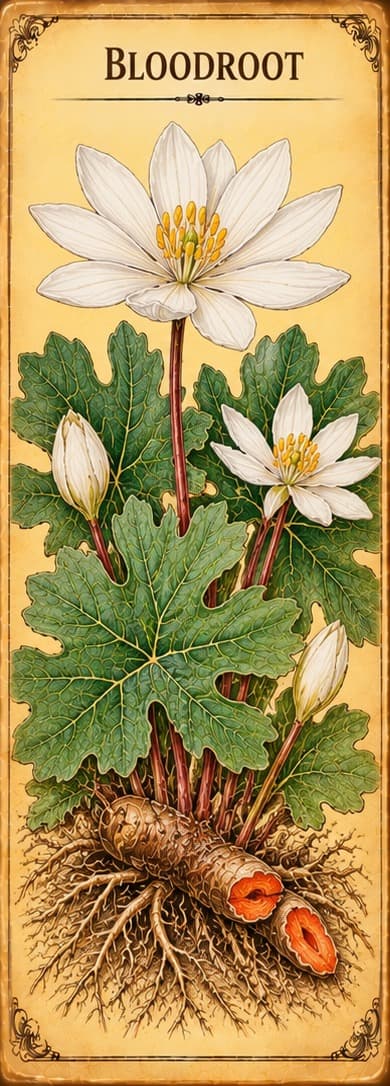
Bloodroot
Sanguinaria canadensis
A woodland wildflower whose red root sap was used by Indigenous peoples for fever and rheumatism. It's an ingredient in black salve, a corrosive paste that has caused severe disfiguring injuries.
Safety at a glance
- PregnancyNothing recorded
- BreastfeedingNothing recorded
- MedicinesNothing recorded
- Who should avoid itNothing recorded
- AllergiesNothing recorded
- Toxicity2 notes →
Tap a box to read the safety notes below. “Nothing recorded” means our sources don't cover it, not that it's safe.
What is Bloodroot?
- Plant family
- Papaveraceae, the poppy family
- Parts used
- The root and its red sap
- Where it grows
- Eastern North America
- Genus
- Sanguinaria
- Species
- canadensis
Also called
Canadian Bloodroot
Traditionally used for
- Fever
- Rheumatism
- Coughs
Traditionally described as
- Corrosive (in black salve)
Traditions that use it
- Native American Ethnobotany
Used for fever and rheumatism, and to cause vomiting.
Natural compounds
Safety
Side effects
Open wounds from black salve often become infected and may need care from several medical specialists.[1]Study
Toxicity testing
Bloodroot is a common ingredient of black salve, a corrosive paste sold as a skin cancer cure. Black salve destroys healthy skin as well as diseased skin. One man needed 17 plastic surgeries over 3 years to repair his face. The US FDA has documented at least 24 such injuries.[2]Study
Mouthwashes containing bloodroot compounds were withdrawn after they were linked to leukoplakia, white patches in the mouth that can turn into cancer. The patches didn't go away after people stopped using the mouthwash.[3]Study
What does the research say?
Traditional use
These are traditional uses, not proven treatments.
Indigenous peoples of North America used bloodroot for fever and rheumatism and to cause vomiting. In homeopathy it's used for coughs, sore throat and menopause symptoms, though these effects haven't been proven.[2]Study
Native Americans used bloodroot for many conditions. Some tribes took small doses to stop vomiting and larger doses to cause it, older people drank it as a tea for rheumatism, and the Rappahannock used it for fever. It was also prized as a red skin dye.[3]Study
In short
Never put black salve or bloodroot paste on your skin; it destroys healthy tissue.
Sources
- [1] Black Salve: A Dangerous Corrosive Disguised as an Alternative Medicine · DOI: 10.7759/cureus.41248Peer-reviewed study
- [2] Black Salve (or escharotics). A picture about an unorthodox medical preparation in oncology · DOI: 10.1002/ski2.241Peer-reviewed study
- [3] Sanguinaria canadensis: Traditional Medicine, Phytochemical Composition, Biological Activities and Current Uses · DOI: 10.3390/ijms17091414Peer-reviewed study
This information is educational and traditional in nature, and is not a substitute for professional medical advice. Unfamiliar word? See what these words mean.