
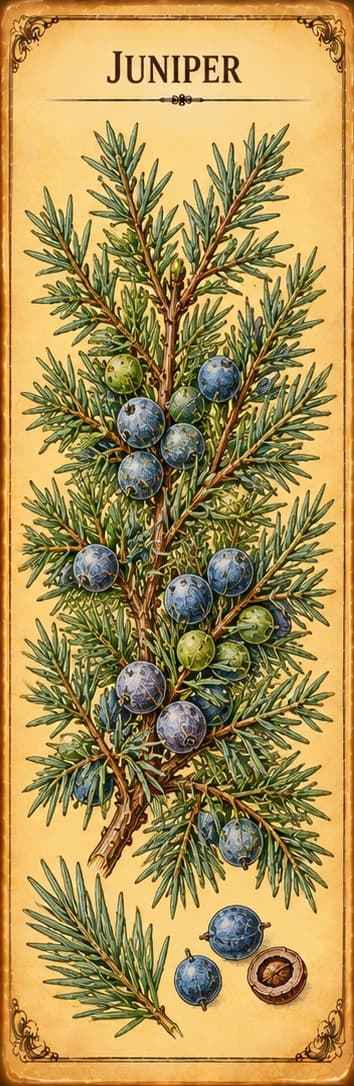
Juniper
Juniperus communis
An evergreen shrub whose berries are a recognized traditional European remedy to increase urination and ease indigestion and gas.
Safety at a glance
- Pregnancy1 note →
- BreastfeedingNothing recorded
- MedicinesNothing recorded
- Who should avoid it1 note →
- AllergiesNothing recorded
- ToxicityNothing recorded
Tap a box to read the safety notes below. “Nothing recorded” means our sources don't cover it, not that it's safe.
What is Juniper?
- Plant family
- Cupressaceae, the cypress family
- Parts used
- The ripe berries (cones)
- Where it grows
- Much of the Northern Hemisphere
- Genus
- Juniperus
- Species
- communis
Also called
Juniper Berry, Common Juniper
Traditionally used for
- Minor urinary complaints
- Indigestion
- Gas
Traditionally described as
- Increases urination
How it's prepared
Common ways Juniper is prepared or sold. This isn't advice on how to take it; see Safety below.
- Tea / Infusion
2–2.5 g of crushed berries steeped in 150 mL of boiling water.[1]Health agency
Safety
Who should avoid it
Not recommended with severe kidney disease, including kidney infections. See a doctor if you get a fever, pain or spasms when urinating, or blood in your urine. Not recommended if your doctor has told you to limit fluids.[1]Health agency
Pregnancy
Not recommended during pregnancy or breastfeeding, because its safety hasn't been established.[1]Health agency
How much to use
Not recommended for anyone under 18. See a doctor if symptoms last more than 2 weeks or get worse.[1]Health agency
What does the research say?
Traditional use
These are traditional uses, not proven treatments.
In Europe, juniper berry is a recognized traditional herbal medicine:
- to increase urination and flush the urinary tract in minor urinary complaints
- for indigestion and gas
This is based on long-standing use, not clinical trials. It's taken as a tea (2–2.5 g of crushed berries in 150 mL boiling water, 1–3 times a day) or as a liquid extract.[1]Health agency
In short
Not recommended with severe kidney disease, in pregnancy or for under-18s.
Sources
- [1] European Union herbal monograph on Juniperus communis L., galbulus (pseudo-fructus) (EMA/HMPC/241320/2021) — European Medicines Agency, Committee on Herbal Medicinal Products (HMPC)Government health agency
This information is educational and traditional in nature, and is not a substitute for professional medical advice. Unfamiliar word? See what these words mean.