
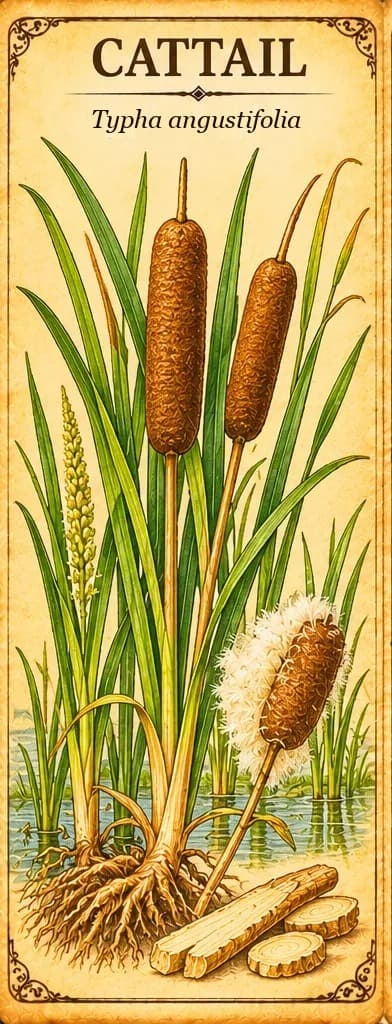
Cattail
Typha angustifolia
A common wetland plant whose pollen reduced inflammation in rat studies.
Safety at a glance
- PregnancyNothing recorded
- BreastfeedingNothing recorded
- MedicinesNothing recorded
- Who should avoid itNothing recorded
- AllergiesNothing recorded
- ToxicityNothing recorded
Tap a box to read the safety notes below. “Nothing recorded” means our sources don't cover it, not that it's safe.
What is Cattail?
- Plant family
- Typhaceae, the cattail family
- Parts used
- The pollen
- Where it grows
- Wetlands across North America, Europe and Asia
- Genus
- Typha
- Species
- angustifolia
Also called
Narrowleaf Cattail, Bulrush
Traditionally used for
- Inflammation
Traditionally described as
- May help reduce inflammation (in animal studies)
Traditions that use it
- Native American Ethnobotany
Used by the Pima, Hopi, Micmac and Malecite.
What does the research say?
Traditional use
These are traditional uses, not proven treatments.
The Pima baked narrow-leaf cattail pollen into biscuits, cooked it into porridge, and ate the tender white stalks raw. They also wove the leaves into mats and roofs and the stalks into baskets.[1]Traditional text
The Micmac and Malecite used the root for kidney or bladder stones (gravel).[1]Traditional text
Laboratory & animal research
Lab and animal results show what might be worth studying in people. They don't show that the herb has these effects in humans.
In rats, extracts of cattail pollen reduced both sudden (acute) and long-lasting inflammation. The authors say this supports its traditional use.[2]Study
Technical detail: carrageenan paw edema and cotton pellet granuloma models; 44.3% granuloma inhibition at 125 mg/kg.
In short
No studies in people or safety studies were found.
Sources
- [1] Native American Ethnobotany Database: Typha angustifolia — Botanical Research Institute of Texas (BRIT); compiled by Daniel E. MoermanTraditional text
- [2] Evaluation of anti-inflammatory activity of Typha angustifolia pollen grains extracts in experimental animals · DOI: 10.4103/0253-7613.103303Peer-reviewed study
This information is educational and traditional in nature, and is not a substitute for professional medical advice. Unfamiliar word? See what these words mean.