
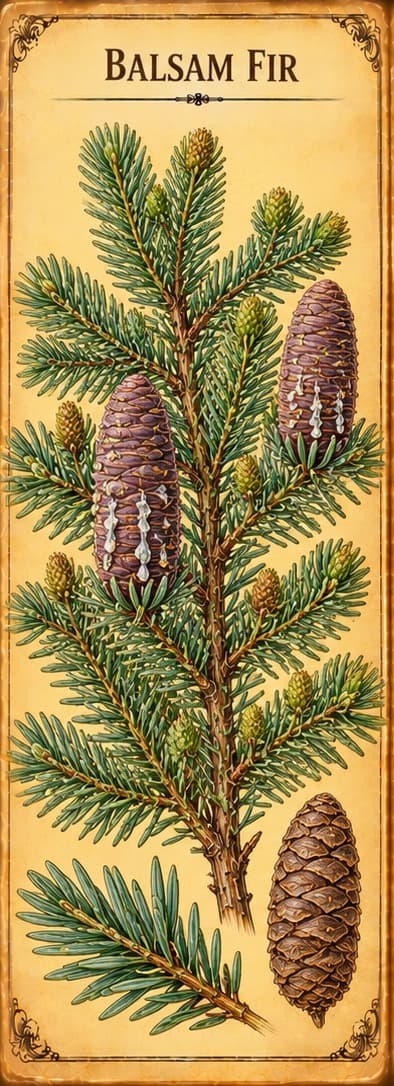
Balsam Fir
Abies balsamea
A fragrant North American fir whose needles and oil killed Lyme disease ticks in winter field tests.
Safety at a glance
- PregnancyNothing recorded
- BreastfeedingNothing recorded
- MedicinesNothing recorded
- Who should avoid itNothing recorded
- AllergiesNothing recorded
- ToxicityNothing recorded
Tap a box to read the safety notes below. “Nothing recorded” means our sources don't cover it, not that it's safe.
What is Balsam Fir?
- Plant family
- Pinaceae, the pine family
- Parts used
- The needles and resin
- Where it grows
- Eastern and central Canada and the northeastern United States
- Genus
- Abies
- Species
- balsamea
Traditionally used for
- Tick control
Traditionally described as
- Aromatic
- Kills ticks
Traditions that use it
- Native American Ethnobotany
Used by the Abnaki, Algonquin, Chippewa, Cree, Iroquois and other peoples.
Natural compounds
What does the research say?
Traditional use
These are traditional uses, not proven treatments.
Northeastern peoples used balsam fir gum (resin) on sores, cuts, insect bites, boils and itching, and the Abnaki used it as an antiseptic. The Abnaki also stuffed the needles into pillows for good health.[1]Traditional text
The Woodlands Cree drank a bark tea for colds, coughs and tuberculosis, and the Iroquois used it for coughs, colds and rheumatism. The Chippewa inhaled fumes of the melted gum for headache and used steam from the root for sore joints.[1]Traditional text
Laboratory & animal research
Lab and animal results show what might be worth studying in people. They don't show that the herb has these effects in humans.
Balsam fir needles and their essential oil killed blacklegged ticks, which spread Lyme disease, during winter. The oil worked within days at cold temperatures, and one of its main compounds, beta-pinene, also killed ticks.[2]Study
In short
Its medicinal use hasn't been studied.
Sources
- [1] Native American Ethnobotany Database: Abies balsamea — Botanical Research Institute of Texas (BRIT); compiled by Daniel E. MoermanTraditional text
- [2] Balsam fir (Abies balsamea) needles and their essential oil kill overwintering ticks (Ixodes scapularis) at cold temperatures · DOI: 10.1038/s41598-022-15164-zPeer-reviewed study
This information is educational and traditional in nature, and is not a substitute for professional medical advice. Unfamiliar word? See what these words mean.