
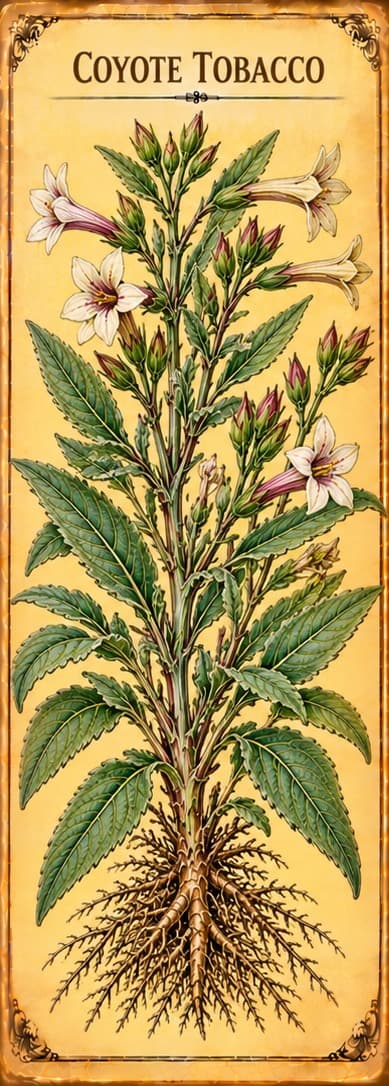
Coyote Tobacco
Nicotiana attenuata
A wild tobacco of western North America. Indigenous peoples of the Columbia Plateau smoked native tobacco for at least 1,200 years.
Safety at a glance
- PregnancyNothing recorded
- BreastfeedingNothing recorded
- MedicinesNothing recorded
- Who should avoid itNothing recorded
- AllergiesNothing recorded
- Toxicity1 note →
Tap a box to read the safety notes below. “Nothing recorded” means our sources don't cover it, not that it's safe.
What is Coyote Tobacco?
- Plant family
- Solanaceae, the nightshade family
- Parts used
- The leaves, traditionally smoked
- Where it grows
- Western North America
- Genus
- Nicotiana
- Species
- attenuata
Also called
Wild Tobacco
Traditionally used for
- Traditional smoking
Traditionally described as
- Contains nicotine
Traditions that use it
- Native American Ethnobotany
Wild tobacco smoked in pipes on the Columbia Plateau for at least 1,200 years.
Natural compounds
Safety
Toxicity testing
Coyote tobacco contains nicotine, an addictive stimulant.[1]Study
What does the research say?
Traditional use
These are traditional uses, not proven treatments.
Nicotine found in ancient stone pipes shows that Indigenous peoples of the Columbia River Basin, including ancestors of the Nez Perce, smoked wild tobacco for at least 1,200 years. They likely tended native species such as coyote tobacco long before trade tobacco arrived in the 1790s.[1]Study
Many Western peoples smoked coyote tobacco, including the Hopi, Navajo, Apache, Paiute, Klamath and Blackfoot, often in ceremonies. The Hopi smoked it for ceremonial occasions, and the Navajo used it in the Night Chant.[2]Traditional text
The Paiute used it widely as medicine: as a poultice for swellings, rheumatism, cuts, eczema and snakebites, as a wash for hives and aches, and smoked for colds and asthma. The Ramah Navajo smoked the leaves for headache and cough.[2]Traditional text
In short
Contains nicotine, an addictive stimulant.
Sources
- [1] Biomolecular archaeology reveals ancient origins of indigenous tobacco smoking in North American Plateau · DOI: 10.1073/pnas.1813796115Peer-reviewed study
- [2] Native American Ethnobotany Database: Nicotiana attenuata — Botanical Research Institute of Texas (BRIT); compiled by Daniel E. MoermanTraditional text
This information is educational and traditional in nature, and is not a substitute for professional medical advice. Unfamiliar word? See what these words mean.