
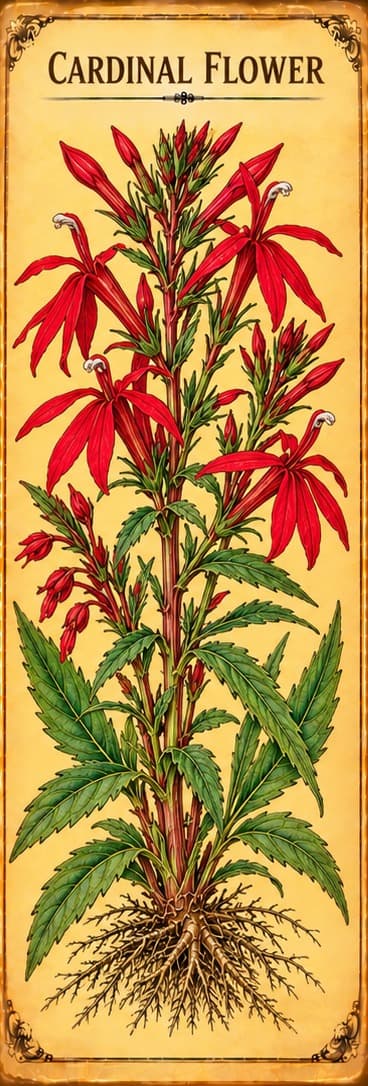
Cardinal Flower
Lobelia cardinalis
A red-flowered lobelia of the Americas. Its main alkaloid, lobinaline, is being studied in the lab for Parkinson's disease and addiction.
Safety at a glance
- PregnancyNothing recorded
- BreastfeedingNothing recorded
- MedicinesNothing recorded
- Who should avoid itNothing recorded
- AllergiesNothing recorded
- ToxicityNothing recorded
Tap a box to read the safety notes below. “Nothing recorded” means our sources don't cover it, not that it's safe.
What is Cardinal Flower?
- Plant family
- Campanulaceae, the bellflower family
- Parts used
- The whole plant has been studied
- Where it grows
- North and Central America
- Genus
- Lobelia
- Species
- cardinalis
Traditionally used for
- Lab research only
Traditionally described as
- Contains lobinaline
Traditions that use it
- Native American Ethnobotany
Used by the Cherokee, Iroquois, Delaware, Meskwaki and Pawnee.
Natural compounds
What does the research say?
Traditional use
These are traditional uses, not proven treatments.
The Cherokee used cardinal flower for colds, fever, stomach trouble, worms, rheumatism and sores that were hard to heal, and as a poultice for headache. The Delaware drank a root tea for typhoid.[1]Traditional text
The Iroquois used it for pain, fever, cramps and sores, and as a medicine that strengthened all others. The Meskwaki and Pawnee used the roots as a love medicine.[1]Traditional text
Laboratory & animal research
Lab and animal results show what might be worth studying in people. They don't show that the herb has these effects in humans.
Cardinal flower's main alkaloid, lobinaline, acts on the same brain receptors as nicotine and on dopamine, a brain messenger. In lab and rat studies, it was a strong antioxidant and slowed dopamine clearance. Researchers see it as a lead for Parkinson's disease and addiction research.[2]Study
Technical detail: binds α4β2 and α7 nicotinic acetylcholine receptors; inhibits the dopamine transporter.
In short
No safety studies were found.
Sources
- [1] Native American Ethnobotany Database: Lobelia cardinalis — Botanical Research Institute of Texas (BRIT); compiled by Daniel E. MoermanTraditional text
- [2] Novel multifunctional pharmacology of lobinaline, the major alkaloid from Lobelia cardinalis · DOI: 10.1016/j.fitote.2016.04.013Peer-reviewed study
This information is educational and traditional in nature, and is not a substitute for professional medical advice. Unfamiliar word? See what these words mean.