
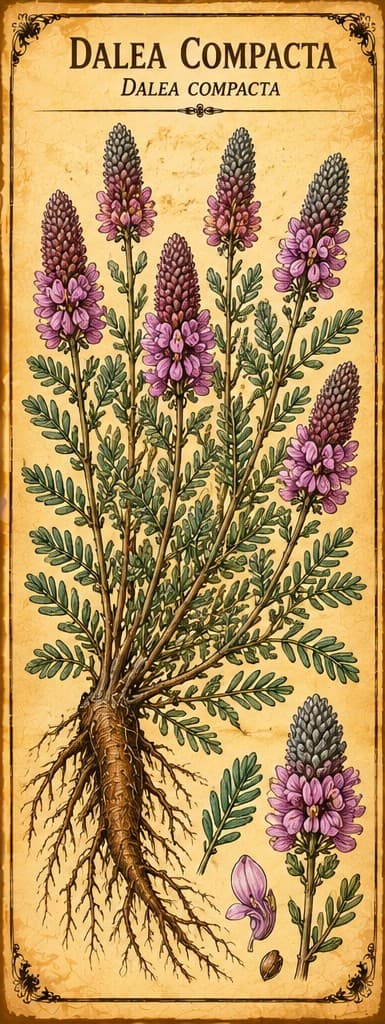
Dalea Compacta
Dalea compacta
Compact prairie clover, a purple-flowered prairie plant whose root the Zuni used for stomachaches and as a poultice for sores and rashes.
Safety at a glance
- PregnancyNothing recorded
- BreastfeedingNothing recorded
- MedicinesNothing recorded
- Who should avoid itNothing recorded
- AllergiesNothing recorded
- ToxicityNothing recorded
Tap a box to read the safety notes below. “Nothing recorded” means our sources don't cover it, not that it's safe.
What is Dalea Compacta?
- Plant family
- Fabaceae, the pea and bean family
- Parts used
- The root
- Where it grows
- Arkansas, Louisiana, Oklahoma and Texas
- Genus
- Dalea
- Species
- compacta
Also called
Compact Prairie Clover, Bush Prairie Clover
Traditionally used for
- Stomachache
- Sores
- Rashes (traditional)
Traditionally described as
- Pea-family root
Traditions that use it
- Native American Ethnobotany
Used by the Zuni for stomachaches and skin sores.
What does the research say?
Traditional use
These are traditional uses, not proven treatments.
The Zuni people of New Mexico drank a root tea for stomachaches and put a root poultice on sores and rashes.[1]Traditional text
A 2026 review of the prairie clovers also records the Zuni use of this species for stomachaches and as a poultice for sores and skin rashes. No lab or human studies of this species were found.[2]Study
Related prairie clovers have wider traditional uses. The Pawnee and Dakota used purple prairie clover for heart disease, diarrhea, measles and pneumonia, and the Dakota used golden prairie clover for dysentery, stomachaches and colic. In Ecuador, the flowers of an Andean species are used for pneumonia. These uses are for other species, not compact prairie clover.[2]Study
The prairie clover genus has 172 species, from Canada to Argentina and Chile. North American species were used by peoples such as the Apache and Dakota for headaches, rheumatism, heart disease and pneumonia, and in Ecuador for stomach problems. These uses are for the genus, not compact prairie clover specifically.[3]Study
Laboratory & animal research
Lab and animal results show what might be worth studying in people. They don't show that the herb has these effects in humans.
Prairie clovers are rich in flavonoids, and lab studies on several species have supported some of their traditional uses.[3]Study
In short
No lab, human or safety studies were found.
Sources
- [1] Native American Ethnobotany Database: Dalea compacta — Botanical Research Institute of Texas (BRIT); compiled by Daniel E. MoermanTraditional text
- [2] Phytochemistry and Pharmacological Potential of the Genus Dalea: Current Evidence and Future Directions · DOI: 10.3390/ph19081294Peer-reviewed study
- [3] Dalea Genus, Chemistry, and Bioactivity Studies · DOI: 10.1016/B978-0-444-64185-4.00008-3Peer-reviewed study
This information is educational and traditional in nature, and is not a substitute for professional medical advice. Unfamiliar word? See what these words mean.