
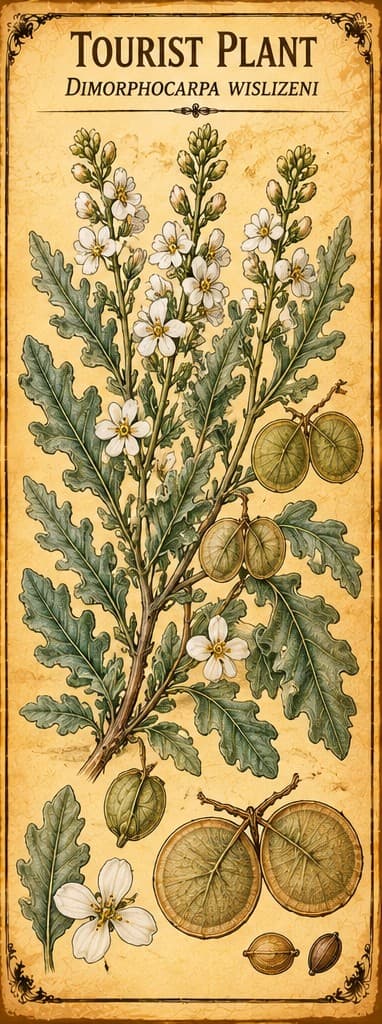
Tourist Plant
Dimorphocarpa wislizeni
Spectacle pod, a desert mustard that the Hopi, Navajo and Apache used on wounds, sores, swellings and itching.
Safety at a glance
- PregnancyNothing recorded
- BreastfeedingNothing recorded
- MedicinesNothing recorded
- Who should avoid itNothing recorded
- AllergiesNothing recorded
- ToxicityNothing recorded
Tap a box to read the safety notes below. “Nothing recorded” means our sources don't cover it, not that it's safe.
What is Tourist Plant?
- Plant family
- Brassicaceae, the mustard and cabbage family
- Parts used
- The whole plant, leaves, seeds and pods
- Where it grows
- The deserts of the southwestern United States and northern Mexico
- Genus
- Dimorphocarpa
- Species
- wislizeni
Also called
Spectacle Pod, Touristplant
Traditionally used for
- Wounds
- Sores
- Swelling
- Itching (traditional)
Traditionally described as
- Whole plant
- seeds and pods
Traditions that use it
- Native American Ethnobotany
Used by the Hopi, Navajo, Zuni, Apache and Western Keres peoples.
Safety
Side effects
The Hopi describe the plant as a strong irritant on the skin.[1]Traditional text
What does the research say?
Traditional use
These are traditional uses, not proven treatments.
The Hopi sprinkled the powdered plant, leaves or ground pods on wounds and scrapes, and used the ground stalk as a salve for sores. The Navajo used it for itching, scabs, insect bites and hemorrhoids, and children chewed it to strengthen their teeth.[1]Traditional text
The White Mountain Apache used a tea of the plant as a wash for swellings and throat troubles. The Western Keres inhaled the crushed seeds and leaves for a sore nose and used them as snuff. The Hopi describe the plant as a strong skin irritant.[1]Traditional text
Laboratory & animal research
Lab and animal results show what might be worth studying in people. They don't show that the herb has these effects in humans.
A water extract was one of several plants that killed cancer cells in a hamster study listed in a 2019 review of plants for colon cancer.[2]Study
In short
Described by the Hopi as a strong skin irritant.
Sources
- [1] Native American Ethnobotany Database: Dimorphocarpa wislizeni — Botanical Research Institute of Texas (BRIT); compiled by Daniel E. MoermanTraditional text
- [2] Medicinal Plants in the Prevention and Treatment of Colon Cancer · DOI: 10.1155/2019/2075614Peer-reviewed study
This information is educational and traditional in nature, and is not a substitute for professional medical advice. Unfamiliar word? See what these words mean.