
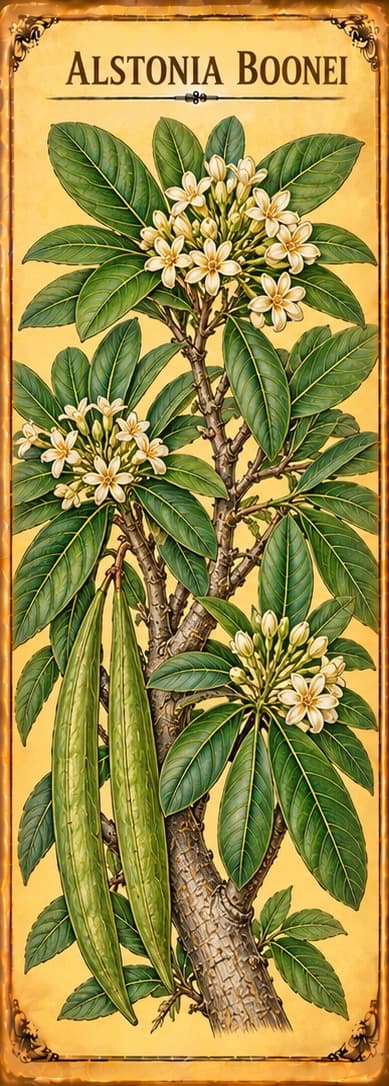
Alstonia Boonei
Alstonia boonei
God's tree, a sacred West African tree whose bark is used for malaria and fever. Lab studies support its use against malaria.
Safety at a glance
- Pregnancy1 note →
- BreastfeedingNothing recorded
- MedicinesNothing recorded
- Who should avoid itNothing recorded
- AllergiesNothing recorded
- Toxicity2 notes →
Tap a box to read the safety notes below. “Nothing recorded” means our sources don't cover it, not that it's safe.
What is Alstonia Boonei?
- Plant family
- Apocynaceae, the dogbane and milkweed family
- Parts used
- The bark, leaves, roots and latex (sap)
- Where it grows
- West and Central Africa
- Genus
- Alstonia
- Species
- boonei
Also called
God's Tree
Regional names
Onyame Dua, Osen-nuru, Sinduro, Nyamenlebaka
Traditionally used for
- Malaria
- Fever (traditional)
Traditionally described as
- Rich in alkaloids
Health topics
Where Alstonia Boonei appears in symptom search, and why. Being listed doesn't mean it's a proven treatment.
- Fever
Traditionally used for malaria fever. A bark extract lowered fever in mice; not tested in people.
- High Blood Sugar
A cold bark infusion is traditionally taken for diabetes. Not studied in people.
- Joint Discomfort
Traditionally used for joint pain. Root bark compounds reduced joint swelling in arthritic rats; no human trials.
- Menstrual Discomfort
A bark decoction is traditionally taken for period pain. Not studied in people.
Traditions that use it
- African Traditional Medicine
Sacred in some West African forest communities; used for malaria and fever.
Natural compounds
How it's prepared
Common ways Alstonia Boonei is prepared or sold. This isn't advice on how to take it; see Safety below.
Safety
Pregnancy
The bark is traditionally given to help pass the afterbirth, and it has been reported as possibly able to cause miscarriage.[1]Study
Toxicity testing
A man who took an herbal product containing Alstonia boonei, prekese and papaya extracts developed serious liver and kidney damage, which improved after he stopped. Alstonia boonei has been linked to liver and kidney damage in animal studies.[2]Study
In arthritic rats, compounds from the root bark made the liver and kidneys heavier, and one raised a liver enzyme. The researchers said this could mean the root bark is toxic.[1]Study
How much to use
There are no studies of safe doses, side effects or long-term use of Alstonia boonei.[1]Study
What does the research say?
Traditional use
These are traditional uses, not proven treatments.
Called God's tree (Onyame dua) in Ghana, Alstonia boonei is sacred in some West African forest communities, so its parts aren't eaten. It is traditionally used for malaria, fever, diabetes and infections, and as an aphrodisiac.[1]Study
The bark is the part most used, fresh or dried. In Ghana, a bark decoction sweetened with honey is taken up to 4 times a day for pain, including period pain, pelvic pain, painful urination from infections, joint pain and the aches of malaria fever.[1]Study
A cold infusion of the bark is taken 2 to 3 times a day by people with diabetes to lower blood sugar, and given to children to clear roundworms, threadworms and other gut worms.[1]Study
Fresh bark is made into tinctures used for snake, rat and scorpion bites and stings. The bark is also given to women to help pass the afterbirth and to increase breast milk, and is mixed with other plants for jaundice, broken bones and asthma. The sap is taken as a laxative, and hardened sap is put on yaws sores.[1]Study
The root bark is commonly used with other herbs to manage arthritis in West and Central Africa.[3]Study
Laboratory & animal research
Lab and animal results show what might be worth studying in people. They don't show that the herb has these effects in humans.
Lab and animal studies support its use against malaria and fever, and found antimicrobial and blood-sugar-lowering effects. It is rich in alkaloids and triterpenes.[1]Study
In rats with arthritis, compounds from the root bark (lupeol acetate and amyrins) reduced joint swelling. A stem bark extract reduced swelling, pain and fever in rats and mice.[1]Study
In lab tests, extracts of the root bark neutralized free radicals (unstable molecules that can damage cells), though more weakly than vitamin C.[3]Study
A Ghanaian arthritis remedy made mostly of Alstonia boonei root bark, with a little Rauvolfia vomitoria root bark and palm nut, reduced joint swelling in rats.[1]Study
In a 2024 lab study, three compounds taken from the stem bark were tested against bacteria. The only compound reported to have any effect, a weak one, came from a different plant (akuamma seeds).[4]Study
In short
Linked to liver and kidney damage in animal studies and, in one case, in a mixed herbal product.
Sources
- [1] A Review of the Ethnobotany and Pharmacological Importance of Alstonia boonei De Wild (Apocynaceae) · DOI: 10.5402/2012/587160Peer-reviewed study
- [2] Complementary and Alternative Medicine-Induced Combined Hepatorenal Toxicity: A Case Report · DOI: 10.7759/cureus.100197Peer-reviewed study
- [3] The Useful Medicinal Properties of the Root-Bark Extract of Alstonia boonei (Apocynaceae) May Be Connected to Antioxidant Activity · DOI: 10.1155/2014/741478Peer-reviewed study
- [4] Secondary metabolites from the stem bark of Alstonia boonei and the seeds of Picralima nitida with antibacterial activities · DOI: 10.1080/14786419.2024.2349254Peer-reviewed study
This information is educational and traditional in nature, and is not a substitute for professional medical advice. Unfamiliar word? See what these words mean.