
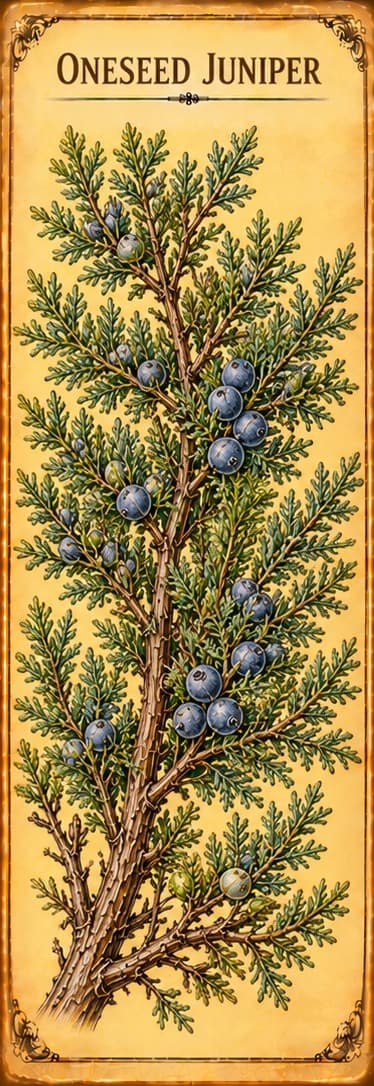
Oneseed Juniper
Juniperus monosperma
A southwestern juniper whose berries were eaten and seasoned meat, and whose leaves were used by the Apache and Hopi for colds, coughs and indigestion.
Safety at a glance
- PregnancyNothing recorded
- BreastfeedingNothing recorded
- MedicinesNothing recorded
- Who should avoid itNothing recorded
- AllergiesNothing recorded
- ToxicityNothing recorded
Tap a box to read the safety notes below. “Nothing recorded” means our sources don't cover it, not that it's safe.
What is Oneseed Juniper?
- Plant family
- Cupressaceae, the cypress family
- Parts used
- The berries, leaves, twigs and bark
- Where it grows
- The southwestern United States
- Genus
- Juniperus
- Species
- monosperma
Traditionally used for
- Food
- Colds
- Coughs
- Indigestion (traditional)
Traditionally described as
- Aromatic berries and leaves
Traditions that use it
- Native American Ethnobotany
Used by the Hopi, Apache, Acoma, Jemez, Isleta and Western Keres.
What does the research say?
Traditional use
These are traditional uses, not proven treatments.
Southwestern peoples ate the berries fresh, cooked, in stews and gravies, and as a seasoning for meat, and in hard times as a starvation food.[1]Traditional text
The White Mountain Apache drank a leaf tea for colds and coughs. The Hopi used it for indigestion and as a laxative, and put heated twigs on bruises and sprains. Jemez and Isleta women drank a leaf tea after childbirth.[1]Traditional text
In short
No lab, human or safety studies were found.
Sources
- [1] Native American Ethnobotany Database: Juniperus monosperma — Botanical Research Institute of Texas (BRIT); compiled by Daniel E. MoermanTraditional text
This information is educational and traditional in nature, and is not a substitute for professional medical advice. Unfamiliar word? See what these words mean.