
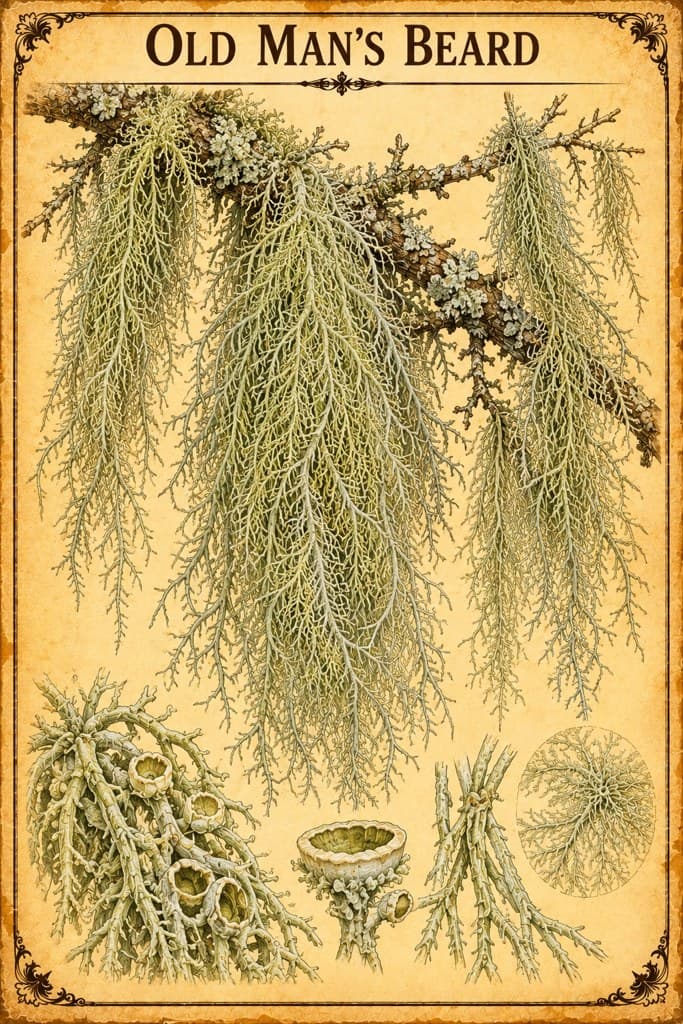
Old Man's Beard
Usnea barbata
Usnea, a beard-like lichen used in Chinese medicine and around the world for infections, wounds and coughs. Its usnic acid kills some microbes in the lab.
Safety at a glance
- PregnancyNothing recorded
- BreastfeedingNothing recorded
- MedicinesNothing recorded
- Who should avoid itNothing recorded
- AllergiesNothing recorded
- Toxicity1 note →
Tap a box to read the safety notes below. “Nothing recorded” means our sources don't cover it, not that it's safe.
What is Old Man's Beard?
- Plant family
- Parmeliaceae, a large family of lichens
- Parts used
- The whole lichen
- Where it grows
- Forests worldwide, hanging from tree branches
- Genus
- Usnea
- Species
- barbata
Also called
Usnea, Beard Lichen
Traditional names
Song Luo
Traditionally used for
- Infections
- Wounds
- Cough (traditional)
Traditionally described as
- Contains usnic acid
Traditions that use it
- Traditional Chinese Medicine
Called song luo; first recorded in 101 BC, though rarely used today.
Natural compounds
Safety
Toxicity testing
Usnic acid taken by mouth can damage the liver. Weight-loss supplements containing it were linked to many reports of liver damage, and in 2001 the US FDA warned about one of them, LipoKinetix, which was then withdrawn.[1]Study
What does the research say?
Traditional use
These are traditional uses, not proven treatments.
Usnea is a lichen, not a plant. In Chinese medicine, where it's called song luo, it was first recorded in 101 BC and used as a tea for infections, malaria, wounds, snakebite and cough, though it's rarely used today. Around the world it has been used for tuberculosis, pain, fever, wounds and athlete's foot, and in salves, deodorants and tinctures.[2]Study
Laboratory & animal research
Lab and animal results show what might be worth studying in people. They don't show that the herb has these effects in humans.
In short
Usnic acid taken by mouth can damage the liver; weight-loss supplements containing it were withdrawn.
Sources
- [1] Hepatotoxicity of usnic acid and underlying mechanisms · DOI: 10.1080/26896583.2024.2366737Peer-reviewed study
- [2] Review of usnic acid and Usnea barbata toxicity · DOI: 10.1080/10590500802533392Peer-reviewed study
- [3] Antioxidant, Photoprotective, and Antimicrobial Potential of Oil Extract of Usnea barbata L. F.H.Wigg from Călimani Mountains, Romania · DOI: 10.3390/molecules31081324Peer-reviewed study
This information is educational and traditional in nature, and is not a substitute for professional medical advice. Unfamiliar word? See what these words mean.