
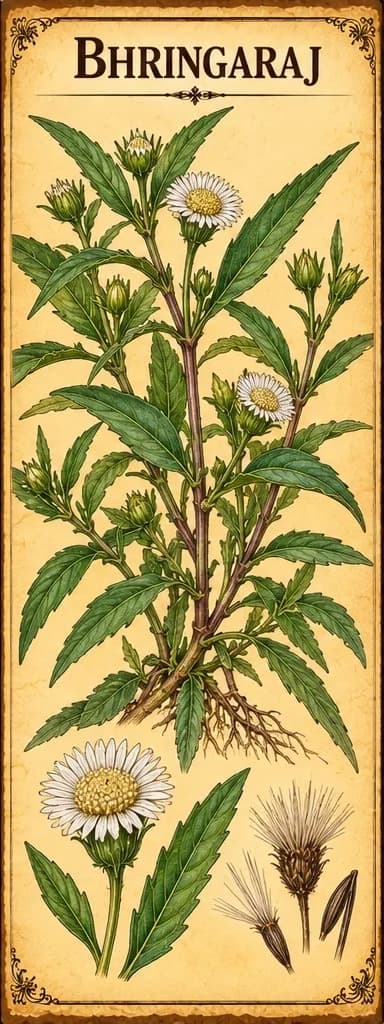
Bhringaraj
Eclipta prostrata
A daisy-family plant used in India, Nepal and Bangladesh for jaundice and other liver problems, skin problems and hair loss. Its hair and liver effects have only been tested in animals.
Safety at a glance
- PregnancyNothing recorded
- BreastfeedingNothing recorded
- MedicinesNothing recorded
- Who should avoid itNothing recorded
- AllergiesNothing recorded
- ToxicityNothing recorded
Tap a box to read the safety notes below. “Nothing recorded” means our sources don't cover it, not that it's safe.
What is Bhringaraj?
- Plant family
- Asteraceae, the daisy family
- Parts used
- The whole plant, especially the leaves and shoots
- Where it grows
- Tropical and subtropical regions; widely used in India, Nepal and Bangladesh
- Genus
- Eclipta
- Species
- prostrata
Older scientific names
Eclipta alba
Traditionally used for
- Hair loss
- Graying hair
- Jaundice
- Skin problems
- Wounds
- Fever (traditional)
Traditionally described as
- Revitalizing herb (Ayurveda)
Health topics
Where Bhringaraj appears in symptom search, and why. Being listed doesn't mean it's a proven treatment.
- Cuts, Wounds, Burns and Skin Ulcers
Traditional use only: used for cuts, wounds and burns in India and Nepal. Not studied in people.
- Fever
Traditional use only: used for fever in India. Not studied in people.
- Hair Loss
Traditionally used for hair loss and graying hair. In animal studies a leaf extract helped hair regrow; it hasn't been tested on its own in people.
- Liver Disease (Hepatitis, Cirrhosis)
Traditionally used for jaundice in India and Bangladesh. A leaf extract protected the liver in rats; it hasn't been tested in people.
Traditions that use it
- Ayurveda
Used as a revitalizing, anti-aging herb.
What does the research say?
Traditional use
These are traditional uses, not proven treatments.
Traditional uses recorded across South Asia and beyond:
- India: skin problems, jaundice and other liver problems, stomach and gut problems, asthma, fever, hair loss and graying hair, cuts and wounds, and an enlarged spleen.
- India: leaf juice with honey for mucus and congestion in babies, and shoot juice with mustard oil for diarrhea and dysentery.
- Nepal: the leaves and shoots, to prevent and treat infected wounds.
- Bangladesh: jaundice.
- South America: some groups use it for snakebites.
- Ayurveda: a revitalizing, anti-aging herb.
Laboratory & animal research
Lab and animal results show what might be worth studying in people. They don't show that the herb has these effects in humans.
In animal studies, a leaf extract put on the skin helped hair regrow almost as fast as 2% minoxidil, a standard hair-loss treatment: about 19 days to full regrowth, compared with 16. The review notes it's not clear whether it helps hair loss caused by disease, aging or genetics.[1]Study
Technical detail: ethanolic leaf extract; 19.01 ± 0.51 vs 16.05 ± 0.41 days; hair length at day 30, 21.08 vs 22.13 mm.
In rats with chemically caused liver damage, a water extract of the leaves lowered raised liver enzymes and bilirubin.[1]Study
Technical detail: carbon tetrachloride-induced hepatotoxicity; 250 mg/kg; reduced GOT, GPT and bilirubin.
In lab tests, extracts and compounds from the plant have shown activity against microbes and cancer cells. Few studies have pinned down which compounds are responsible, and the review's authors call for more animal and clinical studies.[1]Study
Technical detail: coumestans (including wedelolactone), phenolic acids, flavonoids, triterpenoid and steroid saponins, and thiophenes.
In short
Hasn't been studied on its own in people, so its safety is unknown.
Sources
- [1] Eclipta prostrata (L.) L. (Asteraceae): Ethnomedicinal Uses, Chemical Constituents, and Biological Activities · DOI: 10.3390/biom11111738Peer-reviewed study
This information is educational and traditional in nature, and is not a substitute for professional medical advice. Unfamiliar word? See what these words mean.