
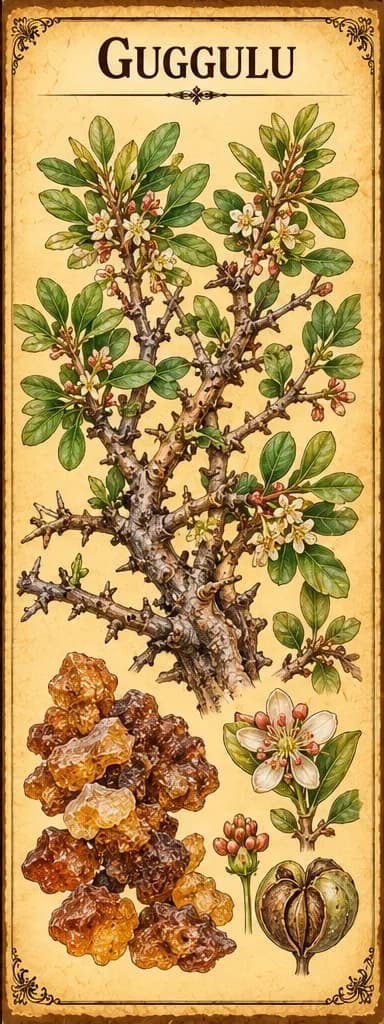
Guggulu
Commiphora wightii
The resin of the guggul tree, used in Ayurveda for thousands of years for arthritis, skin diseases and more. Studies on whether it lowers cholesterol are mixed, and it may make some medicines less effective.
Safety at a glance
- PregnancyNothing recorded
- BreastfeedingNothing recorded
- Medicines2 notes →
- Who should avoid itNothing recorded
- Allergies1 note →
- Toxicity1 note →
Tap a box to read the safety notes below. “Nothing recorded” means our sources don't cover it, not that it's safe.
Guggulu may interact with some medicines. If you take any medicine, read Interactions with medicines below and talk to your doctor or pharmacist before using it.
What is Guggulu?
- Plant family
- Burseraceae, the frankincense and myrrh family
- Parts used
- The resin (gum) from the tree
- Genus
- Commiphora
- Species
- wightii
Also called
Guggul, Gum guggul
Older scientific names
Commiphora mukul, Balsamodendron mukul
Traditionally used for
- Arthritis
- Rheumatism
- Hemorrhoids
- Urinary problems
- Skin diseases
- Nerve diseases (traditional)
Traditionally described as
- Ayurvedic resin
Health topics
Where Guggulu appears in symptom search, and why. Being listed doesn't mean it's a proven treatment.
- Acne
Promoted for acne, but Memorial Sloan Kettering finds the evidence lacking for guggul on its own.
- High Blood Pressure
In one small 6-week trial, guggul extract lowered blood pressure compared with no treatment, and worked better combined with nifedipine.
- High Cholesterol
Studies in people are mixed, and one trial suggested guggul may raise cholesterol. It may also make some medicines less effective.
- Joint Discomfort
Traditionally used in Ayurveda for arthritis and rheumatism. Memorial Sloan Kettering finds the evidence lacking.
Traditions that use it
- Ayurveda
Used for thousands of years, alone or in herbal formulas, for rheumatism and arthritis, nerve diseases, hemorrhoids, urinary problems and skin diseases.
How it's prepared
Common ways Guggulu is prepared or sold. This isn't advice on how to take it; see Safety below.
Safety
Interactions with medicines
Guggul may make some medicines less effective. Lab studies suggest it speeds up a liver enzyme (CYP3A4) that breaks down many common medicines. Don't take it if you take medicines processed this way, and tell your doctor or pharmacist about any supplements you use.[2]General reference
Guggul may affect blood test results. It has raised thyroid test results (TSH, T3 and T4) and lowered triglycerides.[2]General reference
Allergies
Skin allergies (contact dermatitis) have been reported from slimming and anti-cellulite creams containing guggul.[2]General reference
Side effects
Side effects can include headache, mild nausea, belching, hiccups, loose stools and an allergic rash.[2]General reference
Toxicity testing
Liver problems have been reported with products that mix guggul with other ingredients:
- very high liver enzymes in a 63-year-old woman after 6 months of a cholesterol product that also contained red yeast rice; she recovered after stopping it
- liver failure needing a transplant in a woman who took a supplement with usnic acid, green tea and guggul; usnic acid was thought to be the main cause
What does the research say?
Traditional use
These are traditional uses, not proven treatments.
Guggul resin has been used in Ayurveda for thousands of years, alone or mixed with other herbs. Traditional uses include rheumatism and arthritis, nerve diseases, hemorrhoids (piles), urinary problems and skin diseases.
Today it's also promoted for acne, high cholesterol and weight loss. Memorial Sloan Kettering finds the evidence lacking for these uses, except cholesterol, where studies are mixed.[2]General reference
Laboratory & animal research
Lab and animal results show what might be worth studying in people. They don't show that the herb has these effects in humans.
In lab tests, guggulsterone, a compound in the resin, changed how the liver makes cholesterol. Mice fed guggul had lower cholesterol than mice on a normal diet. In lab and animal studies, guggulsterone also slowed tumor growth, and guggul protected the heart in one animal study.[2]General reference
Technical detail: cholesterol lowering in mice attributed to FXR inhibition; guggulsterone was antiangiogenic and induced apoptosis in tumor cells (JNK activation, Akt repression).
Research in people
Studies in people on whether guggul lowers cholesterol are mixed. Some small studies suggest it may help, others found unclear benefit, and one trial suggested it may actually raise cholesterol. It showed no benefit when taken with Triphala, an Ayurvedic herbal mix. More research is needed to know whether it's safe and effective.[2]General reference
In a 6-week trial in India, 57 people newly diagnosed with high blood pressure took guggul extract (1.5 g a day), the blood pressure medicine nifedipine, or both. Compared with untreated people, the guggul group had lower blood pressure and cholesterol and higher HDL ("good") cholesterol. Guggul plus nifedipine worked better than guggul alone. The trial was small.[1]Study
Technical detail: randomized; guggul and nifedipine alone were single-blind, the combination double-blind; 10 mg/day nifedipine; also lower LDL, VLDL, triglycerides, free fatty acids and phospholipids.
In short
May make some medicines less effective; side effects include rash, upset stomach and headache.
Sources
- [1] Single- or double-blind treatment with Balsamodendron mukul and nifedipine in hypertensive patients · DOI: 10.1111/j.1524-6175.2006.04281.xPeer-reviewed study
- [2] Guggul — Memorial Sloan Kettering Cancer Center, About HerbsGeneral reference
This information is educational and traditional in nature, and is not a substitute for professional medical advice. Unfamiliar word? See what these words mean.