
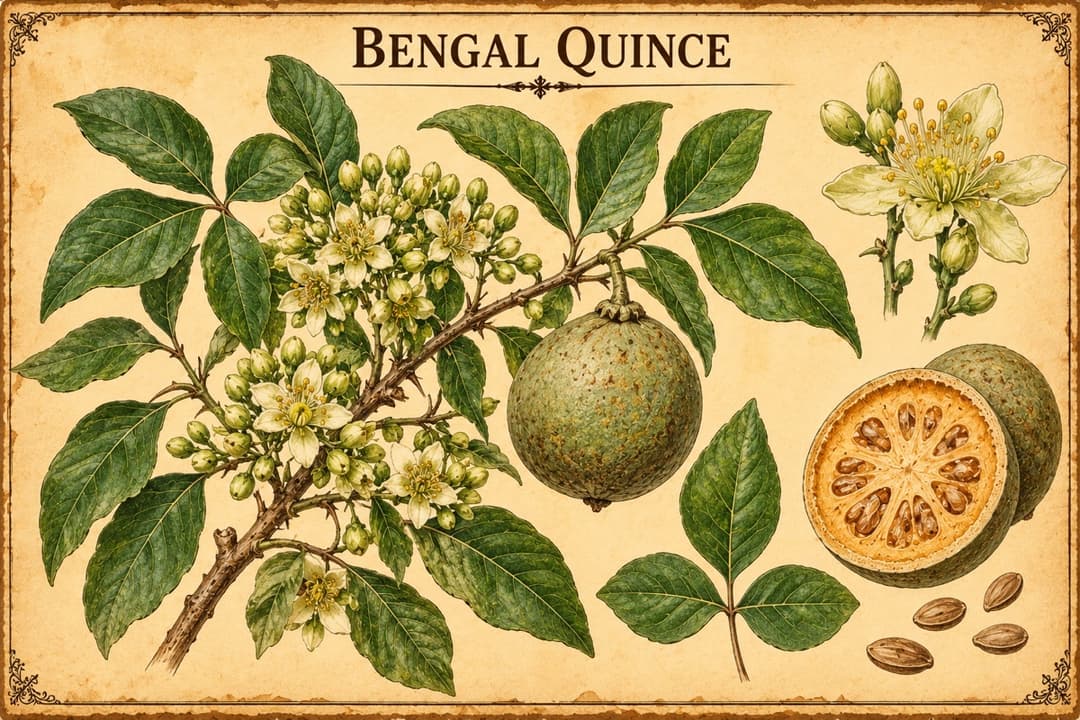
Bengal Quince
Aegle marmelos
Bael, a sacred Indian tree whose fruit is eaten as food and used in traditional medicine for diarrhea, stomach ulcers and fever. Its gut effects have only been tested in animals.
Safety at a glance
- PregnancyNothing recorded
- BreastfeedingNothing recorded
- MedicinesNothing recorded
- Who should avoid itNothing recorded
- AllergiesNothing recorded
- ToxicityNothing recorded
Tap a box to read the safety notes below. “Nothing recorded” means our sources don't cover it, not that it's safe.
What is Bengal Quince?
- Plant family
- Rutaceae, the citrus family
- Parts used
- The fruit, leaves, root, bark and flowers
- Where it grows
- India, Iran, Myanmar, Pakistan, Bangladesh and parts of South East Asia
- Genus
- Aegle
- Species
- marmelos
Also called
Bael
Traditional names
Bilva, Vilvam
Traditionally used for
- Diarrhea
- Dysentery
- Stomach ulcers
- Fever
- Vomiting
- Cough (traditional)
Traditionally described as
- Laxative
- Stomach tonic
Health topics
Where Bengal Quince appears in symptom search, and why. Being listed doesn't mean it's a proven treatment.
- Diarrhea
Traditionally used, especially the fruit, for long-lasting diarrhea and dysentery. A fruit pulp extract reduced diarrhea in rats with colitis; it hasn't been tested in people.
- Fever
Traditional use only: the leaves, root and bark are used for fever. Not studied in people.
- Occasional Nausea
Traditional use only: the leaves are used for nausea and vomiting. Not studied in people.
- Stomach Ulcers and H. pylori
Traditionally used for stomach ulcers. A fruit pulp extract protected rats from aspirin-caused ulcers; it hasn't been tested in people.
Traditions that use it
- Ayurveda
A sacred tree used since Vedic times. The fruit is used for diarrhea and ulcers, and the root is part of dashamula, an Ayurvedic root formula.
How it's prepared
Common ways Bengal Quince is prepared or sold. This isn't advice on how to take it; see Safety below.
- Culinary Preparation
The fruit pulp is eaten in juice, puddings and murabba, a sweet preserve.[1]Study
- Decoction
The bark is boiled into a tea for fever and cough.[1]Study
Safety
Side effects
Chewing bael leaves can cause white patches on the lips and inside the mouth. A 51-year-old woman who chewed 2 to 3 leaves a day for about 6 weeks developed this. A patch test confirmed bael as the cause, and her color began to return after she stopped.[2]Study
What does the research say?
Traditional use
These are traditional uses, not proven treatments.
Bael is a sacred tree in India, with roots in the Vedic era around 2000 BC. It holds an important place in several traditional systems of medicine.[3]Study
Traditional uses by plant part:
- Fruit: eaten as food, in juice, puddings and murabba (a sweet preserve). Used as a laxative, for breathing problems, and for long-lasting diarrhea and stomach ulcers.
- Leaves: fever, nausea and vomiting, swelling, dysentery and indigestion.
- Root: urinary problems, a racing heartbeat, fever and belly pain. It's part of dashamula, an Ayurvedic root formula used for fever, diarrhea and gas.
- Bark: villagers boil it into a tea for fever and cough.
- Flowers: distilled into a remedy for dysentery and diabetes, and used as a stomach tonic and for epilepsy.
Various parts are also used for asthma, fractures, anemia, wounds, high blood pressure, jaundice and swollen joints.[1]Study
Laboratory & animal research
Lab and animal results show what might be worth studying in people. They don't show that the herb has these effects in humans.
In rats with chemically caused colitis (inflammation of the large bowel), an extract of the dried fruit pulp given for 14 days reduced bowel damage, inflammation and diarrhea. In lab tests, it also acted against gut bacteria.[4]Study
Technical detail: 50% ethanol extract of dried fruit pulp, 200 mg/kg orally; TNBS-induced colitis; lower nitric oxide, lipid peroxidation and myeloperoxidase.
In rats, fruit pulp extract taken for 14 days before aspirin protected the stomach and upper gut from aspirin-caused ulcers.[5]Study
Technical detail: aspirin-induced gastroduodenal ulceration; improved mucosal thickness, ulcer index and antioxidant enzymes (SOD, catalase, glutathione).
In male rats, extracts of the bark and leaves lowered fertility and sperm movement, with stronger effects at higher doses. Fertility came back soon after the extract was stopped.[1]Study
Technical detail: bark alkaloids marmin and fagarine; 50% ethanolic leaf extract at 100–300 mg/kg/day for 60 days shrank accessory sex organs.
Lab and animal studies also report activity against diarrhea, microbes, viruses, stomach ulcers and inflammation.[1]Study
Technical detail: alkaloids (aegeline), coumarins (marmin, marmelosin, psoralen, imperatorin) and terpenoids.
In short
Not tested in people. Chewing the leaves caused white patches on the lips in one report, and leaf and bark extracts lowered fertility in male rats.
Sources
- [1] Phytochemical and biological review of Aegle marmelos Linn. · DOI: 10.2144/fsoa-2022-0068Peer-reviewed study
- [2] Oral and Lip Depigmentation Induced by Bael Leaves and Clove Phytochemicals · DOI: 10.4103/idoj.idoj_661_25Peer-reviewed study
- [3] Exploring pharmacological potential of Aegle marmelos: integrating traditional knowledge with modern physiology and molecular biology · DOI: 10.1007/s12298-025-01586-2Peer-reviewed study
- [4] Protective effects of Aegle marmelos fruit pulp on 2,4,6-trinitrobenzene sulfonic acid-induced experimental colitis · DOI: 10.4103/0973-1296.127366Peer-reviewed study
- [5] The protective role of Aegle marmelos on aspirin-induced gastro-duodenal ulceration in albino rat model: a possible involvement of antioxidants · DOI: 10.4103/1319-3767.96452Peer-reviewed study
This information is educational and traditional in nature, and is not a substitute for professional medical advice. Unfamiliar word? See what these words mean.