
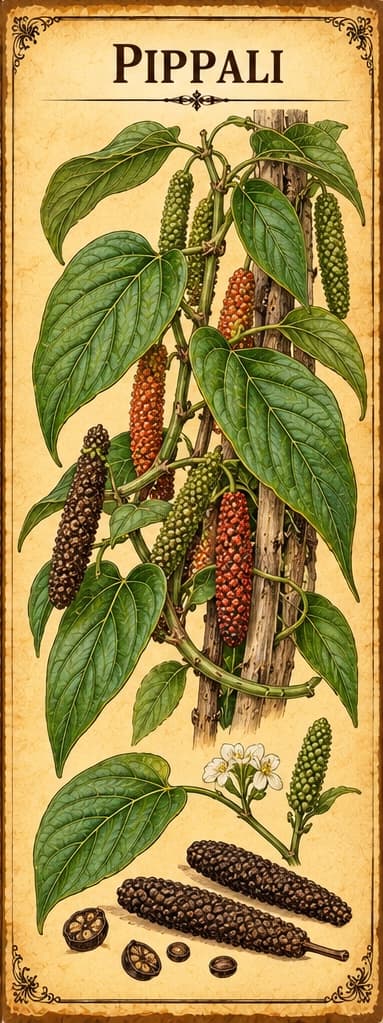
Pippali
Piper longum
Long pepper, a climbing shrub from India whose fruit is used in Ayurveda for cough, asthma and colds, and as a rejuvenating tonic. Small studies in people found little or uncertain benefit.
Safety at a glance
- PregnancyNothing recorded
- BreastfeedingNothing recorded
- MedicinesNothing recorded
- Who should avoid itNothing recorded
- AllergiesNothing recorded
- ToxicityNothing recorded
Tap a box to read the safety notes below. “Nothing recorded” means our sources don't cover it, not that it's safe.
What is Pippali?
- Plant family
- Piperaceae, the pepper family
- Parts used
- The dried fruit
- Where it grows
- Widely found throughout India
- Genus
- Piper
- Species
- longum
Also called
Long pepper
Traditionally used for
- Cough
- Asthma
- Colds
- Bronchitis
- Muscle pain
- Loss of appetite (traditional)
Traditionally described as
- Rejuvenating tonic (Ayurveda)
Health topics
Where Pippali appears in symptom search, and why. Being listed doesn't mean it's a proven treatment.
- Cough
Traditional use only: used for cough, bronchitis, asthma and colds. Not studied in people for this.
- Joint Discomfort
In one small study without a comparison group, people with rheumatoid arthritis reported relief after 15 days of Vardhamana Pippali.
- Loss of Appetite
Traditional use only: taken by mouth for loss of appetite. Not studied in people.
Traditions that use it
- Ayurveda
A rejuvenating (rasayana) herb in the Charaka Samhita, often given as Vardhamana Pippali, a gradually rising then tapering dose.
What does the research say?
Traditional use
These are traditional uses, not proven treatments.
Long pepper is used for breathing problems such as cough, bronchitis, asthma and colds. It's rubbed on the skin for muscle pain and inflammation. Taken by mouth, it's used for loss of appetite, sleeplessness, and liver and spleen problems.[1]Study
In Ayurveda, pippali is one of the rejuvenating (rasayana) herbs described in the Charaka Samhita. It's often given as Vardhamana Pippali, a dose that rises gradually and then tapers, so larger amounts can be taken without discomfort.[2]Study
Laboratory & animal research
Lab and animal results show what might be worth studying in people. They don't show that the herb has these effects in humans.
In rats, oil from the dried fruit reduced paw swelling.[1]Study
Technical detail: carrageenan-induced paw edema; compared with ibuprofen.
In rabbits, a long pepper extract increased how much boswellic acid (from frankincense) the body absorbed.[3]Study
Technical detail: 2.5 and 10 mg/kg Piper longum extract raised boswellic acid bioavailability.
Research in people
In a study in India, 73 people with rheumatoid arthritis took Vardhamana Pippali for 15 days. They reported up to 50% relief of their symptoms, and a blood marker of inflammation (ESR) fell. There was no comparison group, so the study can't show that pippali caused the improvement.[2]Study
In a randomized trial in India, 40 people with an underactive thyroid took pippali for 19 days, in either a rising-and-tapering or a fixed dose (69 g in total). Thyroid hormone levels (TSH) barely changed, and symptom scores didn't improve significantly. The authors concluded it had minimal effect.[4]Study
Technical detail: Zulewski's clinical score; serum T3, T4 and TSH at baseline, day 20 and day 40.
In short
Barely studied in people, so its safety is unknown.
Sources
- [1] Antiinflammatory Activity of Piper longum Fruit Oil · DOI: 10.4103/0250-474X.57300Peer-reviewed study
- [2] Clinical evaluation of Vardhamana Pippali Rasayana in the management of Amavata (Rheumatoid Arthritis) · DOI: 10.4103/0974-8520.92555Peer-reviewed study
- [3] Enhanced Bioavailability of Boswellic Acid by Piper longum: A Computational and Pharmacokinetic Study · DOI: 10.3389/fphar.2020.551911Peer-reviewed study
- [4] Efficacy of Pippali in vardhamana and fixed dosage pattern in primary hypothyroidism: A randomized clinical trial · DOI: 10.1016/j.jaim.2022.100555Peer-reviewed study
This information is educational and traditional in nature, and is not a substitute for professional medical advice. Unfamiliar word? See what these words mean.