
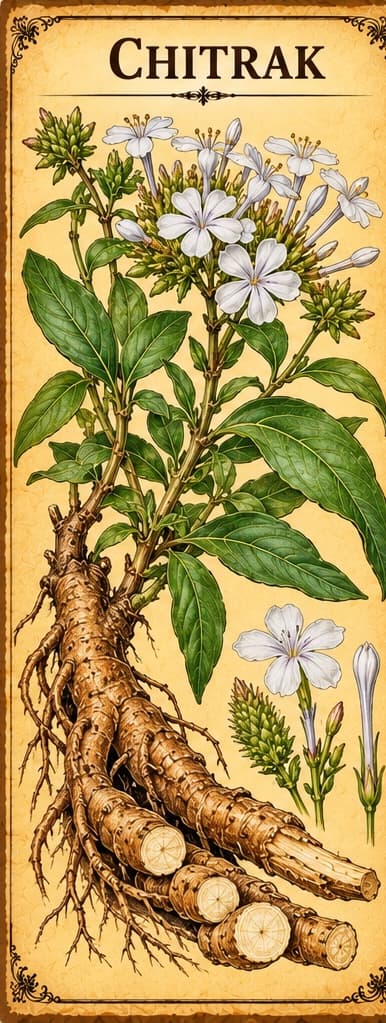
Chitrak
Plumbago zeylanica
An Ayurvedic plant whose root is used for liver disorders and long-lasting inflammation. Ayurveda purifies the root before use, and root extracts damaged the liver and kidneys in rats.
Safety at a glance
- PregnancyNothing recorded
- BreastfeedingNothing recorded
- MedicinesNothing recorded
- Who should avoid itNothing recorded
- AllergiesNothing recorded
- Toxicity1 note →
Tap a box to read the safety notes below. “Nothing recorded” means our sources don't cover it, not that it's safe.
What is Chitrak?
- Plant family
- Plumbaginaceae, the leadwort family
- Parts used
- The root, purified before use
- Genus
- Plumbago
- Species
- zeylanica
Also called
Ceylon leadwort
Traditional names
Chitraka
Traditionally used for
- Liver disorders
- Long-lasting inflammation (traditional)
Traditionally described as
- Used only after purification (Ayurveda)
Health topics
Where Chitrak appears in symptom search, and why. Being listed doesn't mean it's a proven treatment.
- Liver Disease (Hepatitis, Cirrhosis)
Named in Ayurveda as a remedy for liver disorders. A purified-root tea protected rats' livers, but root extracts damaged the liver in another rat study. Not tested in people.
Traditions that use it
- Ayurveda
A well-known Ayurvedic medicine; the root is purified in lime water before use, and the classics name it as a remedy for liver disorders.
How it's prepared
Common ways Chitrak is prepared or sold. This isn't advice on how to take it; see Safety below.
Safety
Toxicity testing
In rats, chitrak root extracts given for 28 days damaged the liver and kidneys. The most toxic extract killed half the rats at about 93 mg per kg of body weight. Toxicity rose with the amount of plumbagin, a compound in the root.[2]Study
Technical detail: OECD 425 and 407; LD50 93.45 mg/kg (petroleum ether), 928.4 mg/kg (acetone and hydroalcoholic extracts); raised AST, urea and creatinine.
Depends on how it's prepared
Ayurveda uses chitrak root only after purification (shodhana) in lime water, to remove its harmful effects.[3]Study
What does the research say?
Traditional use
These are traditional uses, not proven treatments.
Chitraka is a well-known Ayurvedic medicine. Its root is used, and Ayurveda requires it to be purified before use to remove its harmful effects. This purification, called shodhana, involves soaking the root in lime water.[3]Study
Technical detail: in one study, plumbagin content was 0.29% before and 0.98% after purification with churnodaka (lime water).
The root is used in traditional medicine for long-lasting inflammatory diseases and other disorders.[2]Study
The Ayurveda classics name chitraka as a remedy for liver disorders.[1]Study
Laboratory & animal research
Lab and animal results show what might be worth studying in people. They don't show that the herb has these effects in humans.
In rats given an overdose of paracetamol (acetaminophen), a tea made by boiling purified chitrak root reduced liver damage.[1]Study
Technical detail: detoxified root decoction; lower SGOT, SGPT, alkaline phosphatase and bilirubin, with regenerative changes on histology; Plumbago rosea was more protective than P. zeylanica.
In short
Root extracts damaged the liver and kidneys in rats; not tested in people.
Sources
- [1] Comparative hepatoprotective activity of detoxified roots of Plumbago zeylanica L. and Plumbago rosea L. in Wistar rats · DOI: 10.1016/j.jaim.2021.04.002Peer-reviewed study
- [2] Comparative toxicity profiles of Plumbago zeylanica L. root petroleum ether, acetone and hydroalcoholic extracts in Wistar rats · DOI: 10.4103/0974-8520.182750Peer-reviewed study
- [3] Standard operating procedure of Purification of Chitraka (Plumbago zeylanica Linn.) along with pharmacognostical and analytical profiles of Plumbagin · DOI: 10.4103/ayu.AYU_299_20Peer-reviewed study
This information is educational and traditional in nature, and is not a substitute for professional medical advice. Unfamiliar word? See what these words mean.