
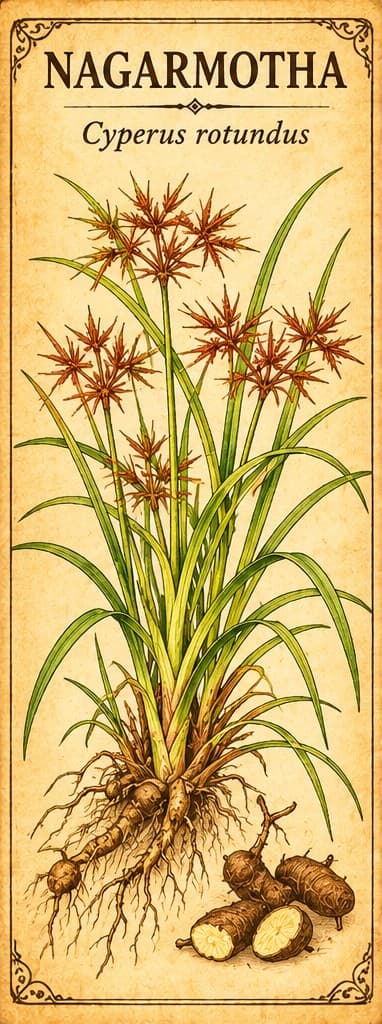
Nagarmotha
Cyperus rotundus
Nut grass, whose rhizome has been used in Ayurveda for 2,000 years and in Chinese medicine for stomach pain and period problems.
Safety at a glance
- PregnancyNothing recorded
- BreastfeedingNothing recorded
- MedicinesNothing recorded
- Who should avoid itNothing recorded
- AllergiesNothing recorded
- ToxicityNothing recorded
Tap a box to read the safety notes below. “Nothing recorded” means our sources don't cover it, not that it's safe.
What is Nagarmotha?
- Plant family
- Cyperaceae, the sedge family
- Parts used
- The rhizomes (underground stems) and tubers
- Where it grows
- Thought to come from India; now found worldwide
- Genus
- Cyperus
- Species
- rotundus
Also called
Nut Grass
Traditionally used for
- Stomach pain
- Period problems
- Digestion (traditional)
Traditionally described as
- Aromatic rhizome
Traditions that use it
- Ayurveda
Widely used in Ayurveda for about 2,000 years.
- Traditional Chinese Medicine
Rhizome used for liver problems, stomach pain, breast tenderness and period problems.
What does the research say?
Traditional use
These are traditional uses, not proven treatments.
Laboratory & animal research
Lab and animal results show what might be worth studying in people. They don't show that the herb has these effects in humans.
Over 550 compounds have been found in it. In lab and animal studies, extracts calmed inflammation, eased pain, protected the stomach and liver, lowered blood sugar and fought microbes. How it works isn't clear, and human studies are lacking.[1]Study
In short
No human or safety studies were found.
Sources
- [1] Plants in traditional medicine with special reference to Cyperus rotundus L.: a review · DOI: 10.1007/s13205-018-1328-6Peer-reviewed study
- [2] Phytochemistry, data mining, pharmacology, toxicology and the analytical methods of Cyperus rotundus L. (Cyperaceae): a comprehensive review · DOI: 10.1007/s11101-023-09870-3Peer-reviewed study
This information is educational and traditional in nature, and is not a substitute for professional medical advice. Unfamiliar word? See what these words mean.