
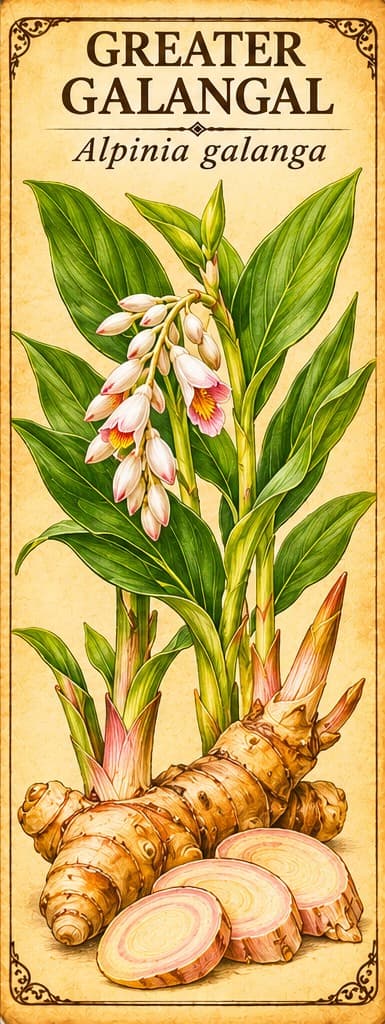
Greater Galangal
Alpinia galanga
A ginger-family spice used in Ayurveda, Chinese and Thai medicine. In a trial it improved erectile problems caused by antidepressants.
Safety at a glance
- PregnancyNothing recorded
- BreastfeedingNothing recorded
- MedicinesNothing recorded
- Who should avoid itNothing recorded
- AllergiesNothing recorded
- ToxicityNothing recorded
Tap a box to read the safety notes below. “Nothing recorded” means our sources don't cover it, not that it's safe.
What is Greater Galangal?
- Plant family
- Zingiberaceae, the ginger family
- Parts used
- The rhizome
- Where it grows
- South and Southeast Asia
- Genus
- Alpinia
- Species
- galanga
Also called
Galangal
Traditionally used for
- Spice
- Erectile problems (research)
Traditionally described as
- Aromatic rhizome
Traditions that use it
- Ayurveda
Used as a medicinal herb.
- Traditional Chinese Medicine
Used as a medicinal herb.
What does the research say?
Traditional use
These are traditional uses, not proven treatments.
Greater galangal, a member of the ginger family, is widely used as a cooking spice and as a medicine in Ayurveda, traditional Chinese medicine and Thai folk medicine.[1]Study
Laboratory & animal research
Lab and animal results show what might be worth studying in people. They don't show that the herb has these effects in humans.
Lab and animal studies suggest it may help lower blood sugar and calm inflammation, but human studies are scarce.[1]Study
Research in people
In a 4-week triple-blind trial of 60 men taking SSRI antidepressants, a 500 mg galangal extract improved erectile function much more than a placebo.[2]Study
In short
No safety studies were found.
Sources
- [1] Antidiabetic and Anti-Inflammatory Potential of Zingiberaceae Plants in Dietary Supplement Interventions · DOI: 10.3390/molecules31020311Peer-reviewed study
- [2] Assessing the effect of Alpinia galanga extract on the treatment of SSRI-induced erectile dysfunction: A randomized triple-blind clinical trial · DOI: 10.3389/fpsyt.2023.1105828Peer-reviewed study
This information is educational and traditional in nature, and is not a substitute for professional medical advice. Unfamiliar word? See what these words mean.