
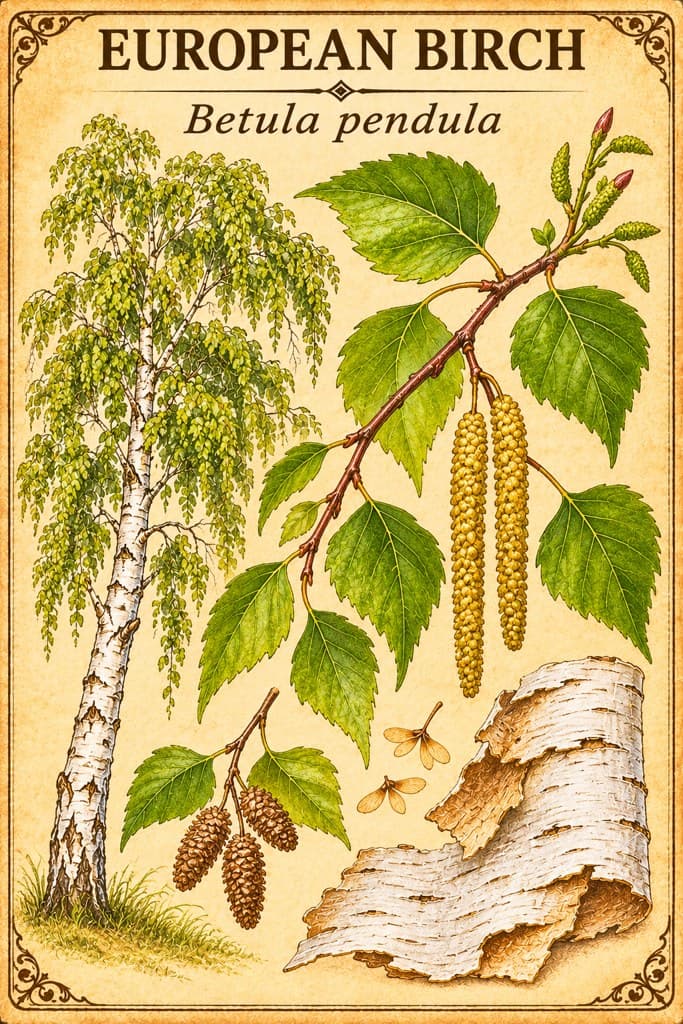
European Birch
Betula pendula
Silver birch, whose leaf is recognized in Europe as a traditional medicine to increase urine flow. Gels made from its bark helped burns and blistering skin wounds heal in trials.
Safety at a glance
- Pregnancy1 note →
- BreastfeedingNothing recorded
- MedicinesNothing recorded
- Who should avoid itNothing recorded
- AllergiesNothing recorded
- ToxicityNothing recorded
Tap a box to read the safety notes below. “Nothing recorded” means our sources don't cover it, not that it's safe.
What is European Birch?
- Plant family
- Betulaceae, the birch family
- Parts used
- The leaves and bark
- Where it grows
- Europe and northern Asia
- Genus
- Betula
- Species
- pendula
Also called
Silver Birch, Downy Birch
Older scientific names
Betula pubescens
Traditionally used for
- Urine flow
- Gout
- Arthritis (traditional)
- Wound healing
Traditionally described as
- Leaves rich in flavonoids; bark rich in betulin
Traditions that use it
- European Folk Medicine
Leaves used since Greek and Roman times; recognized by the EMA for urine flow.
Natural compounds
Safety
Pregnancy
Because there isn't enough safety information, birch leaf isn't recommended during pregnancy, while breastfeeding, or for children under 12.[1]Study
What does the research say?
Traditional use
These are traditional uses, not proven treatments.
Birch leaf (from silver birch, downy birch or their hybrids) is recognized in Europe as a traditional herbal medicine to increase urine flow and help flush the urinary tract in minor urinary problems, for adults and children over 12, for 2 to 4 weeks. It is an official drug in the European Pharmacopoeia.[2]Health agency
Birch leaf has been used since ancient Greek and Roman times, for gout, arthritis, rheumatism and other pain. In Serbian folk medicine, birch leaves, bark and seeds are used for skin conditions, chesty coughs, colds and kidney pain.[1]Study
Several birch species are traditionally used for inflammatory diseases, including arthritis.[3]Study
Laboratory & animal research
Lab and animal results show what might be worth studying in people. They don't show that the herb has these effects in humans.
Birch bark is rich in betulin and betulinic acid. In lab tests, a birch bark extract and both compounds slowed the growth of skin, breast and cervical cancer cells.[4]Study
Research in people
In a trial of 57 people with minor burns, more healed faster with a gel containing birch bark extract than with a standard wound gel.[1]Study
A gel made from birch bark compounds (Oleogel-S10) helps wounds heal in people with epidermolysis bullosa, a rare blistering skin disease. In a trial of 156 children, 45% had a wound fully close within 45 days, compared with 26% using a plain gel.[5]Study
In short
Not recommended in pregnancy, breastfeeding or for children under 12.
Sources
- [1] Biological activity of the birch leaf and bark · DOI: 10.5937/leksir2242089DPeer-reviewed study
- [2] Birch leaf (Betulae folium): summary for the public (EMA/482160/2015) — European Medicines Agency, Committee on Herbal Medicinal Products (HMPC)Government health agency
- [3] Medicinal plants of the genus Betula--traditional uses and a phytochemical-pharmacological review · DOI: 10.1016/j.jep.2014.11.010Peer-reviewed study
- [4] Physico-chemical comparison of betulinic acid, betulin and birch bark extract and in vitro investigation of their cytotoxic effects towards skin epidermoid carcinoma (A431), breast carcinoma (MCF7) and cervix adenocarcinoma (HeLa) cell lines · DOI: 10.1080/14786419.2010.545352Peer-reviewed study
- [5] Long-Term Efficacy and Safety of Oleogel-S10 (Birch Triterpenes) for Pediatric Patients With Epidermolysis Bullosa · DOI: 10.1111/pde.70224Peer-reviewed study
This information is educational and traditional in nature, and is not a substitute for professional medical advice. Unfamiliar word? See what these words mean.