
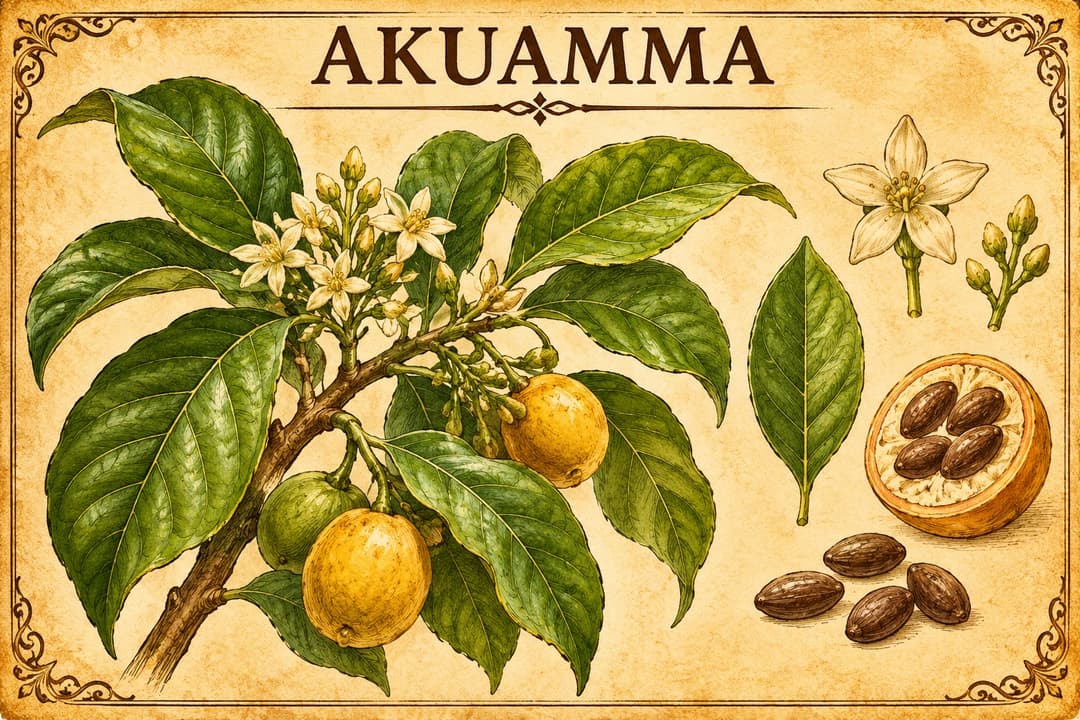
Akuamma
Picralima nitida
A West African tree whose seeds are a traditional remedy for pain, fever and malaria. Its compounds act weakly on opioid receptors, and it's sold online for pain and mood.
Safety at a glance
- Pregnancy1 note →
- BreastfeedingNothing recorded
- Medicines1 note →
- Who should avoid itNothing recorded
- AllergiesNothing recorded
- Toxicity2 notes →
Tap a box to read the safety notes below. “Nothing recorded” means our sources don't cover it, not that it's safe.
Akuamma may interact with some medicines. If you take any medicine, read Interactions with medicines below and talk to your doctor or pharmacist before using it.
What is Akuamma?
- Plant family
- Apocynaceae, the dogbane and milkweed family
- Parts used
- Mainly the seeds; also the stem bark and leaves
- Where it grows
- West and Central Africa
- Genus
- Picralima
- Species
- nitida
Regional names
Abere, Otosu, Mkpokiri
Older scientific names
Picralima nitida
Traditionally used for
- Pain
- Fever
- Malaria
- Cough (traditional)
Traditionally described as
- Seeds rich in alkaloids such as akuammine
Health topics
Where Akuamma appears in symptom search, and why. Being listed doesn't mean it's a proven treatment.
- Cough
Used traditionally for cough. A seed extract reduced coughing in guinea pigs; not tested in people.
- Fever
The seeds are a traditional remedy for fever. Not tested in people.
- High Blood Pressure
Used traditionally for high blood pressure, and lowered it in animal studies. Not tested in people.
- High Blood Sugar
Used traditionally for diabetes. A leaf extract lowered blood sugar in diabetic mice; not tested in people.
Traditions that use it
- African Traditional Medicine
Seeds used across West Africa for pain, fever and malaria.
Natural compounds
Safety
Interactions with medicines
In lab tests, akuamma seed extract strongly blocked CYP2D6, a liver enzyme that breaks down many medicines, and moderately blocked two others (CYP3A4 and CYP2C19). This could raise the levels of those medicines in the body. The researchers called it a particular concern; it hasn't been tested in people.[1]Study
Side effects
Pregnancy
When pregnant rats were given a seed extract, their young had lower birth weights and signs of liver and kidney harm. The researchers concluded it should not be used by pregnant women.[4]Study
Toxicity testing
In a 90-day rat study, a seed extract damaged DNA at every dose tested and caused signs of liver damage. It also changed reproductive hormone levels.[4]Study
An alkaloid extract of the stem bark damaged the liver when injected into animals. Put on the skin or in the eye, it caused no irritation.[5]Study
What does the research say?
Traditional use
These are traditional uses, not proven treatments.
In West African folk medicine, parts of the akuamma tree are used for fever, high blood pressure, jaundice, period pain, stomach and gut problems, and malaria.[6]Study
The seeds are mainly used for pain and fever. In Ghana, a seed product called Picap is a popular pain reliever. In the US, akuamma is sold online and in shops as capsules, powders and tinctures, which people take for pain, mood and stress.[7]Study
In Nigeria the seeds are used for diabetes, jaundice, pneumonia, malaria and high blood pressure. For rheumatism, the bark is ground and cooked with other plants, and a spoonful of the mixture is taken in corn pap once a day.[1]Study
In southwestern Nigeria, a common malaria remedy is made from akuamma seeds, Alstonia boonei bark and Gongronema latifolium leaves, extracted in lime.[8]Study
Akuamma is used traditionally for cough.[3]Study
Laboratory & animal research
Lab and animal results show what might be worth studying in people. They don't show that the herb has these effects in humans.
The seed's main compounds act on the body's opioid receptors, the same targets as morphine, but weakly. In mice, they did little to block pain from heat, which doesn't support the seeds' traditional use for pain.[2]Study
When rats were given the ground seed by mouth, only one of its main compounds, akuammine, reached the blood in meaningful amounts, and even that was poorly absorbed.[7]Study
In guinea pigs and mice, a seed extract reduced coughing, helped clear mucus and reduced pain.[3]Study
A leaf extract lowered blood sugar by about 38% in diabetic mice.[9]Study
The Nigerian malaria remedy containing akuamma slowed malaria parasites in infected mice. It also raised liver enzymes, a sign of liver stress, and at the highest dose raised a kidney marker.[8]Study
In chicks, a seed extract acted like both testosterone and estrogen. It didn't harm the liver, kidneys or blood.[10]Study
Lab and animal studies have found that akuamma extracts or compounds relieve pain and swelling, lower blood sugar and blood pressure, act against malaria parasites and germs, and protect against stomach ulcers.[6]Study
In short
Harmed unborn young and damaged DNA in rats; avoid in pregnancy. May interact with many medicines.
Sources
- [1] Potential inhibition of major human cytochrome P450 isoenzymes by selected tropical medicinal herbs—Implication for herb–drug interactions · DOI: 10.1002/fsn3.789Peer-reviewed study
- [2] Isolation and Pharmacological Characterization of Six Opioidergic Picralima nitida Alkaloids · DOI: 10.1021/acs.jnatprod.0c01036Peer-reviewed study
- [3] Antitussive, expectorant and analgesic effects of the ethanol seed extract of Picralima nitida (Stapf) Th. & H. DurandPeer-reviewed study
- [4] Toxicological evaluation of Picralima nitida in rodents · DOI: 10.1016/j.jep.2019.03.008Peer-reviewed study
- [5] Evaluation of toxicity profile of an alkaloidal fraction of the stem bark of Picralima nitida · DOI: 10.1080/J157v04n03_04Peer-reviewed study
- [6] Medicinal uses, phytochemistry and pharmacology of Picralima nitida (Apocynaceae) in tropical diseases: a review · DOI: 10.1016/S1995-7645(13)60182-0Peer-reviewed study
- [7] Comprehensive pharmacokinetics and ADME evaluation of Akuamma alkaloids · DOI: 10.1016/j.jchromb.2025.124713Peer-reviewed study
- [8] In vivo anti-plasmodial activities and toxic impacts of lime extract of a combination of Picralima nitida, Alstonia boonei and Gongronema latifolium in mice infected with Chloroquine-sensitive Plasmodium berghei · DOI: 10.4314/ahs.v15i4.27Peer-reviewed study
- [9] Antioxidant and antidiabetic profiles of two African medicinal plants: Picralima nitida (Apocynaceae) and Sonchus oleraceus (Asteraceae) · DOI: 10.1186/1472-6882-13-175Peer-reviewed study
- [10] Assessment of an ethanolic seed extract of Picralima nitida ([Stapf] Th. and H. Durand) on reproductive hormones and its safety for use · DOI: 10.5455/jice.20151030085004Peer-reviewed study
This information is educational and traditional in nature, and is not a substitute for professional medical advice. Unfamiliar word? See what these words mean.