
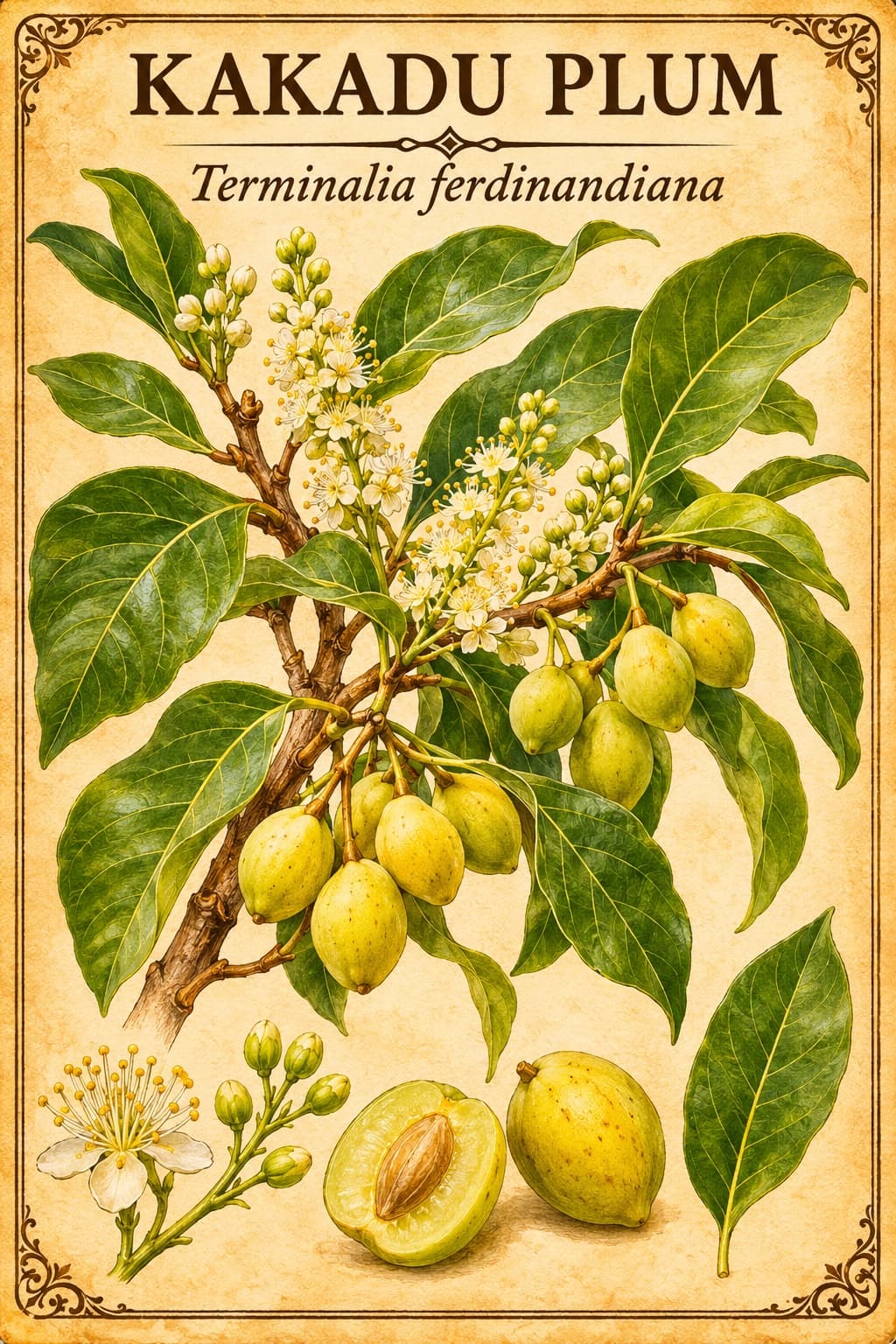
Kakadu Plum
Terminalia ferdinandiana
A small northern Australian fruit, the richest known source of vitamin C. Aboriginal Australians use it as food and as a remedy for colds, flu and headaches.
Safety at a glance
- PregnancyNothing recorded
- BreastfeedingNothing recorded
- MedicinesNothing recorded
- Who should avoid itNothing recorded
- AllergiesNothing recorded
- Toxicity1 note →
Tap a box to read the safety notes below. “Nothing recorded” means our sources don't cover it, not that it's safe.
What is Kakadu Plum?
- Plant family
- Combretaceae, the combretum family
- Parts used
- The fruit
- Where it grows
- Northern Australia
- Genus
- Terminalia
- Species
- ferdinandiana
Traditionally used for
- Food
- Colds and flu (traditional)
- Antiseptic (traditional)
Traditionally described as
- Very rich in vitamin C
Health topics
Where Kakadu Plum appears in symptom search, and why. Being listed doesn't mean it's a proven treatment.
- Colds and Nasal Congestion
Traditionally used by Aboriginal Australians for colds and flu. Not studied in people.
Natural compounds
Safety
Toxicity testing
Food safety studies are lacking. In lab tests on human gut and liver cells, extracts harmed cells only at very high concentrations.[1]Study
What does the research say?
Traditional use
These are traditional uses, not proven treatments.
Aboriginal Australians have eaten Kakadu plum and used it as medicine for centuries. In Western Australia the fresh or dried fruit is made into refreshing drinks, and the fruit is traditionally used as an antiseptic, a soothing balm, and for colds, flu and headaches.[2]Study
Laboratory & animal research
Lab and animal results show what might be worth studying in people. They don't show that the herb has these effects in humans.
Kakadu plum is the richest known source of vitamin C, about 7,000 mg per 100 g of fruit.[3]Study
The fruit has been reported to have over 900 times more vitamin C per gram than blueberries, and is also high in other antioxidants.[4]Study
In lab tests, fruit and leaf extracts killed food-poisoning bacteria including Listeria and drug-resistant Staphylococcus aureus (MRSA).[5]Study
In short
Food safety studies are lacking.
Sources
- [1] Impact of polyphenol-rich extracts of Terminalia ferdinandiana fruits and seeds on viability of human intestinal and liver cells in vitro · DOI: 10.1016/j.fochms.2021.100024Peer-reviewed study
- [2] Chemical and Nutritional Composition of Terminalia ferdinandiana (Kakadu Plum) Kernels: A Novel Nutrition Source · DOI: 10.3390/foods7040060Peer-reviewed study
- [3] Integrating Australian Native Foods for a More Sustainable Food System: A Qualitative Co-Design Study with Aboriginal Communities · DOI: 10.3390/ijerph22040646Peer-reviewed study
- [4] The chemotherapeutic potential of Terminalia ferdinandiana: Phytochemistry and bioactivity · DOI: 10.4103/0973-7847.95855Peer-reviewed study
- [5] Antioxidant Rich Extracts of Terminalia ferdinandiana Inhibit the Growth of Foodborne Bacteria · DOI: 10.3390/foods8080281Peer-reviewed study
This information is educational and traditional in nature, and is not a substitute for professional medical advice. Unfamiliar word? See what these words mean.