
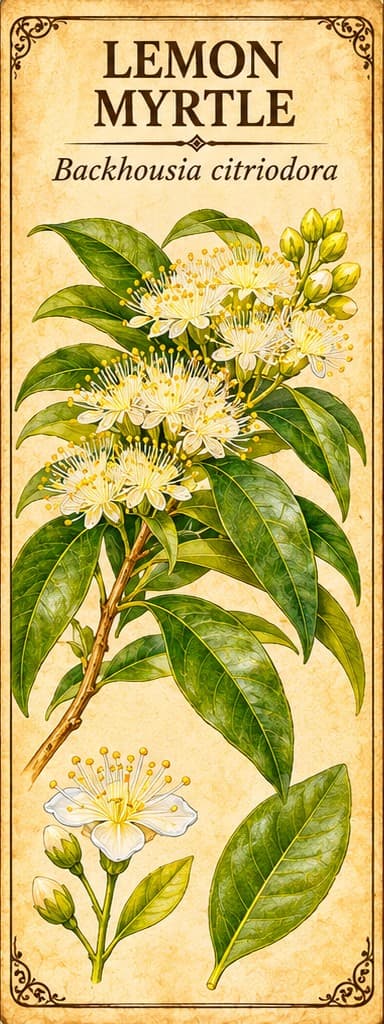
Lemon Myrtle
Backhousia citriodora
An Australian tree whose lemon-scented leaves are a First Nations remedy for wounds and mouth care. Its oil is one of the richest sources of citral and kills germs in lab tests.
Safety at a glance
- PregnancyNothing recorded
- BreastfeedingNothing recorded
- MedicinesNothing recorded
- Who should avoid itNothing recorded
- AllergiesNothing recorded
- Toxicity1 note →
Tap a box to read the safety notes below. “Nothing recorded” means our sources don't cover it, not that it's safe.
What is Lemon Myrtle?
- Plant family
- Myrtaceae, the myrtle family
- Parts used
- The leaves and leaf oil
- Where it grows
- Eastern Australia
- Genus
- Backhousia
- Species
- citriodora
Traditionally used for
- Wounds (traditional)
- Flavoring
- Skin infections
Traditionally described as
- Leaf oil rich in citral
Health topics
Where Lemon Myrtle appears in symptom search, and why. Being listed doesn't mean it's a proven treatment.
- Cuts, Wounds, Burns and Skin Ulcers
A traditional First Nations wound remedy. The oil kills wound germs in lab tests; not tested on wounds in people.
Natural compounds
Safety
Side effects
Citral, the main compound in the oil, can irritate and sensitize the skin at high concentrations, and in lab tests the undiluted oil was very toxic to human skin cells. Citral is considered safe as a food flavoring in the US.[1]Study
Toxicity testing
A water extract of the leaves caused no harm in rats given high doses for 28 days and didn't damage DNA in animals, though it did in one bacterial lab test.[2]Study
What does the research say?
Traditional use
These are traditional uses, not proven treatments.
First Nations Australians traditionally use lemon myrtle for wounds and mouth care, chewing the leaves or putting a leaf paste on the skin.[3]Study
Its leaf oil is one of the richest natural sources of citral, the compound that gives lemons their scent, and it's widely used to flavor food and drinks.[1]Study
Laboratory & animal research
Lab and animal results show what might be worth studying in people. They don't show that the herb has these effects in humans.
In lab studies, the oil and extracts killed bacteria and fungi, including germs that infect wounds and skin, and reduced inflammation.[1]Study
Research in people
In a clinical trial in children with molluscum contagiosum, a common viral skin infection that causes small bumps, lemon myrtle oil put on the skin showed activity against the virus.[1]Study
In short
The oil can irritate and sensitize skin at high strength.
Sources
- [1] Backhousia citriodora F. Muell. (Lemon Myrtle), an Unrivalled Source of Citral · DOI: 10.3390/foods10071596Peer-reviewed study
- [2] Safety Assessment of Lemon Myrtle (Backhousia citriodora) Extract: 28-Day Oral Toxicity Study in Rats and In Vitro and In Vivo Genotoxicity Studies · DOI: 10.3390/toxics14030213Peer-reviewed study
- [3] A low-cost, antimicrobial aloe-alginate hydrogel film containing Australian First Nations remedy 'lemon myrtle oil' (Backhousia citriodora) - Potential for incorporation into wound dressings · DOI: 10.1016/j.heliyon.2024.e37516Peer-reviewed study
This information is educational and traditional in nature, and is not a substitute for professional medical advice. Unfamiliar word? See what these words mean.