
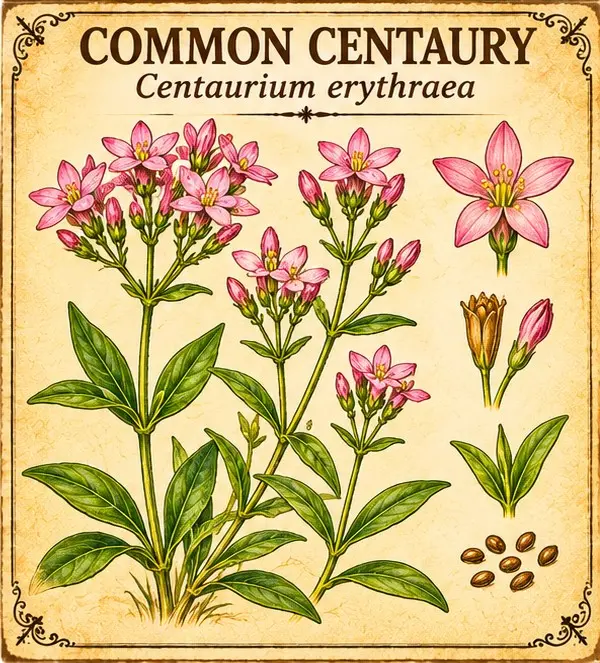
Common Centaury
Centaurium erythraea
A bitter pink-flowered herb recognized by the European Medicines Agency as a traditional remedy for mild indigestion and temporary loss of appetite.
Safety at a glance
- PregnancyNothing recorded
- BreastfeedingNothing recorded
- MedicinesNothing recorded
- Who should avoid it1 note →
- AllergiesNothing recorded
- ToxicityNothing recorded
Tap a box to read the safety notes below. “Nothing recorded” means our sources don't cover it, not that it's safe.
What is Common Centaury?
- Plant family
- Gentianaceae, the gentian family
- Parts used
- The flowering aerial parts
- Where it grows
- Europe, North Africa and western Asia
- Genus
- Centaurium
- Species
- erythraea
Also called
Centaury, Centaurii herba
Older scientific names
Centaurium umbellatum
Traditionally used for
- Indigestion
- Loss of appetite
Traditionally described as
- Contains bitter secoiridoids such as swertiamarin
Health topics
Where Common Centaury appears in symptom search, and why. Being listed doesn't mean it's a proven treatment.
- Indigestion
Recognized by the European Medicines Agency as a traditional remedy for mild indigestion.
- Loss of Appetite
Recognized by the European Medicines Agency as a traditional remedy for temporary loss of appetite.
Safety
Who should avoid it
Don't take centaury if you have a stomach ulcer. It's for adults only; see a doctor if symptoms last more than 2 weeks.[1]Health agency
Side effects
No side effects had been reported when the European Medicines Agency assessed it.[1]Health agency
What does the research say?
Traditional use
These are traditional uses, not proven treatments.
The European Medicines Agency recognizes centaury, based on long-standing use, as a traditional herbal medicine for mild indigestion and other stomach and gut complaints, and for temporary loss of appetite. It's taken as a tea, tincture or extract.[1]Health agency
A bitter pink-flowered herb used in folk medicine in Morocco, Algeria, southern Europe and the Balkans for digestive complaints, loss of appetite, hemorrhoids and to increase urine.[2]Study
Research in people
There are no clinical trials of centaury; lab studies suggest it stimulates appetite and digestion.[1]Health agency
In short
Not for people with stomach ulcers; adults only.
Sources
- [1] Centaurii herba (Centaury): European Union herbal monograph and summary for the public — European Medicines Agency (HMPC)Government health agency
- [2] Phytochemical properties, biological activities and medicinal use of Centaurium erythraea Rafn. · DOI: 10.1016/j.jep.2021.114171Peer-reviewed study
This information is educational and traditional in nature, and is not a substitute for professional medical advice. Unfamiliar word? See what these words mean.