
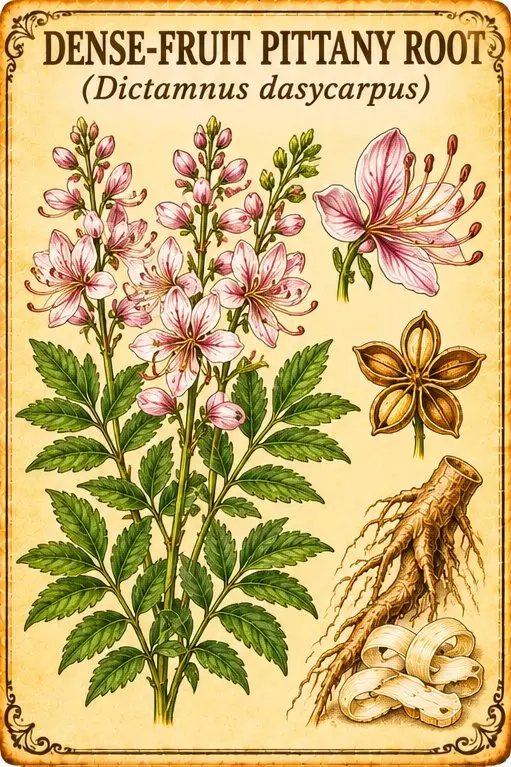
Dense-Fruit Pittany Root
Dictamnus dasycarpus
Bai Xian Pi, a Chinese medicinal root bark. It has been linked to serious, sometimes fatal liver damage.
Safety at a glance
- PregnancyNothing recorded
- BreastfeedingNothing recorded
- MedicinesNothing recorded
- Who should avoid itNothing recorded
- AllergiesNothing recorded
- Toxicity2 notes →
Tap a box to read the safety notes below. “Nothing recorded” means our sources don't cover it, not that it's safe.
What is Dense-Fruit Pittany Root?
- Plant family
- Rutaceae, the citrus family
- Parts used
- The root bark
- Genus
- Dictamnus
- Species
- dasycarpus
Also called
Bai Xian Pi, Dictamni Cortex
Traditionally used for
- Heat and dampness (traditional)
Traditionally described as
- Root bark alkaloids and limonoids
Health topics
Where Dense-Fruit Pittany Root appears in symptom search, and why. Being listed doesn't mean it's a proven treatment.
- Cancer Research
Lab and animal studies only: listed among many effects, it slowed or killed some cancer cells. Not tested against cancer in people.
- Liver Safety Warnings
Linked to serious and sometimes fatal liver damage.
- Poisonous Plants
Has caused confirmed liver injury.
Traditions that use it
- Traditional Chinese Medicine
Bai Xian Pi is used to clear heat, remove dampness and dispel wind.
Safety
Toxicity testing
Dense-fruit pittany root has been linked to serious liver damage. A 2002 review of hepatitis linked to Chinese herbs found it was taken by 6 patients, including two who died, though the products were mixtures that could have contained other ingredients.[1]Study
In 2017, doctors confirmed liver injury caused by the root bark alone in a patient taking 15 g a day of the powder, more than the amount set by the Chinese Pharmacopoeia. Tests showed the product was genuine and free of contaminants.[2]Study
What does the research say?
Traditional use
These are traditional uses, not proven treatments.
The root bark of Dictamnus dasycarpus, called Bai Xian Pi, is used in traditional Chinese medicine to clear heat, remove dampness and dispel wind.[3]Study
Laboratory & animal research
Lab and animal results show what might be worth studying in people. They don't show that the herb has these effects in humans.
More than 200 compounds have been found in the plant. Lab and animal studies report effects against inflammation and cancer and in protecting the heart and blood vessels.[3]Study
In short
Can cause serious liver damage.
Sources
- [1] Hepatitis associated with Chinese herbs · DOI: 10.1097/00042737-200205000-00015Peer-reviewed study
- [2] Dictamni Cortex powder-induced liver injury based on integrated evidence chain · DOI: 10.19540/j.cnki.cjcmm.2017.0015Peer-reviewed study
- [3] The traditional uses, phytochemistry, pharmacology and toxicology of Dictamnus dasycarpus: a review · DOI: 10.1093/jpp/rgab141Peer-reviewed study
This information is educational and traditional in nature, and is not a substitute for professional medical advice. Unfamiliar word? See what these words mean.