
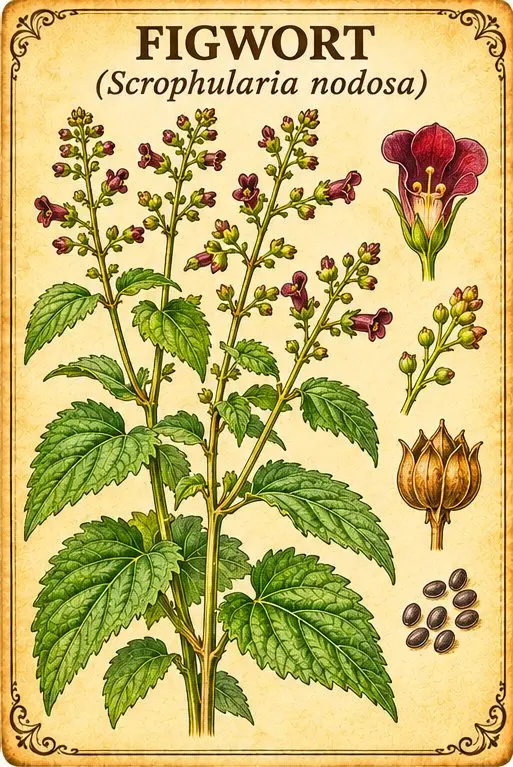
Figwort
Scrophularia nodosa
A Eurasian herb rich in iridoids that reduce inflammation in the lab. It has no clinical studies.
Safety at a glance
- PregnancyNothing recorded
- BreastfeedingNothing recorded
- MedicinesNothing recorded
- Who should avoid itNothing recorded
- AllergiesNothing recorded
- Toxicity1 note →
Tap a box to read the safety notes below. “Nothing recorded” means our sources don't cover it, not that it's safe.
What is Figwort?
- Plant family
- Scrophulariaceae, the figwort family
- Parts used
- The above-ground parts
- Genus
- Scrophularia
- Species
- nodosa
Traditionally used for
- Traditional use for inflammation
Traditionally described as
- Iridoid-rich; contains cardiac glycosides
Health topics
Where Figwort appears in symptom search, and why. Being listed doesn't mean it's a proven treatment.
- Cuts, Wounds, Burns and Skin Ulcers
Only tested in a herbal blend on horse wounds; figwort's own effect is unclear.
Safety
Toxicity testing
Figwort contains cardiac glycosides, a type of compound that acts on the heart. No human safety studies were found.[1]Study
What does the research say?
Traditional use
These are traditional uses, not proven treatments.
Figwort is a herb of temperate Europe and Asia. Its traditional uses are linked to effects against inflammation, germs, fungi and parasites, and to supporting the liver, heart, immune system and urine flow.[1]Study
Laboratory & animal research
Lab and animal results show what might be worth studying in people. They don't show that the herb has these effects in humans.
Figwort is rich in iridoids, compounds that in lab studies reduce inflammation and pain and act as antioxidants. There are no clinical studies of figwort in people.[1]Study
Technical detail: iridoids include aucuboside, catalpol, catalposide and harpagide esters.
In a 2025 study, a blend of five herbal extracts including figwort calmed inflammation in human cells in the lab, and was well tolerated and seemed to support healing of open wounds in a few horses. Because it was a blend, figwort's own effect is unclear.[2]Study
In short
Contains heart-active compounds; no human safety data.
Sources
- [1] Targeting Inflammation with Natural Products: A Mechanistic Review of Iridoids from Bulgarian Medicinal Plants · DOI: 10.3390/molecules30173456Peer-reviewed study
- [2] Anti-Inflammatory and Regenerative Properties of Herbal Extracts: Wound Management in Equine Models · DOI: 10.33393/dti.2025.3499Peer-reviewed study
This information is educational and traditional in nature, and is not a substitute for professional medical advice. Unfamiliar word? See what these words mean.