
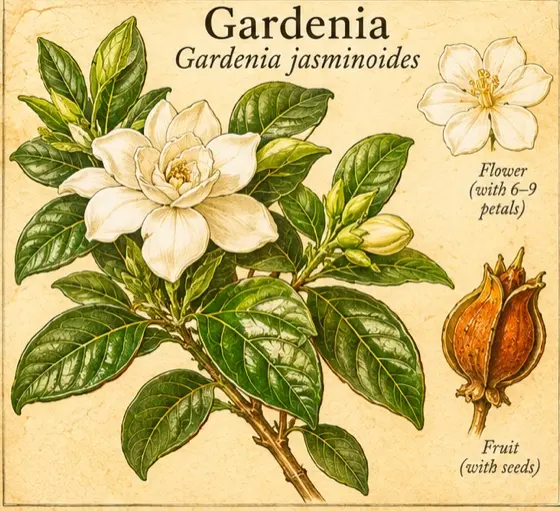
Gardenia
Gardenia jasminoides
A fragrant shrub whose orange fruit, zhi zi, is a Chinese medicine for fever and jaundice and a natural yellow dye. Long-term use has been linked to a rare bowel condition.
Safety at a glance
- PregnancyNothing recorded
- BreastfeedingNothing recorded
- MedicinesNothing recorded
- Who should avoid itNothing recorded
- AllergiesNothing recorded
- Toxicity1 note →
Tap a box to read the safety notes below. “Nothing recorded” means our sources don't cover it, not that it's safe.
What is Gardenia?
- Plant family
- Rubiaceae, the coffee family
- Parts used
- The dried ripe fruit
- Where it grows
- Southern China and East Asia
- Genus
- Gardenia
- Species
- jasminoides
Also called
Cape Jasmine
Regional names
Sanshishi
Traditional names
Zhi Zi, Gardeniae Fructus
Traditionally used for
- Fever and jaundice (traditional Chinese)
- Yellow food dye
Traditionally described as
- Fruit rich in geniposide and the yellow pigment crocin
Health topics
Where Gardenia appears in symptom search, and why. Being listed doesn't mean it's a proven treatment.
- Fever
Used in traditional Chinese medicine, with other herbs, for fever.
Traditions that use it
- Traditional Chinese Medicine
Known as zhi zi. Used to "clear heat" and "cool the blood", usually with other herbs, for fever and jaundice.
Natural compounds
Safety
Side effects
Long-term use of Chinese herbal medicines containing gardenia fruit has been linked to mesenteric phlebosclerosis. This is a rare condition in which the veins of the bowel harden and the right side of the colon loses blood supply. In two reported cases, stopping the herbal medicine and managing other health conditions kept it from getting worse.[1]Study
Technical detail: idiopathic mesenteric phlebosclerotic colitis (IMP); mesenteric venous sclerosis and calcification.
Toxicity testing
Long-term use of gardenia can cause side effects and toxic reactions. Some processing methods reduce these.[2]Study
What does the research say?
Traditional use
These are traditional uses, not proven treatments.
The dried fruit of gardenia (zhi zi) is used in traditional Chinese medicine to "clear heat", increase urine and "cool the blood". It's usually combined with other herbs for fever and jaundice.[2]Study
Technical detail: traditional actions include purging fire, eliminating restlessness, clearing heat and promoting diuresis; used for damp-heat syndrome.
Gardenia fruit is also commonly used as a natural yellow dye.[3]Study
Laboratory & animal research
Lab and animal results show what might be worth studying in people. They don't show that the herb has these effects in humans.
More than 215 compounds have been found in the fruit, including iridoids such as geniposide and the yellow pigment crocin. In lab and animal studies, it reduced inflammation, acted as an antioxidant, eased fatigue, prevented blood clots and protected the liver and gallbladder. Other studies report effects on blood sugar, low mood and sleep quality.[2]Study
Technical detail: genipin and crocin are the two major bioactive phytochemical series.
In short
Long-term use of gardenia-containing herbal medicines has been linked to mesenteric phlebosclerosis, a rare bowel vein disease.
Sources
- [1] Clinical challenges in diagnosing idiopathic mesenteric phlebosclerotic colitis: two case reports and an up-to-date literature review · DOI: 10.3389/fgstr.2025.1549662Peer-reviewed study
- [2] A comprehensive review of ethnopharmacology, chemical constituents, pharmacological effects, pharmacokinetics, toxicology, and quality control of gardeniae fructus · DOI: 10.1016/j.jep.2023.117397Peer-reviewed study
- [3] Chemistry and bioactivity of Gardenia jasminoides · DOI: 10.1016/j.jfda.2016.11.005Peer-reviewed study
This information is educational and traditional in nature, and is not a substitute for professional medical advice. Unfamiliar word? See what these words mean.