
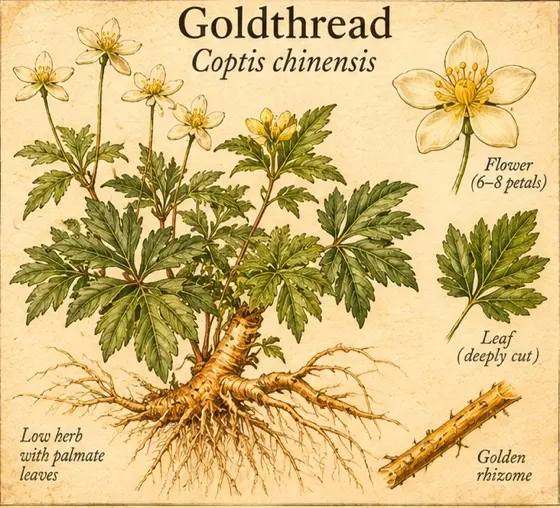
Goldthread
Coptis chinensis
A small plant whose bright yellow underground stem, huang lian, is a major Chinese medicine for dysentery, diabetes, sore throat and eczema. It's rich in berberine, and added to metformin it improved blood sugar in pooled trials.
Safety at a glance
- Pregnancy1 note →
- BreastfeedingNothing recorded
- Medicines1 note →
- Who should avoid itNothing recorded
- AllergiesNothing recorded
- Toxicity1 note →
Tap a box to read the safety notes below. “Nothing recorded” means our sources don't cover it, not that it's safe.
Goldthread may interact with some medicines. If you take any medicine, read Interactions with medicines below and talk to your doctor or pharmacist before using it.
What is Goldthread?
- Plant family
- Ranunculaceae, the buttercup family
- Parts used
- The yellow rhizome (underground stem)
- Where it grows
- Central and southern China
- Genus
- Coptis
- Species
- chinensis
Also called
Chinese Goldthread
Traditional names
Huang Lian, Coptidis Rhizoma
Traditionally used for
- Dysentery and diarrhea (traditional Chinese)
- Diabetes (traditional and studied)
- Sore throat and mouth ulcers (traditional)
Traditionally described as
- Very bitter; rich in berberine and other alkaloids
Health topics
Where Goldthread appears in symptom search, and why. Being listed doesn't mean it's a proven treatment.
- Diarrhea
A traditional Chinese remedy for bacterial dysentery.
- High Blood Sugar
Goldthread formulas added to metformin improved blood sugar in pooled Chinese trials.
- Sore Throat
Traditionally used in China for sore throat and mouth ulcers.
Traditions that use it
- Traditional Chinese Medicine
Known as huang lian. Used for bacterial dysentery, diabetes, whooping cough, sore throat, mouth ulcers and eczema.
Natural compounds
Safety
Interactions with medicines
Berberine-containing herbs may change how the body processes many medicines. In one study, goldenseal extract lowered levels of the diabetes drug metformin by about 25%, enough to affect blood sugar control. If you take any medicine, talk with your health care provider before using goldthread.[1]Health agency
Pregnancy
Berberine can harm newborns. The US National Institutes of Health advises that women who are pregnant or breastfeeding shouldn't use goldenseal, another berberine-rich plant, and that it shouldn't be given to infants, for this reason.[1]Health agency
Toxicity testing
Berberine is both goldthread's most important active compound and its main toxic compound.[2]Study
What does the research say?
Traditional use
These are traditional uses, not proven treatments.
Goldthread, known in China as huang lian, is a small plant whose bright yellow underground stem is a major Chinese medicine. It's widely used in China for:
- Bacterial dysentery
- Diabetes
- Whooping cough
- Sore throat and mouth ulcers
- Eczema
Laboratory & animal research
Lab and animal results show what might be worth studying in people. They don't show that the herb has these effects in humans.
128 natural compounds have been found in goldthread, mainly alkaloids. Berberine is its most important active compound. In lab and animal studies, its extracts and compounds acted against bacteria, viruses, fungi, diabetes and cancer, and protected the heart.[2]Study
Research in people
A 2022 review pooled 33 Chinese trials with 2,846 people with type 2 diabetes. Adding goldthread-containing formulas to metformin improved blood sugar, long-term blood sugar (HbA1c), insulin and blood fats more than metformin alone. The quality of the evidence for fasting blood sugar was rated moderate, and there was some publication bias.[3]Review or trial
Technical detail: FBG MD −1.16; HbA1c −0.78%; HOMA-IR −0.77; LDL-C −0.70; TG −0.57 (units as reported). Funnel plot, Egger's test and trim-and-fill indicated moderate publication bias.
In short
Its berberine can harm newborns, so avoid it in pregnancy and breastfeeding. It may affect metformin and other medicines.
Sources
- [1] Goldenseal: Usefulness and Safety — National Center for Complementary and Integrative Health (NIH)Government health agency
- [2] Coptidis Rhizoma: a comprehensive review of its traditional uses, botany, phytochemistry, pharmacology and toxicology · DOI: 10.1080/13880209.2019.1577466Peer-reviewed study
- [3] Systematic review and meta-analysis of Coptis chinensis Franch.-containing traditional Chinese medicine as an adjunct therapy to metformin in the treatment of type 2 diabetes mellitus · DOI: 10.3389/fphar.2022.956313Review or clinical trial
This information is educational and traditional in nature, and is not a substitute for professional medical advice. Unfamiliar word? See what these words mean.