
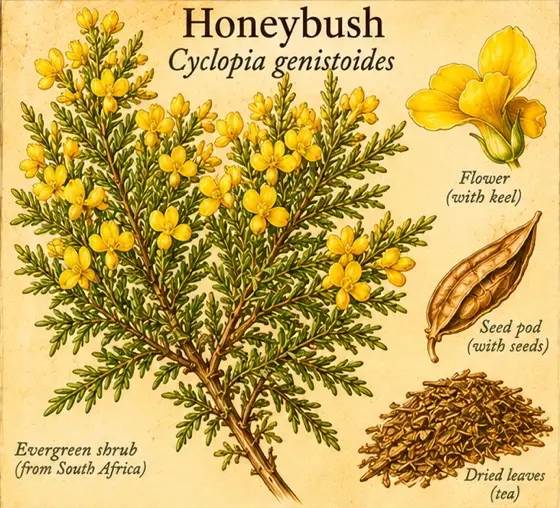
Honeybush
Cyclopia intermedia
A South African shrub made into a sweet, caffeine-free herbal tea since the early 1800s. Lab and animal studies show antioxidant and estrogen-like effects, but it hasn't been tested in people.
Safety at a glance
- PregnancyNothing recorded
- BreastfeedingNothing recorded
- MedicinesNothing recorded
- Who should avoid it1 note →
- AllergiesNothing recorded
- ToxicityNothing recorded
Tap a box to read the safety notes below. “Nothing recorded” means our sources don't cover it, not that it's safe.
What is Honeybush?
- Plant family
- Fabaceae, the pea and bean family
- Parts used
- The leaves, stems and flowers, fermented or green, as a tea
- Where it grows
- The Cape fynbos region of South Africa
- Genus
- Cyclopia
- Species
- intermedia
Also called
Honeybush Tea
Traditional names
Heuningbos, Bergtee
Older scientific names
Cyclopia subternata, Cyclopia genistoides
Traditionally used for
- Herbal tea
- Antioxidant (lab research)
Traditionally described as
- Caffeine-free
- low in tannins
- rich in polyphenols
Traditions that use it
- African Traditional Medicine
Brewed as a herbal tea in South Africa's Western and Eastern Cape since at least the early 1800s.
Natural compounds
How it's prepared
Common ways Honeybush is prepared or sold. This isn't advice on how to take it; see Safety below.
- Tea / Infusion
Brewed as a caffeine-free herbal tea with a honey-like flavor.[1]Study
Safety
Who should avoid it
Some honeybush compounds act like weak estrogens in lab tests. Whether this matters for people with conditions affected by hormones, such as some breast cancers, hasn't been studied.[2]Study
Side effects
Honeybush is mainly drunk as an everyday caffeine-free tea. There are no clinical trials of its health effects or of concentrated extracts in people.[1]Study
What does the research say?
Traditional use
These are traditional uses, not proven treatments.
Honeybush is a group of shrubs in the pea family that grow only in the Cape fynbos of South Africa. Their yellow flowers smell of honey. Several species, mainly Cyclopia intermedia, are made into honeybush tea, produced since about the start of the 19th century. The tea is popular for its honey-like flavor. It has no caffeine and is low in tannins (the compounds that make tea bitter).[1]Study
Laboratory & animal research
Lab and animal results show what might be worth studying in people. They don't show that the herb has these effects in humans.
Honeybush is rich in polyphenols. In lab tests, its extracts acted as antioxidants and protected DNA from damage.[1]Study
Technical detail: antimutagenic activity.
In lab tests, some honeybush extracts and polyphenols acted like weak forms of the hormone estrogen. Scientists are studying whether this could be useful, but it hasn't been tested in people.[2]Study
Technical detail: phytoestrogenic activity.
In obese, diabetic female mice, a polyphenol-rich honeybush extract slowed weight gain. It switched on genes that help the body burn fat to make heat. This is an animal study only.[3]Study
Technical detail: crude polyphenol-enriched fraction (CPEF) induced UCP1 3.4-fold and PPARα in db/db mice; earlier work showed reduced lipid content in 3T3-L1 fat cells.
In short
Some compounds act like weak estrogens in lab tests. No human trials.
Sources
- [1] Honeybush (Cyclopia sp.) – a rich source of compounds with high antimutagenic properties · DOI: 10.1016/j.fitote.2008.11.001Peer-reviewed study
- [2] Phytoestrogenic potential of Cyclopia extracts and polyphenols · DOI: 10.1055/s-0032-1328463Peer-reviewed study
- [3] Cyclopia intermedia (Honeybush) Induces Uncoupling Protein 1 and Peroxisome Proliferator-Activated Receptor Alpha Expression in Obese Diabetic Female db/db Mice · DOI: 10.3390/ijms24043868Peer-reviewed study
This information is educational and traditional in nature, and is not a substitute for professional medical advice. Unfamiliar word? See what these words mean.